All species › Nightjars › Nightjars and nighthawks › Common Nighthawk
Common Nighthawk | Chordeiles minor
Amerikaanse nachtzwaluw | Añapero yanqui | Bacurau-norte-americano
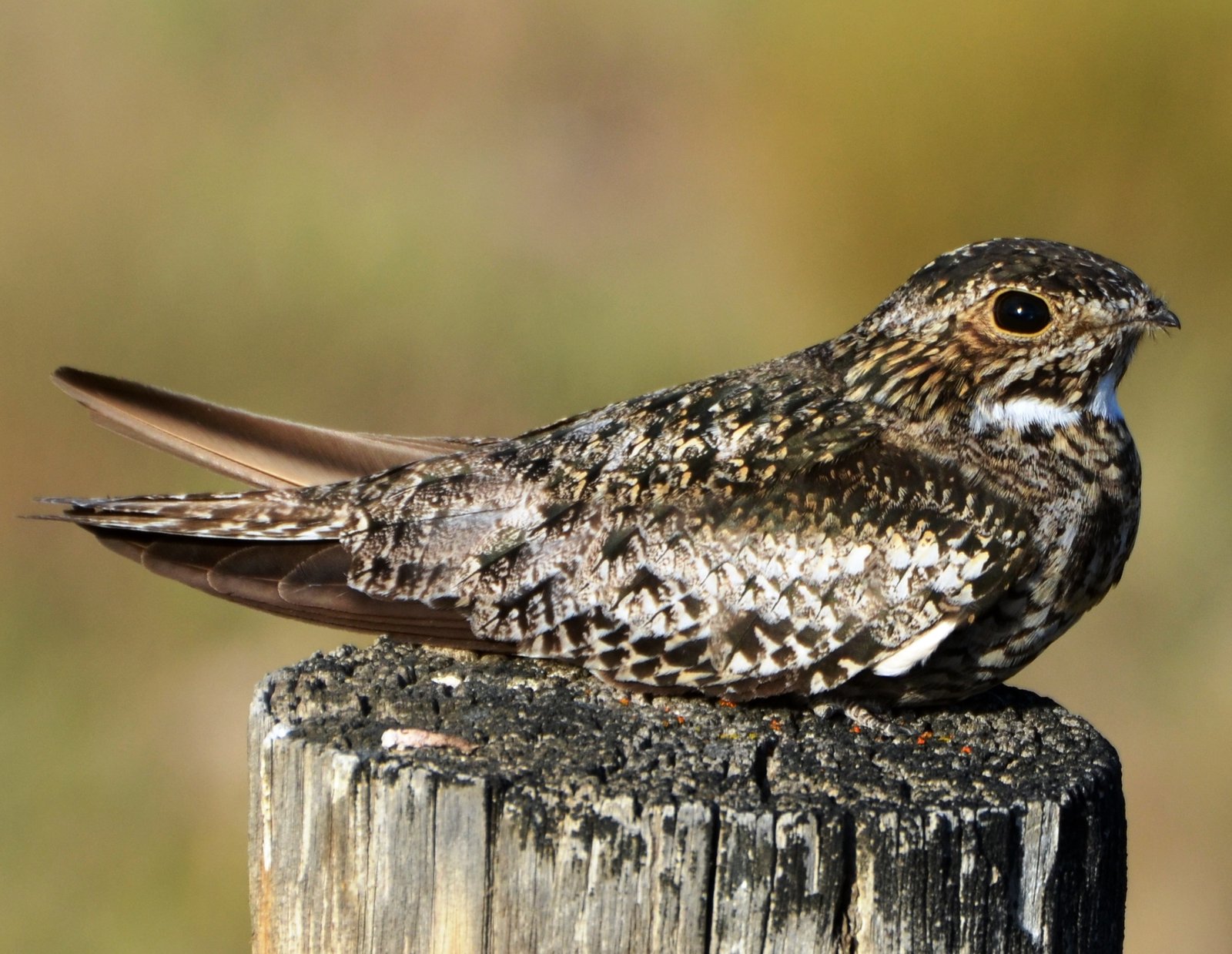
The Common Nighthawk is a long-winged migrant from North America that crosses the guide area on its way to and from its wintering grounds in South America. It hunts high with an erratic, swallow-like flight, often by day and in groups on migration. Some birds winter in Amazonia.
Voice
A nasal, buzzy peent in flight, mainly on the breeding grounds; usually silent in the guide area. In display in North America the male dives with a booming wing sound.
Recording: Don Profota — CC BY-NC-SA 4.0 · xeno-canto
Identification
22–25 cm, with long, pointed wings that reach beyond the tail tip at rest, and a notched tail. The upperparts are greyish brown to blackish brown, speckled with grey and buff. The underparts are white or buff with dense dark bars. The male has a white throat patch, a broad white band halfway along the primaries and a white band near the tail tip; the female has a buff throat, a narrower wing band and no tail band. Juveniles are greyer, with pale feather edges.
Confusion species
Lesser Nighthawk Chordeiles acutipennis is slightly smaller, with shorter, blunter wings, the white band closer to the wingtip and buff spots on the primaries; it usually hunts lower. Nacunda Nighthawk Chordeiles nacunda is much larger, with a white belly and a short tail. Short-tailed Nighthawk Lurocalis semitorquatus has broad wings without a white band and a short tail.
Habitat
On migration and in winter over all kinds of open country: savanna, rivers, forest edges, the canopy of lowland forest and towns, from the lowlands into the Andes. It hunts flying insects high in the air, by day and at dusk, often in loose groups. It breeds only in North and Central America, laying its eggs on bare ground or on gravel roofs.
Where the bird is most at home, classified by the vegetation units of the Andes and the west coast.


Range and movements
In Colombia and Ecuador mainly a passage migrant, both east and west of the Andes, sometimes also over mountain valleys. In Peru and Bolivia a passage migrant and winter visitor, mainly in Amazonia and the savannas, scarce on the Pacific coast. Outside the guide area it breeds from Canada to Central America and winters in South America, mainly in southern Amazonia and further south to Argentina.
- Summer visitor (c. Apr–Sep)
- Winter visitor (c. Oct–Mar)
- Passage (Mar–Apr, Oct–Nov)
- dark = core range, pale = thinly spread
How and when to look
In September–November and March–May, watch in the late afternoon for groups passing high overhead, especially over rivers and open country in the lowlands east of the Andes.
Conservation status
Least Concern, although the population in North America is declining, probably through loss of insects and of nest sites.
Scientific name
Chordeiles minor | (Forster, 1771)
Forster described the species in 1771 as Caprimulgus minor; because it was later moved to another genus, the author and year stand in brackets. The genus Chordeiles was introduced in 1832 by Swainson. The genus name comes from Greek chordē, 'string, chord', and deilē, 'evening', after the calls at dusk. The specific name is Latin minor, 'smaller'. The specimen the first description was based on came from South Carolina, United States.