All species › Nightjars › Nightjars and nighthawks › Rufous-bellied Nighthawk
Rufous-bellied Nighthawk | Lurocalis rufiventris
Roodbuiknachtzwaluw | Añapero ventrirrufo | Tuju-de-barriga-ruiva
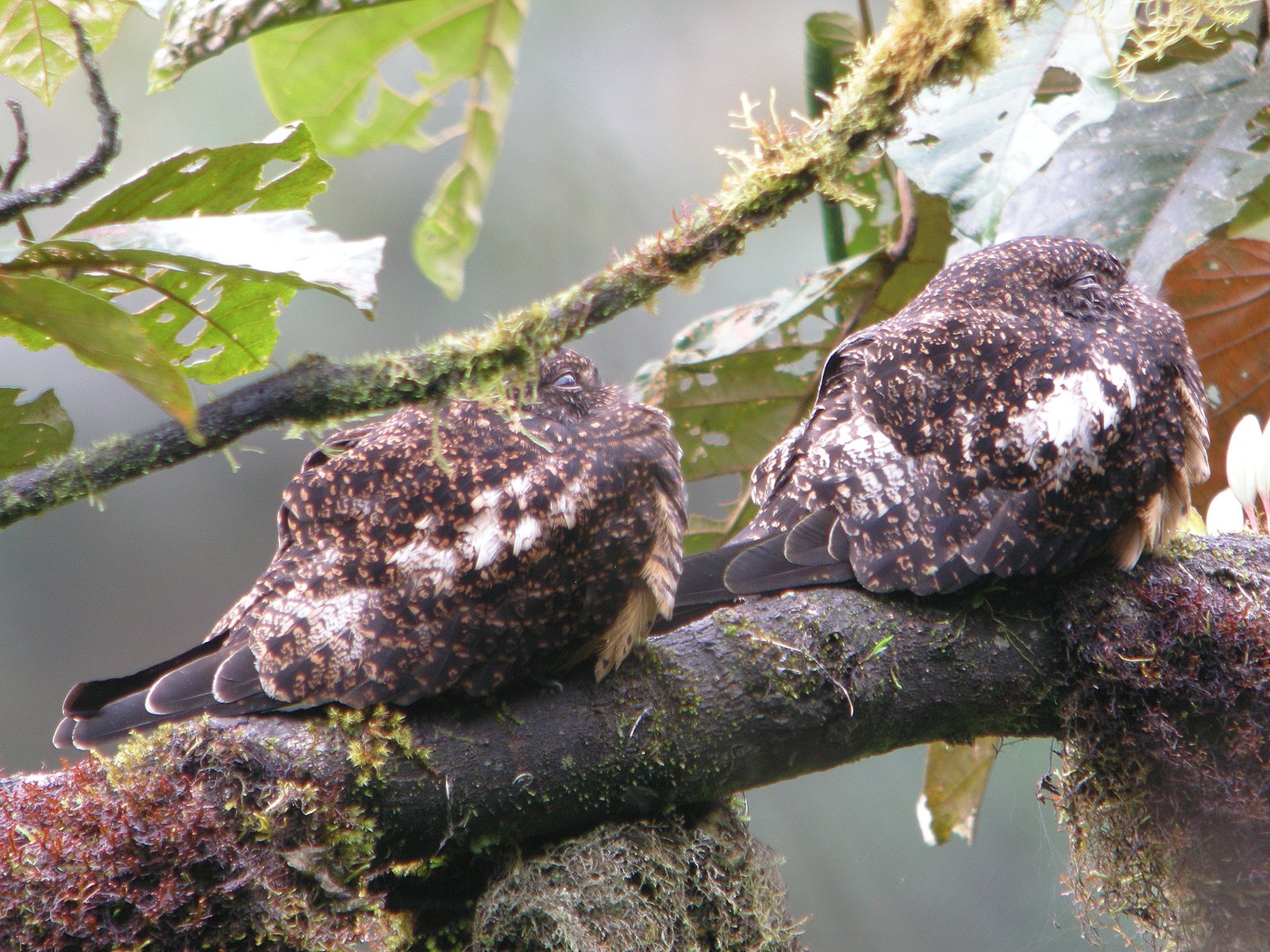
The Rufous-bellied Nighthawk is a large, dark nighthawk with a short tail and long, broad wings, living in the cloud forest of the Andes. At dusk it hunts flying insects over the canopy and along forest edges with a fluttering, bat-like flight. It is the montane species of the genus Lurocalis; Short-tailed Nighthawk replaces it in the lowlands.
Voice
The song is a rapidly delivered series of notes that gradually descend in pitch, given both in flight and from a perch, mainly at dusk. Also a muffled pow, a series of muffled rising coos and a low growl.
Recording: Mitch Lysinger — CC BY-NC-SA 4.0 · xeno-canto
Identification
23–25 cm, stocky, with a short, square tail and long wings that reach beyond the tail tip at rest. The upperparts and wings are dark brown, with rufous and buff spots and speckles. The tail is brown with buff or greyish-brown bars and a pale tip. The chin and breast are dark brown, with a white band or crescent on the throat. The belly, flanks and underwing coverts are warm rufous to buff. There is no white in the wings or tail.
Confusion species
Short-tailed Nighthawk Lurocalis semitorquatus has the same shape, but is smaller, has a darker, barred belly and lives in the lowlands and foothills. Band-winged Nightjar Systellura longirostris occurs at the same elevations, but has a longer tail and a white or buff band across the primaries, and hunts closer to the ground in open terrain.
Habitat
Humid montane forest and cloud forest, forest edges and openings in the forest, roughly between 1500 and 3450 m. It hunts insects on the wing, often over the canopy, along roads and over clearings. By day it roosts lengthwise on a branch, usually alone or in pairs. Little is known about its breeding.
Where the bird is most at home, classified by the vegetation units of the Andes and the west coast.


Range and movements
In Colombia in the Central and Eastern Andes. In Ecuador on the eastern slope and, in the north, also on the western slope of the Andes. In Peru along the eastern slope throughout the country. In Bolivia on the eastern slope in the Yungas. Absent from the lowlands and the Galápagos. Outside the guide area in the Andes of western Venezuela.
- Resident
- dark = core range, pale = thinly spread
How and when to look
At dusk, stand at a viewpoint or along a road through cloud forest and watch above the canopy; the birds fly shortly after sunset and can then also be heard.
Conservation status
Least Concern. The species depends on montane forest and is declining locally through deforestation.
Scientific name
Lurocalis rufiventris | Taczanowski, 1884
Taczanowski described the species in 1884 and placed it straight away in the genus where it still stands. The genus Lurocalis was introduced in 1851 by Cassin. The genus name combines Greek oura, 'tail', with kolos, 'stunted', after the short tail; the initial L is unexplained. The species name comes from Latin rufus, 'rufous', and venter, 'belly'. The specimen the first description was based on came from Tambillo, Peru.