All species › Nightjars › Nightjars and nighthawks › Short-tailed Nighthawk
Short-tailed Nighthawk | Lurocalis semitorquatus
Kortstaartnachtzwaluw | Chotacabras cola corta | Tuju
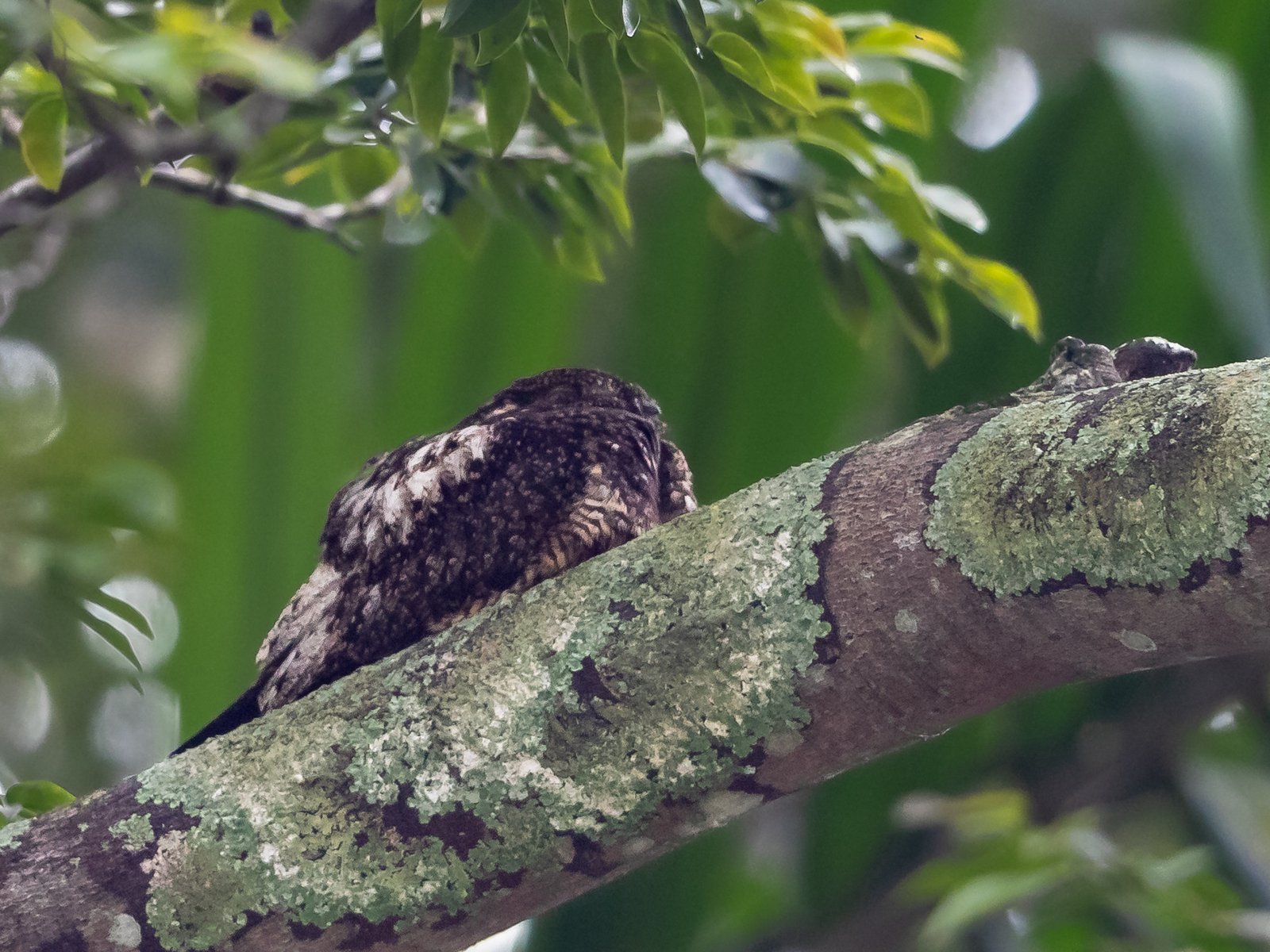
The Short-tailed Nighthawk is a dark, short-tailed nighthawk of lowland forest that hunts at dusk high above the canopy and along rivers. With its long, broad wings and fluttering flight it recalls a large bat. By day it roosts high in a tree, lengthwise on a branch.
Voice
Mainly short, clear calls in flight, such as kwit or pit-pit, often repeated at dusk above the forest. Other sounds are rarely described.
Recording: JAYRSON ARAUJO DE OLIVEIRA — CC BY-NC-SA 4.0 · xeno-canto
Identification
20–24 cm, stocky, with a short, square tail and long wings that reach beyond the tail tip at rest. The whole plumage is dark blackish brown, with fine rufous, grey and buff spots and speckles. A narrow white band on the throat. The belly is dark brown with paler rufous or buff bars; Amazonian birds often have a warmer, chestnut belly. There is no white in the wings or tail. The sexes are alike.
Confusion species
Rufous-bellied Nighthawk Lurocalis rufiventris is larger, with an unbarred rufous belly, and lives higher in montane forest. Band-tailed Nighthawk Nyctiprogne leucopyga is smaller, with a white band across the middle of the tail, and hunts low over rivers and lakes. Nighthawks of the genus Chordeiles have longer, narrower wings with a white or pale band and a longer, notched tail.
Habitat
Humid lowland forest, both terra firme and várzea, forest edges, riverbanks and clearings, and the foothills up to about 1200 m. It hunts insects on the wing at dusk and dawn, often high above the canopy and over rivers, sometimes in small groups. The egg is laid without a nest on a thick branch.
Where the bird is most at home, classified by the vegetation units of the Andes and the west coast.


Range and movements
In Colombia in the Pacific lowlands, the Magdalena valley and Amazonia. In Ecuador in the western and eastern lowlands and foothills. In Peru in the eastern lowlands and foothills. In Bolivia in the lowlands of the north and east. Absent from the high Andes, the dry coastal regions and the Galápagos. Outside the guide area from Mexico through Central America to Brazil, Paraguay and northern Argentina.
- Resident
- dark = core range, pale = thinly spread
How and when to look
At dusk, watch from a riverbank, a clearing or a canopy tower; the birds then fly high with a fluttering flight and give their short calls.
Conservation status
Least Concern. The species is widespread in lowland forest and tolerates forest edges and secondary forest.
Scientific name
Lurocalis semitorquatus | (Gmelin, 1789)
Gmelin described the species in 1789 as Caprimulgus semitorquatus; because it was later moved to another genus, the author and year stand in brackets. The genus Lurocalis was introduced in 1851 by Cassin. The genus name combines Greek oura, 'tail', with kolos, 'stunted', after the short tail; the initial L is unexplained. The species name comes from Latin semi-, 'half', and torquatus, 'collared', after the partial pale throat band. The specimen the first description was based on came from Cayenne, French Guiana.