All species › Nightjars › Nightjars and nighthawks › Band-tailed Nighthawk
Band-tailed Nighthawk | Nyctiprogne leucopyga
Staartbandnachtzwaluw | Añapero colibandeado | Bacurau-de-cauda-barrada
The Band-tailed Nighthawk is a small, dark nighthawk of rivers and lakes in the lowlands east of the Andes. At dusk it hunts low over the water, often with several birds together. It is the only species of the genus Nyctiprogne in the guide area.
Voice
Few recordings exist. The main sound is a soft, frog-like gole-kwoik-kwak, repeated at a steady pace, mainly at dusk and at night from a perch near water; it is regarded as a territorial call.
Recording: JAYRSON ARAUJO DE OLIVEIRA — CC BY-NC-SA 4.0 · xeno-canto
Identification
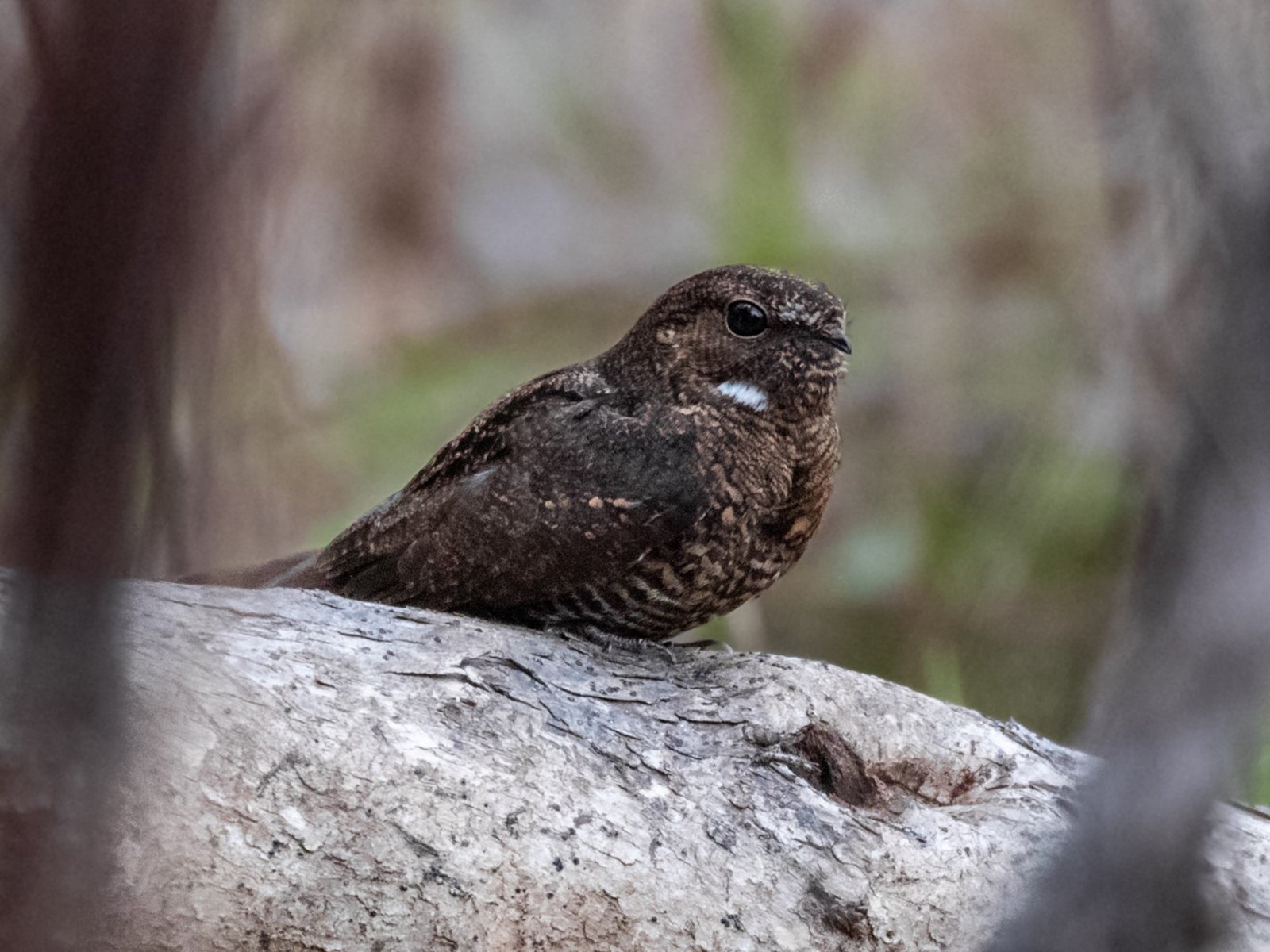
16–19 cm, small, with fairly long, pointed wings and a medium-length tail. The plumage is dark brown, finely spotted and speckled with grey and black, and the belly is barred greyish and black. A white patch on each side of the throat. A narrow white band crosses the middle of the tail and shows mainly in flight. There is no white in the wings. The sexes are nearly alike; young birds are slightly plainer and paler.
Confusion species
Least Nighthawk Chordeiles pusillus and Lesser Nighthawk Chordeiles acutipennis have a white band across the primaries and no white tail band. Sand-coloured Nighthawk Chordeiles rupestris also hunts over rivers, but is much paler, with much white in the wings and tail. Short-tailed Nighthawk Lurocalis semitorquatus is larger, with a short tail without white, and hunts higher over forest.
Habitat
Rivers, streams, oxbow lakes, marshes and flooded grassland in the lowlands, in forest and savanna, up to about 300 m. It hunts beetles, ants, true bugs and termites on the wing at dusk and dawn. By day it roosts low in dense thickets along the water; between feeding bouts it perches on thin horizontal branches above the water, alone or in groups of up to about ten.
Where the bird is most at home, classified by the vegetation units of the Andes and the west coast.


Range and movements
In Colombia in the lowlands of the Orinoco and Amazonia. In Ecuador very locally in the eastern lowlands. In Peru in the north-eastern and eastern lowlands. In Bolivia in the lowlands of the north and east, including the Beni. Absent west of the Andes and from the Galápagos. Outside the guide area in Venezuela, the Guianas, Brazil and Paraguay.
- Resident
- dark = core range, pale = thinly spread
How and when to look
At dusk, take a boat or stand by a river or oxbow lake in Amazonia; the birds then come low over the water and give their frog-like calls.
Conservation status
Least Concern. The species is widespread along rivers and lakes in the lowlands.
Scientific name
Nyctiprogne leucopyga | (Spix, 1825)
Spix described the species in 1825 as Caprimulgus leucopygus; because it was later moved to another genus, the author and year stand in brackets. The genus Nyctiprogne was introduced in 1857 by Bonaparte. The genus name combines Greek nukti-, 'night-', with Latin progne or procne, 'swallow'. The species name comes from Greek leukos, 'white', and pugē, 'rump'. The specimen the first description was based on came from shores of the Amazon.