All species › Nightjars › Nightjars and nighthawks › White-winged Nightjar
White-winged Nightjar | Eleothreptus candicans
Witvleugelnachtzwaluw | Chotacabras aliblanco | Bacurau-de-rabo-branco
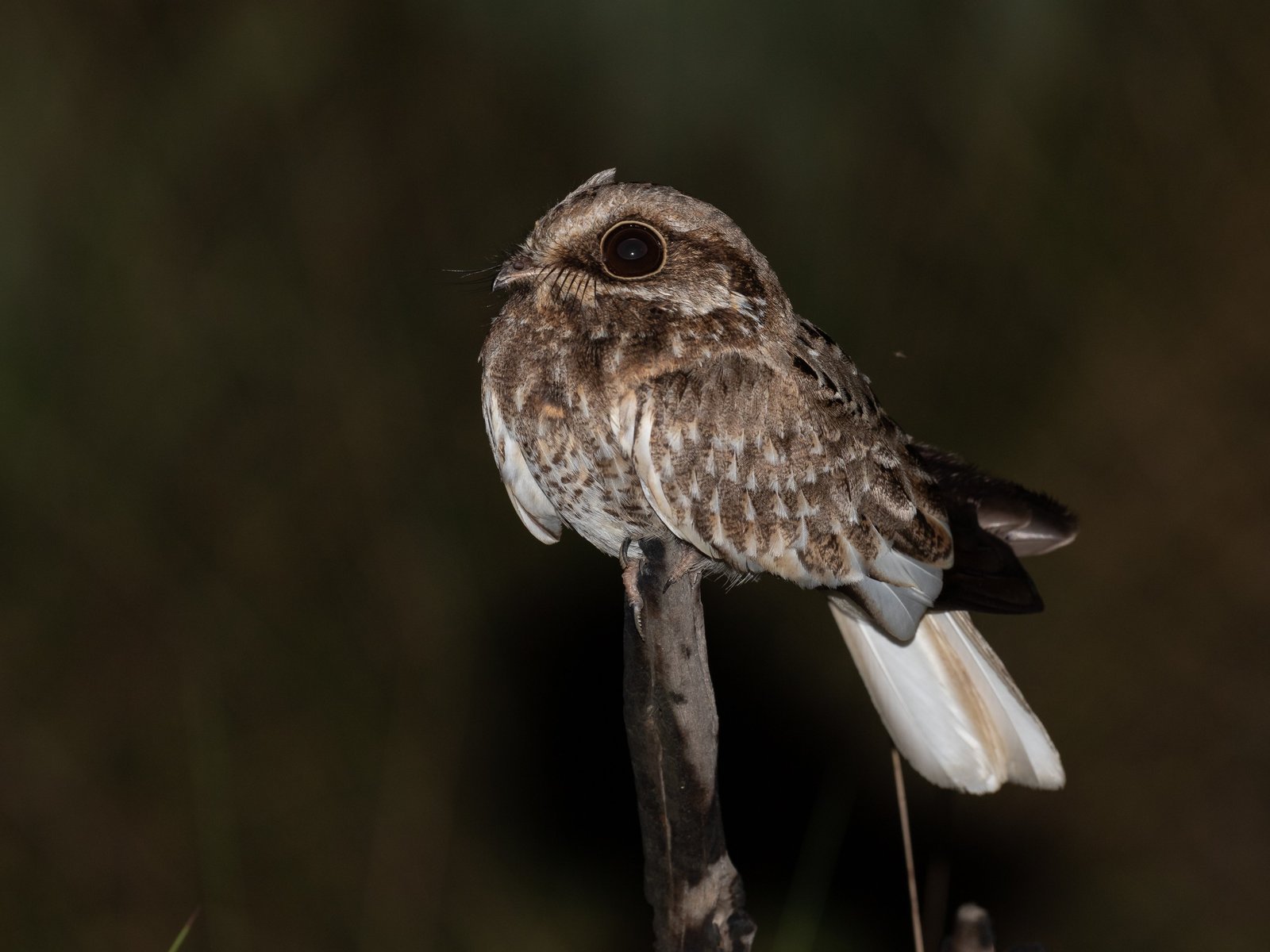
The White-winged Nightjar is a rare nightjar of open savanna, known from a small number of widely separated sites in Bolivia, Brazil and Paraguay. The male has largely white wings and a mostly white tail, which it shows in display flight. In Bolivia the species is known only from the savannas of Beni.
Voice
Poorly documented. Males give a soft territorial call during chases and make mechanical wing sounds in display flight. The alarm call is an abrupt eek.
Recording: Jacob Wijpkema — CC BY-NC-SA 4.0 · xeno-canto
Identification
19–23 cm. The male is pale greyish brown above, with blackish spots on the crown and brown streaks; the face is brown with a white supercilium and moustache. The breast is greyish brown with a chestnut tinge, the belly white. In flight the wings look whitish and the tail is largely white. The female has buff underparts and no white in the plumage. Juveniles are browner.
Confusion species
The male Little Nightjar Setopagis parvula has only a narrow white wing band. Spot-tailed Nightjar Antiurus maculicaudus has a tawny face and only white spots in the tail. Scissor-tailed Nightjar Hydropsalis torquata is larger, the male with a long, forked tail. Females without white resemble females of other small nightjars; note the buff underparts.
Habitat
Open grassland with scattered trees and shrubs, such as savanna and cerrado, in the lowlands up to about 210 m. It hunts insects at night. The female lays two eggs directly on the ground and incubates alone; in Paraguay laying takes place from mid-September to mid-November.
Where the bird is most at home, classified by the vegetation units of the Andes and the west coast.

Range and movements
In Bolivia known only from the savannas of Beni, mainly around the Beni Biological Station in the west of the department, where it has been recorded in September. Absent from Colombia, Ecuador, Peru and the Galápagos. Outside the guide area at a few sites in central Brazil and eastern Paraguay.
- Resident
- dark = core range, pale = thinly spread
How and when to look
There is a chance only in the natural savannas of Beni, at dusk in the austral spring, when males perform display flights over open grassland.
Conservation status
Vulnerable (VU). The world population is very small and scattered over a few sites. The main threats are conversion of savanna to pasture, crops and eucalyptus plantations, and fire.
Scientific name
Eleothreptus candicans | (Pelzeln, 1867)
Pelzeln described the species in 1867 as Stenopsis candicans; because it was later moved to another genus, the author and year stand in brackets. The genus Eleothreptus was introduced in 1840 by Gray. The genus name comes from Greek heleothreptos, 'marsh-bred', from helos 'marsh' and trephō 'to nourish'. The species name comes from Latin candicans, 'whitish, shining white', after the extensive white in the male's plumage. The specimen the first description was based on came from Irisanga, São Paulo, Brazil.