All species › Nightjars › Nightjars and nighthawks › Ocellated Poorwill
Ocellated Poorwill | Nyctiphrynus ocellatus
Gevlekte poorwill | Chotacabras ocelado | Bacurau-ocelado
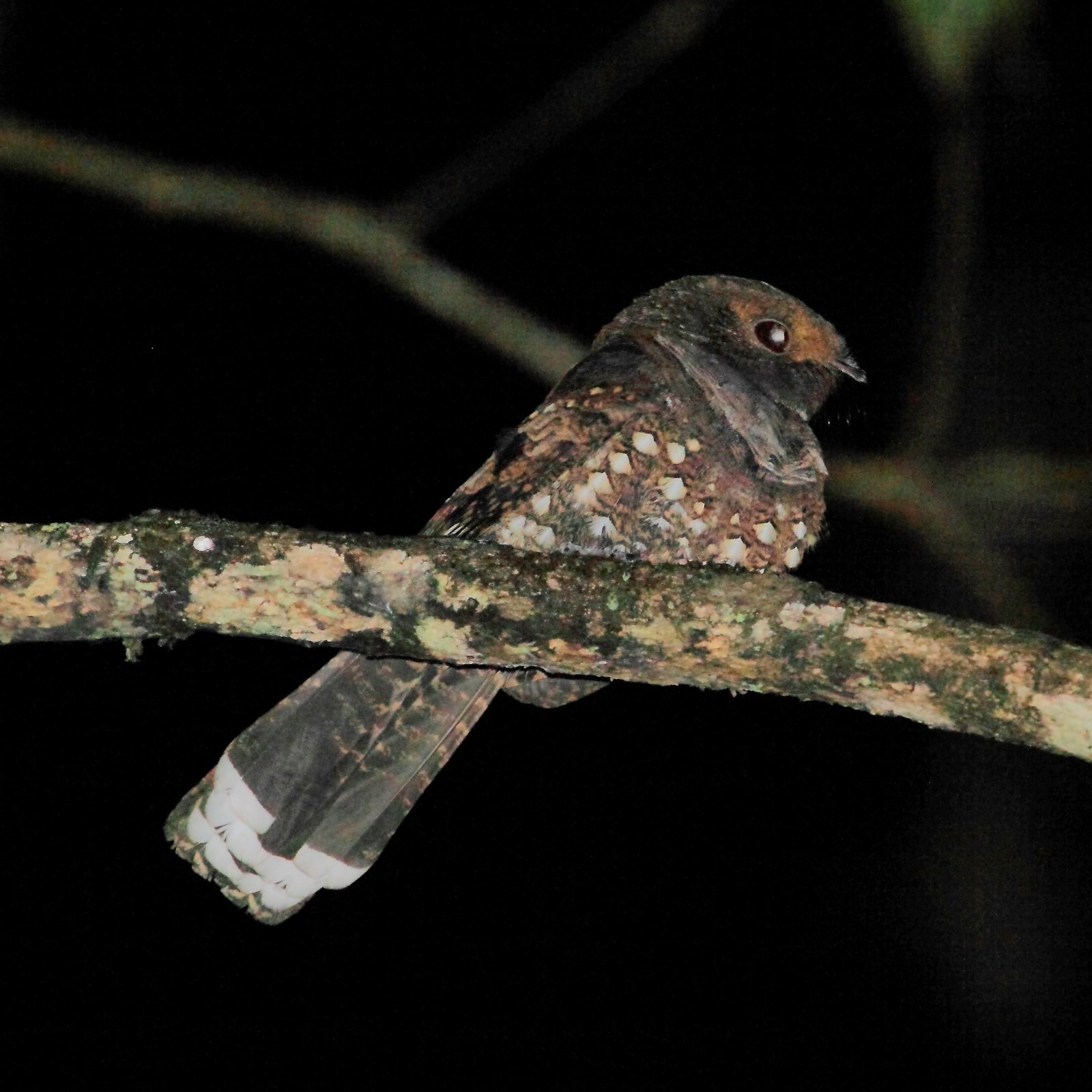
The Ocellated Poorwill is a small, dark nightjar of the interior of humid lowland forest. The name refers to the row of black, pale-edged spots on the scapulars and wing-coverts. Unlike many nightjars it hunts mainly inside the forest and along narrow trails.
Voice
A soft, rolling, slightly falling prrr-ieuw, repeated at intervals from a low perch in the forest, mainly at dusk and in moonlight.
Recording: JAYRSON ARAUJO DE OLIVEIRA — CC BY-NC-SA 4.0 · xeno-canto
Identification
20–22 cm, with a fairly short, rounded tail. The male is dark greyish brown, finely vermiculated, with black spots edged white or buff on the scapulars and wing-coverts, a narrow white band across the throat and narrow white tips to the outer tail feathers. There is no wing band. The female is warmer rufous-brown, with a buff throat band and smaller pale tail tips.
Confusion species
Pauraque Nyctidromus albicollis is larger, with a longer tail, a white wing band and rufous ear-coverts, and lives at forest edges and in open country. Short-tailed Nighthawk Lurocalis semitorquatus has long, pointed wings and a very short tail and hunts above the canopy. Silky-tailed Nightjar Antrostomus sericocaudatus is larger and browner, with a longer tail. Choco Poorwill Nyctiphrynus rosenbergi is very similar, but lives only west of the Andes.
Habitat
The interior and edges of humid lowland terra firme forest, also flooded forest, old secondary forest and narrow forest trails, mostly below 1000 m, locally in the Andean foothills. It catches insects in short sallies from low branches. By day it rests on the forest floor among the leaves; the eggs are laid without a nest on the ground.
Where the bird is most at home, classified by the vegetation units of the Andes and the west coast.


Range and movements
In Colombia scarce in Amazonia in the south-east. In Ecuador and Peru in the lowlands and foothills east of the Andes. In Bolivia in the north and centre of the lowlands. Absent west of the Andes and from the Galápagos. Outside the guide area in Brazil, Paraguay and north-eastern Argentina, and with a separate population in Central America.
- Resident
- dark = core range, pale = thinly spread
How and when to look
At dusk, listen from trails in undisturbed lowland forest for the rolling call. The bird then sits low on a branch or on the ground beside the trail, where its eyes shine in a torch beam.
Conservation status
Least Concern. The species depends on forest, so deforestation in Amazonia reduces its habitat locally.
Scientific name
Nyctiphrynus ocellatus | (Tschudi, 1844)
Tschudi described the species in 1844 as Caprimulgus ocellatus; because it was later moved to another genus, the author and year stand in brackets. The genus Nyctiphrynus was introduced in 1857 by Bonaparte. The genus name comes from Greek nukti-, 'night-', and phrunē, 'toad'. The species name comes from Latin ocellatus, 'with eye-spots', after the round spots on the wing coverts. The specimen the first description was based on came from Peru.