All species › Passerines › Tanagers and allies › Masked Crimson Tanager
Masked Crimson Tanager | Ramphocelus nigrogularis
Zwartmaskertangare | Tangara enmascarada | Pipira-de-máscara
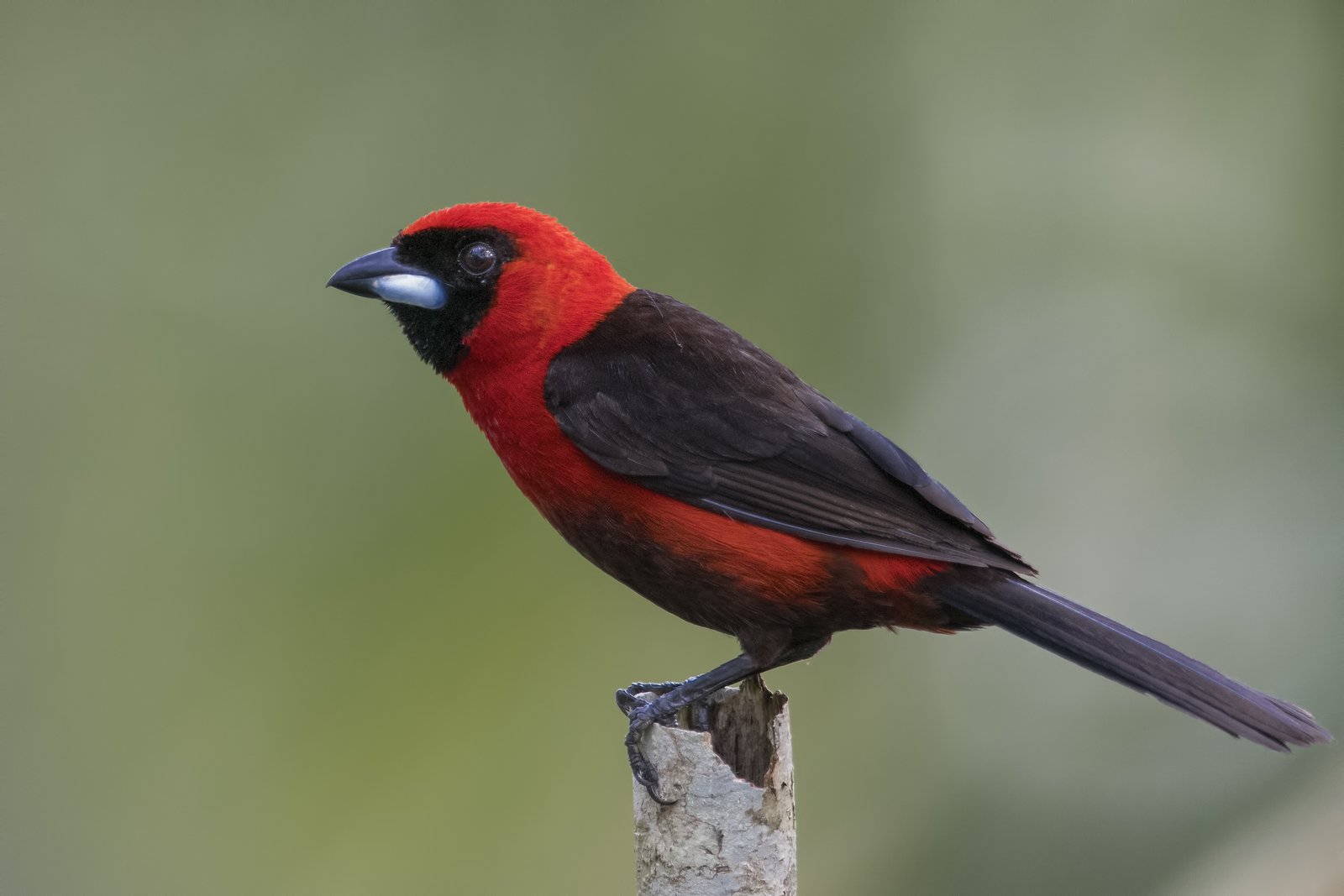
The Masked Crimson Tanager is a tanager of riversides, lakes and flooded forest in western Amazonia. It is bright crimson and black, with a black mask and a silvery-white lower mandible. Small flocks keep to the vegetation along the water.
Voice
Flocks call constantly with sharp chek notes; the song is a short, repeated series of whistled notes.
Recording: Juan Freile — CC BY-NC-SA 4.0 · xeno-canto
Identification
18–19 cm, with a black upper mandible and an expanded, silvery-white lower mandible. The head, nape, breast, mantle and rump are bright crimson; forehead, face and throat form a black mask, and the wings, tail and centre of the belly are black. Male and female are similar; the female is slightly duller, with a less conspicuous lower mandible. Juveniles are duller and browner red.
Confusion species
Silver-beaked Tanager Ramphocelus carbo is mostly dark blackish-red, without a bright crimson head and back. Huallaga Tanager Ramphocelus melanogaster has a dark wine-red head without a black mask and lives in the Andean valleys of Peru. Red canopy tanagers lack the black mask and the silvery-white lower mandible.
Habitat
Waterside vegetation along rivers, lakes and oxbow lakes, várzea and other flooded forest, also river islands and scrub along the water, in the lowlands up to roughly 500 m. It lives in small flocks, often with other tanagers, and eats fruit and insects. The nest is a cup in a shrub or tree, often above water.
Where the bird is most at home, classified by the vegetation units of the Andes and the west coast.


Range and movements
In Colombia in the south-east, in the Amazonian lowlands (Putumayo, Caquetá, Amazonas). In Ecuador in the Amazonian lowlands. In Peru in the Amazonian lowlands, mainly along the large rivers. In Bolivia only in the far north. Absent from the Galápagos. Outside the guide area in western Brazilian Amazonia.
- Resident
- dark = core range, pale = thinly spread
How and when to look
From a boat along riversides and lakes in the Amazonian lowlands you see small flocks of red birds with a black mask in the waterside vegetation; they often perch low over the water.
Conservation status
Least Concern. The species is common in suitable habitat; no direct threats are known.
Scientific name
Ramphocelus nigrogularis | (Spix, 1825)
Spix described the species in 1825 as Tanagra nigrogularis; because it was later moved to another genus, the author and year stand in brackets. The genus Ramphocelus was introduced in 1805 by Desmarest, A-G. The genus name combines Greek rhamphos, 'bill', and koilos, 'hollow, concave'. The species name combines Latin niger, 'black', and gula, 'throat'. The specimen the first description was based on came from São Paulo de Olivença, Amazonas, Brazil.