All species › Passerines › Tanagers and allies › Crimson-backed Tanager
Crimson-backed Tanager | Ramphocelus dimidiatus
Roodbuiktangare | Tangara dorsirroja | Pipira-de-dorso-carmesim
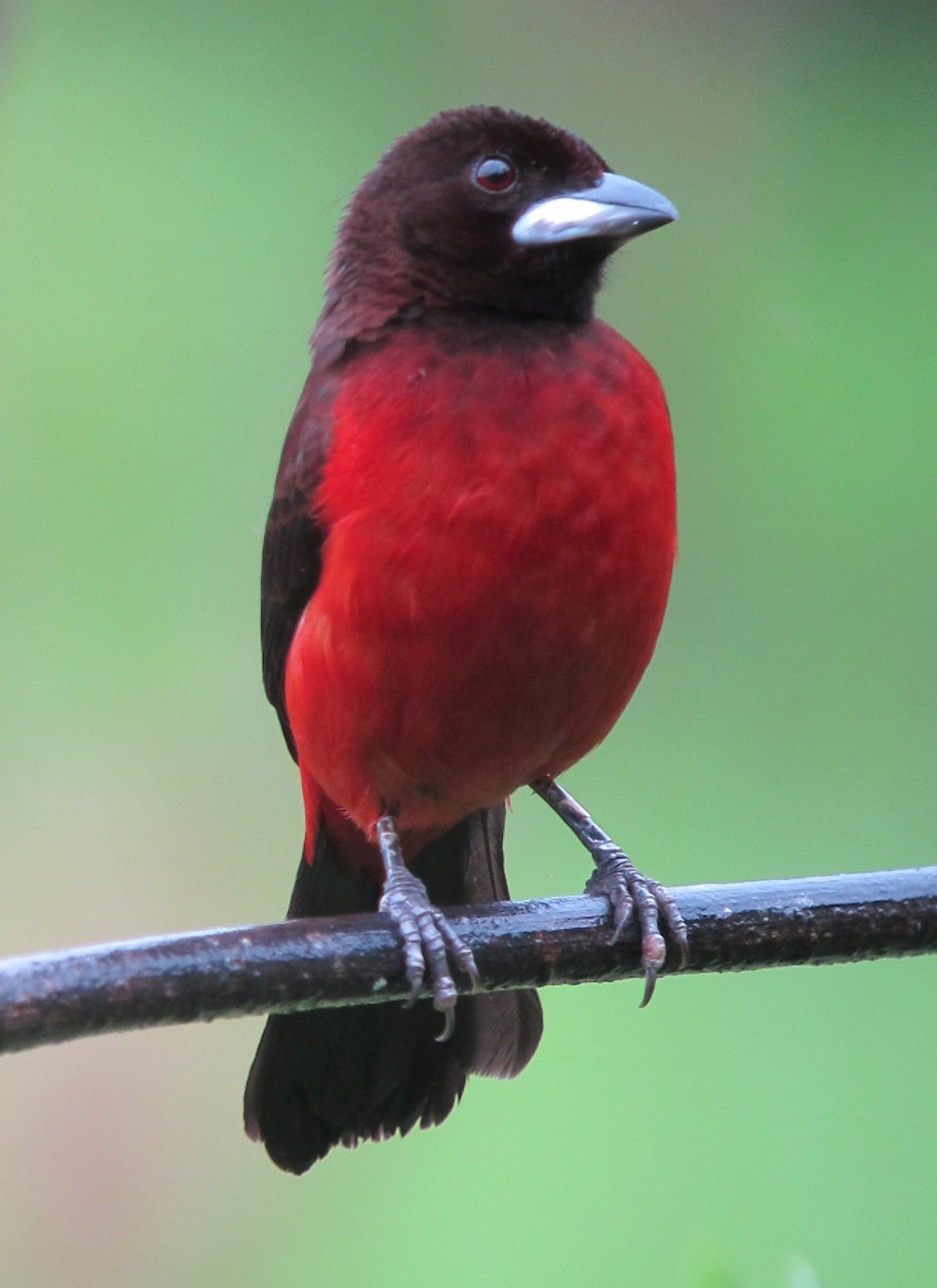
The Crimson-backed Tanager is a dark red tanager with a silvery white, swollen lower mandible, common in Colombia at forest edges, in scrub and in gardens. Small groups move actively and noisily through low shrubbery. It tolerates disturbed and settled land well and is one of the commonest tanagers of northern and western Colombia.
Voice
Often gives a sharp, metallic chink. The song is a simple series of whistled notes, mainly in the early morning.
Recording: Oscar Laverde — CC BY-NC-SA 4.0 · xeno-canto
Identification
18 cm, with a short, thick bill. In the male the lower mandible is strongly swollen and silvery white. The head, throat and mantle are dark crimson to maroon; the rump, breast and belly are brighter red. The wings and tail are black. The female is duller, with a brownish head and back, a reddish rump and belly and a less obvious, greyish bill base. Juveniles resemble the female.
Confusion species
Silver-beaked Tanager Ramphocelus carbo lives mainly east of the Andes; the male is much darker, velvety blackish red, with red only on the throat and breast. The male Flame-rumped Tanager Ramphocelus flammigerus is black with a yellow to orange-red rump and no red below. Masked Crimson Tanager Ramphocelus nigrogularis has a black mask and a black back and lives in the Amazonian lowlands.
Habitat
Forest edges, secondary forest, scrub, hedgerows, coffee plantations, gardens and parks, from the lowlands up to about 1500 m, locally higher. It eats fruit and insects, mainly in low shrubbery. The nest is a cup in a shrub or small tree.
Where the bird is most at home, classified by the vegetation units of the Andes and the west coast.


Range and movements
In Colombia widespread in the Caribbean lowlands, the Magdalena and Cauca valleys, the northern Pacific coast and the eastern Andean foothills down to the llanos. Not known from Ecuador, Peru or Bolivia; isolated reports from Peru probably rest on errors. Does not occur on the Galápagos. Outside the guide area in eastern Panama and western Venezuela.
- Resident
- dark = core range, pale = thinly spread
How and when to look
In gardens and forest edges around Medellín, Cali and in the Magdalena Valley, look for groups of red birds in low shrubbery; the sharp chink often reveals them first.
Conservation status
Least Concern. Common, and benefits from forest clearance and secondary growth.
Scientific name
Ramphocelus dimidiatus | de Lafresnaye, 1837
De Lafresnaye described the species in 1837 and placed it straight away in the genus where it still stands. The genus Ramphocelus was introduced in 1805 by Desmarest, A-G. The genus name combines Greek rhamphos, 'bill', and koilos, 'hollow, concave'. The species name comes from Latin dimidiatus, 'halved, divided in two', for the two-toned plumage. The specimen the first description was based on came from Cartagena, Colombia.