All species › Passerines › Tanagers and allies › Black-and-white Tanager
Black-and-white Tanager | Conothraupis speculigera
Zwart-witte tangare | Tangara negriblanca | Tiê-preto-e-branco
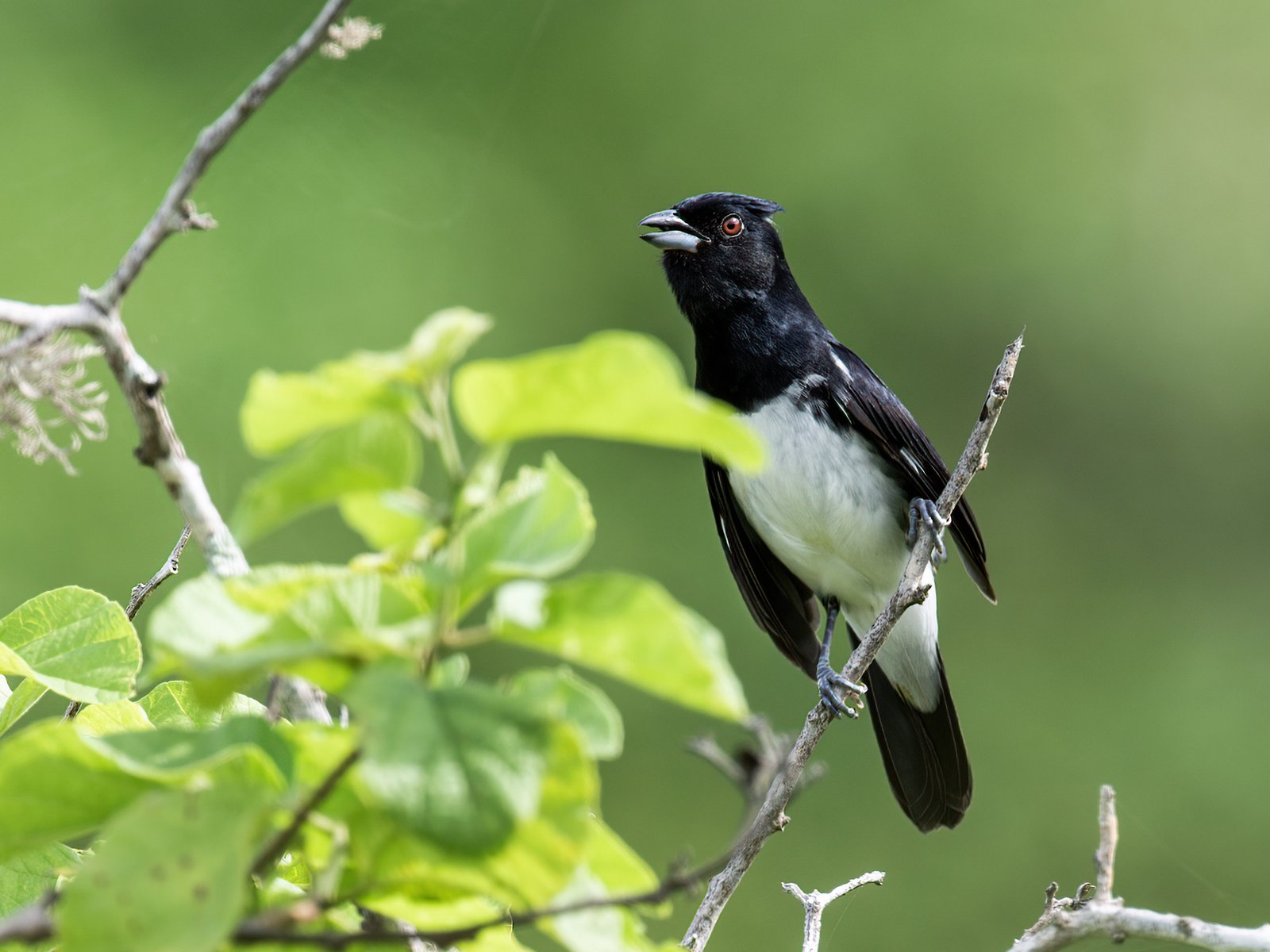
The Black-and-white Tanager is a tanager with a thick, conical bill and one of the few tanagers that migrate regularly. It breeds in the rainy season in the dry forest of the Tumbes region and then moves to the Amazonian lowlands on the other side of the Andes. The male is glossy black with a white belly and a white wing speculum.
Voice
The song is a loud, fast series of clear whistles, usually from a high perch in the rainy season. The call is a short, metallic chip.
Recording: Jerome Fischer — CC BY-NC-SA 4.0 · xeno-canto
Identification
16 cm, with a stout, conical, blue-grey bill. The male is glossy blue-black on the head, breast and upperparts, with a white speculum at the base of the primaries and a white belly and undertail coverts. The female is olive-green above with a greyish head and yellowish olive below, without a speculum. Young males at first resemble the female.
Confusion species
Black-and-white Seedeater Sporophila luctuosa is much smaller, with a short, thick bill, and lives in grassy country in the Andes. White-lined Tanager Tachyphonus rufus is entirely black with only a narrow white line on the shoulder and no white belly. The female resembles the female White-shouldered Tanager Loriotus luctuosus, which has a finer bill and lives in humid lowland forest.
Habitat
Breeds in deciduous dry forest and dense scrub in the lowlands and hills, roughly up to 1500 m, where the male sings from the tree and shrub layer in the rainy season. Outside the breeding season in scrub, forest edges and young growth on river islands in the Amazonian lowlands and foothills. It eats seeds, fruit and insects. The nest is a cup in a shrub.
Where the bird is most at home, classified by the vegetation units of the Andes and the west coast.


Range and movements
Breeds in Ecuador in the south-west (including El Oro and Loja) and in Peru in the north-west (Tumbes, Piura, Lambayeque and northern Cajamarca). Outside the breeding season in eastern Ecuador and in north-eastern and central Peru. Absent from Colombia, Bolivia and the Galápagos. Does not occur outside the guide area.
- Resident
- Winter visitor (c. Oct–Mar)
- Passage (Mar–Apr, Oct–Nov)
- dark = core range, pale = thinly spread
How and when to look
In the rainy season, especially February–April, visit the dry forest of Tumbes, Piura or Loja, where singing males can be heard from the tree and shrub layer. Outside the breeding season the species usually stays hidden in scrub along Amazonian rivers.
Conservation status
Least Concern. Most of the Tumbesian dry forest has been cleared or grazed; the species tolerates some degradation, but its numbers depend on the remaining forest patches.
Scientific name
Conothraupis speculigera | (Gould, 1855)
Gould described the species in 1855 as Schistochlamys speculigera; because it was later moved to another genus, the author and year stand in brackets. The genus Conothraupis was introduced in 1880 by Sclater. The genus name combines Greek kōnos, 'cone', with thraupis, a Greek word for a small bird now used for tanagers. The species name comes from Latin speculum, 'mirror', and -ger, 'bearing', after the white wing speculum. The specimen the first description was based on came from Río Ucayali, Peru.