All species › Passerines › Tanagers and allies › Tit-like Dacnis
Tit-like Dacnis | Xenodacnis parina
Meespitpit | Dacnis andino | Saí-andino
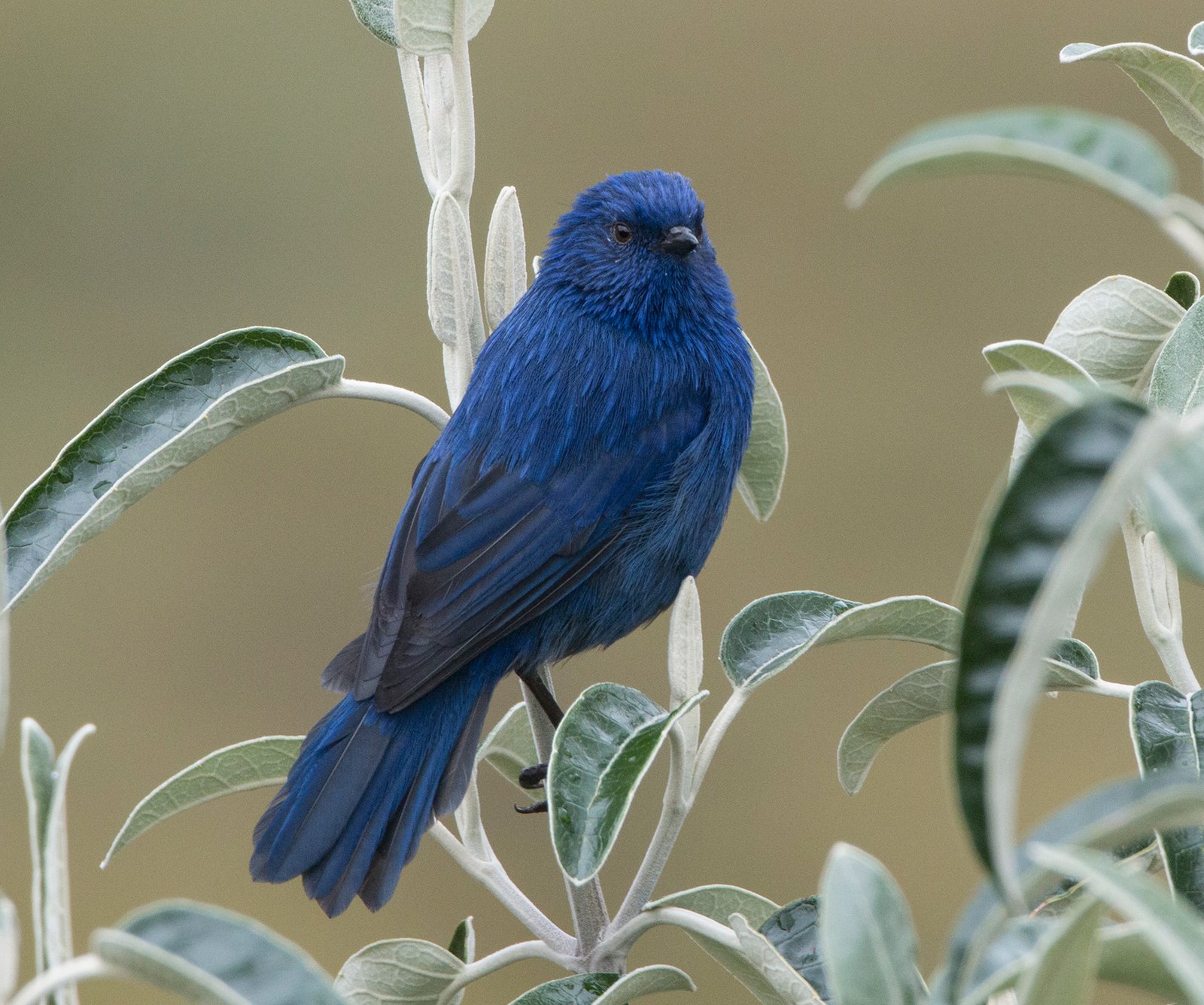
The Tit-like Dacnis is a small, deep blue tanager of the shrubbery around the treeline in the Andes of Ecuador and Peru. It forages like a tit on the undersides of the leaves of Gynoxys shrubs, taking aphids and sugary secretions. Male and female differ strongly.
Voice
The song is a loud, penetrating series of whistles, often mixed with lower notes; the female sometimes joins in a duet with harsher, scratchy notes.
Recording: Dries Van de Loock — CC BY-NC-SA 4.0 · xeno-canto
Identification
11–13 cm, with a short, pointed, blackish bill. The male is dark cobalt-blue, with paler, glossy blue streaks on the crown, back, throat and breast. The female has a blue crown and nape, greyish-brown upperparts with a blue wash on the lower back and cinnamon underparts that become paler towards the belly. Young birds resemble the female. The subspecies differ in size.
Confusion species
Masked Flowerpiercer Diglossa cyanea is larger, with a black mask, red eyes and a hooked bill tip. Bluish Flowerpiercer Diglossa caerulescens is duller greyish blue, without streaks, and lives lower in forest. Blue-backed Conebill Conirostrum sitticolor has a black head and breast and rufous underparts; the female Tit-like Dacnis differs by its blue crown and brown back. Giant Conebill Conirostrum binghami is much larger, with a white cheek and chestnut underparts.
Habitat
Shrubbery and stunted woodland around and above the treeline, often Polylepis groves with Gynoxys shrubs, in Ecuador at about 3700–4000 m and in Peru between about 3200 and 4600 m. It eats mainly tiny insects, such as aphids on the undersides of Gynoxys leaves, and sugary leaf secretions; it occasionally visits flowers. The nest is a small cup of Gynoxys plant down, usually in a tree.
Where the bird is most at home, classified by the vegetation units of the Andes and the west coast.


Range and movements
In Ecuador only locally in the southern Andes, including the Cajas massif in Azuay. In Peru patchily along the Andes, from the north and centre to the south: on the western slope in Lima and Arequipa among other places, on the eastern slope from Junín to Cusco. Absent from Colombia, Bolivia and the Galápagos. It does not occur outside the guide area.
- Resident
- dark = core range, pale = thinly spread
How and when to look
Search Cajas National Park in Ecuador and, in Peru, Polylepis groves with Gynoxys shrubs; watch for small blue birds pecking at the undersides of leaves. The loud song carries far.
Conservation status
Least Concern. Fairly common but patchily distributed; the population is suspected to be declining through fragmentation and clearance of shrubbery and Polylepis woodland and through fires.
Scientific name
Xenodacnis parina | Cabanis, 1873
Cabanis described the species in 1873 and placed it straight away in the genus where it still stands. He introduced the genus Xenodacnis in that same work. The genus name combines Greek xenos, 'different, unusual', with the genus name Dacnis. The species name is New Latin parinus, 'tit-like', after Parus. The specimen the first description was based on came from Maraynioc, Junín, Peru.