All species › Passerines › Tanagers and allies › Slaty Finch
Slaty Finch | Haplospiza rustica
Leikleurige musgors | Semillero pizarra | Cigarra-ardósia
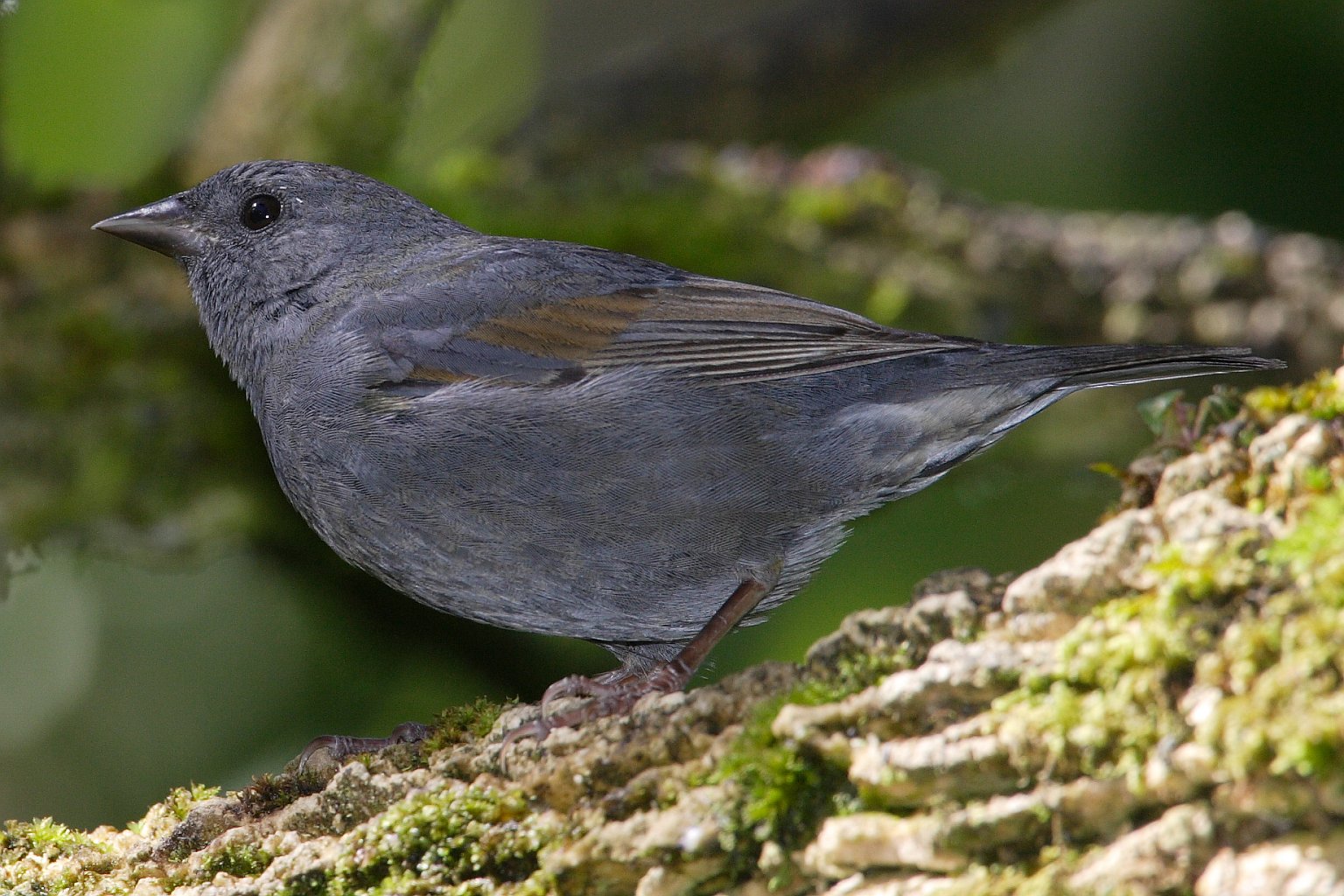
The Slaty Finch is a small, dark grey finch of montane forests with bamboo, from Mexico to Bolivia. It is nomadic and often appears suddenly and in larger numbers where Chusquea bamboo is seeding, then is absent again for years. The male is plain slate-grey, the female olive-brown.
Voice
The song is a short, high, buzzy or trilled series, sometimes ending in a fast trill. The call is a high, thin tseet.
Recording: Jacob Wijpkema — CC BY-NC-SA 4.0 · xeno-canto
Identification
12–13 cm, with a thin, very pointed, conical bill. The male is entirely plain slate-grey, slightly paler on the belly, with darker wing and tail feathers. The female is olive-brown above and paler buffy brown below, with faint dark streaks on the breast. Young birds resemble the female.
Confusion species
Paramo Seedeater Catamenia homochroa has a thicker, pink to yellowish bill and a chestnut vent. Plumbeous Sierra Finch Geospizopsis unicolor is larger and lives in open terrain above the treeline. Plumbeous Seedeater Sporophila plumbea and Slate-colored Seedeater Sporophila schistacea have a short, thick, curved bill and a white patch on the wing. Flowerpiercers Diglossa have an upturned bill with a hooked tip.
Habitat
Humid montane forest, forest edges and clearings with bamboo, especially where Chusquea is flowering or seeding, roughly between 1500 and 3500 m. It eats mainly bamboo seed, as well as other seeds and insects. The nest is a cup of moss and fibres low in dense vegetation.
Where the bird is most at home, classified by the vegetation units of the Andes and the west coast.


Range and movements
In Colombia locally and irregularly in the three Andean ranges In Ecuador on both slopes of the Andes. In Peru along the east slope of the Andes. In Bolivia on the east slope in the Yungas. Absent from the Galápagos. Outside the guide area in southern Mexico, Central America and Venezuela.
- Resident
- dark = core range, pale = thinly spread
How and when to look
Watch for flowering or seeding bamboo in cloud forest; there, groups of small grey finches may suddenly appear that are absent elsewhere for long periods.
Conservation status
Least Concern. The range is large, but the species is nomadic and locally scarce; clearing of montane forest reduces its habitat.
Scientific name
Haplospiza rustica | (Tschudi, 1844)
Tschudi described the species in 1844 as Phrygilus rusticus; because it was later moved to another genus, the author and year stand in brackets. The genus Haplospiza was introduced in 1851 by Cabanis. The genus name comes from Greek haploos, 'plain, simple', and spiza, 'finch'. The species name comes from Latin rusticus, 'rustic, plain', after the plain plumage. The specimen the first description was based on came from Peru.