All species › Passerines › Tanagers and allies › Purplish-mantled Tanager
Purplish-mantled Tanager | Iridosornis porphyrocephalus
Purpermanteltangare | Tangara capiazul | Sanhaço-de-manto-púrpura
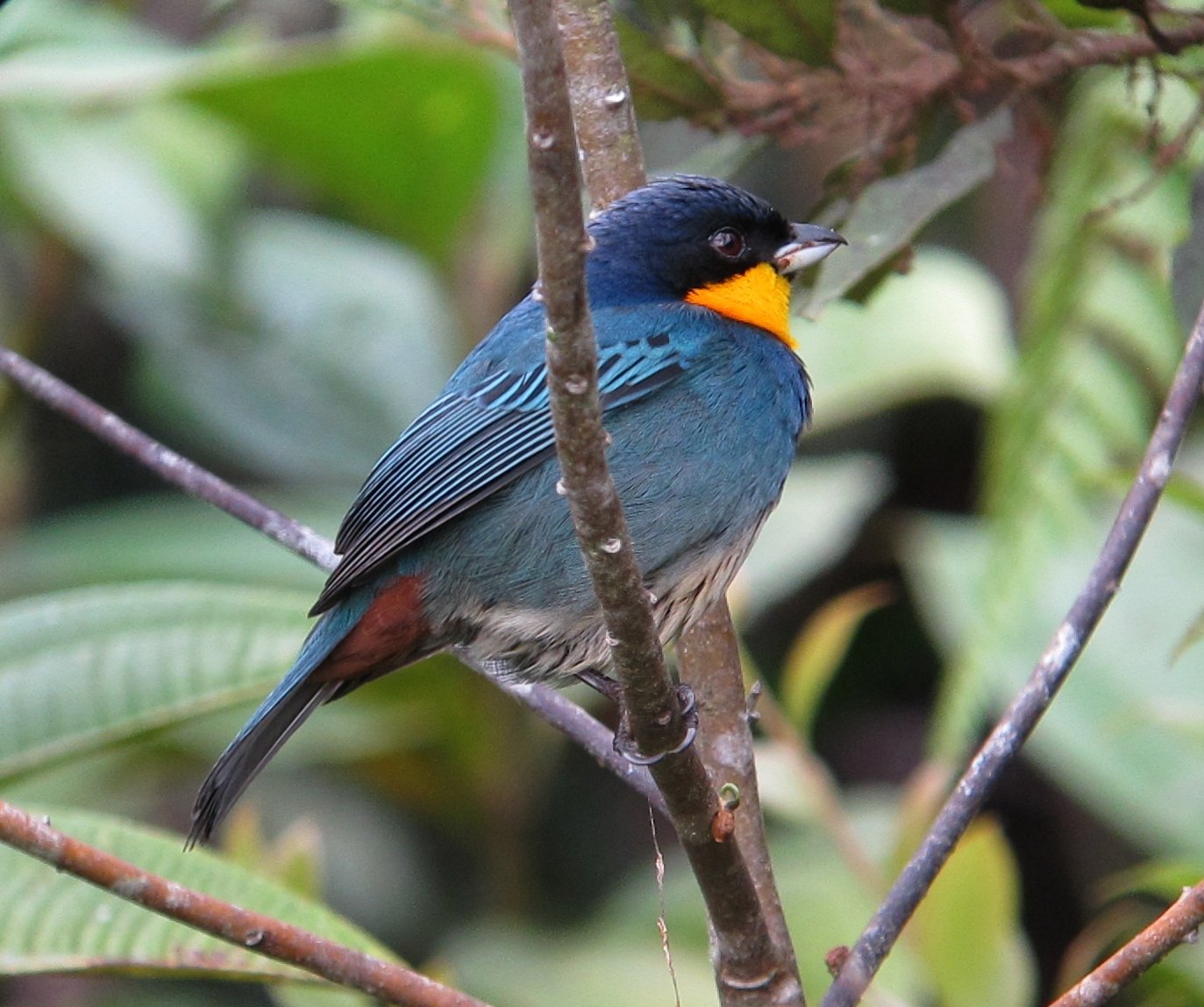
The Purplish-mantled Tanager is a dark blue tanager with a bright yellow throat from the cloud forest of the western Andes of Colombia and Ecuador. It lives low in the undergrowth of humid, mossy forest. On the eastern slope it is replaced by the closely related Yellow-throated Tanager.
Voice
Not very vocal; gives high, thin tseet calls. A song is poorly described.
Recording: Jerome Fischer — CC BY-NC-SA 4.0 · xeno-canto
Identification
15 cm, with a short, stout, black bill. Most of the plumage is deep purplish blue, with a purple sheen on the head and mantle; the forehead and lores are blackish. The throat is bright yellow and contrasts sharply. The belly is duller bluish grey, the undertail coverts rufous. The sexes are alike. Young birds are duller, with a less bright throat.
Confusion species
Yellow-throated Tanager Iridosornis analis has a paler, greyish-blue back and a buff belly, and lives on the eastern slope. Golden-crowned Tanager Iridosornis rufivertex has a black head with a golden-yellow crown and lives higher, at the treeline. Mountain tanagers of the genus Anisognathus have yellow or red underparts and are larger.
Habitat
The undergrowth and middle levels of humid, mossy cloud forest and forest edge, roughly between 1500 and 2600 m. It lives in pairs or small groups, often in a mixed flock, searching for insects and fruit low in dense vegetation. Little is known about the nest.
Where the bird is most at home, classified by the vegetation units of the Andes and the west coast.


Range and movements
In Colombia in the Western Cordillera and on the western slope of the Central Cordillera. In Ecuador on the western slope of the Andes in the north. Absent from Peru, Bolivia and the Galápagos. Does not occur outside the guide area.
- Resident
- dark = core range, pale = thinly spread
How and when to look
Look low at the forest edge and in dense cloud-forest undergrowth in north-western Ecuador, for example around Mindo and the old Nono road, or in the Western Cordillera of Colombia. In mixed flocks watch for a dark bird with a yellow throat just above the ground.
Conservation status
Near Threatened. Its habitat on the western slope of the Andes is being cleared in many places for farming and cattle ranching, causing a decline.
Scientific name
Iridosornis porphyrocephalus | Sclater, 1856
Sclater described the species in 1856 and placed it straight away in the genus where it still stands. The genus Iridosornis was introduced in 1844 by Lesson. The genus name comes from Greek iris, 'rainbow', and ornis, 'bird', thus 'rainbow bird'. The species name comes from Greek porphureos, 'purple', and kephalē, 'head'. The specimen the first description was based on came from near Quito, Ecuador.