All species › Passerines › Tanagers and allies › Yellow-throated Tanager
Yellow-throated Tanager | Iridosornis analis
Geelkeeltangare | Tangara goliamarilla | Sanhaço-de-garganta-amarela
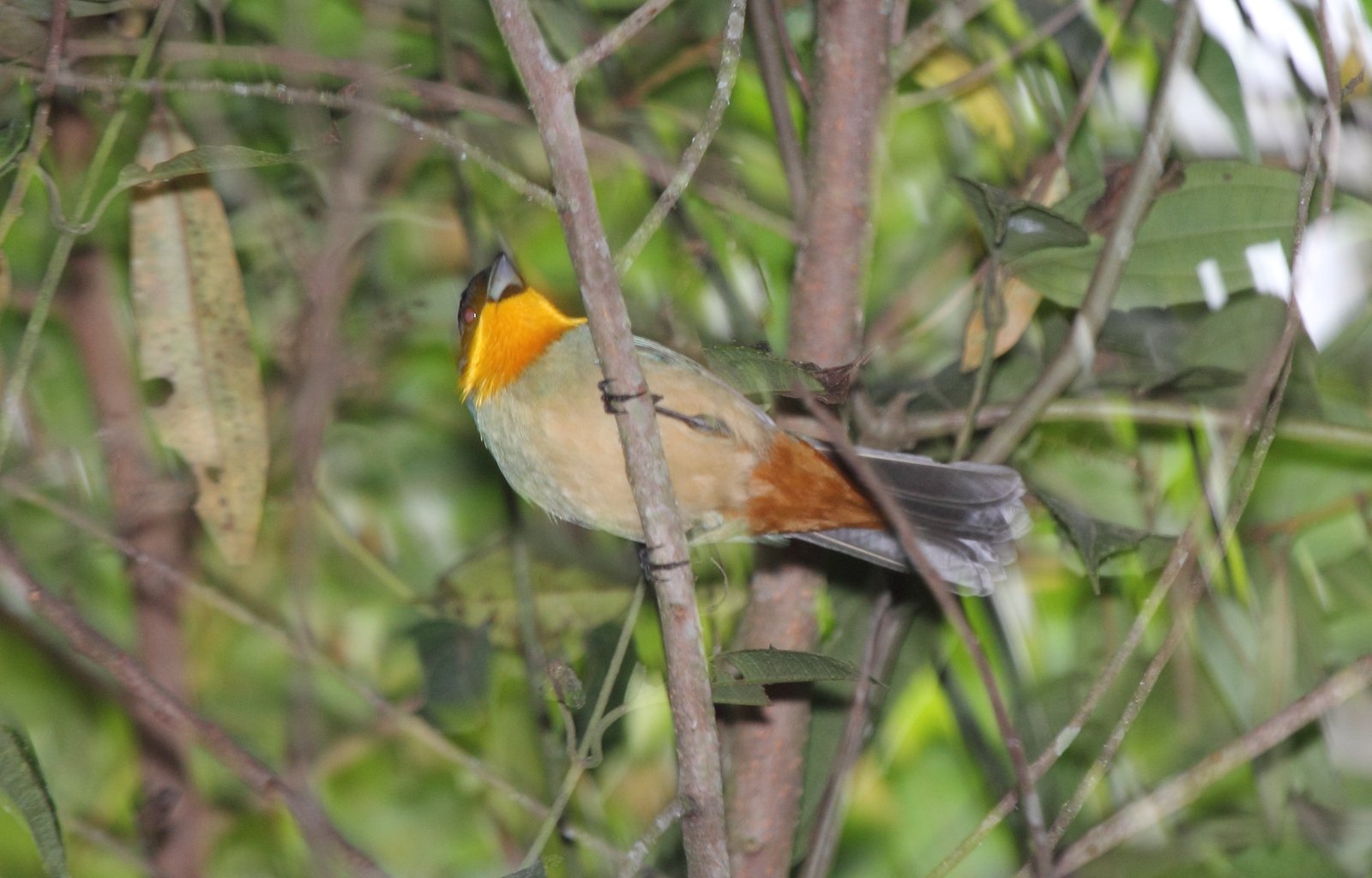
The Yellow-throated Tanager is a blue tanager with a bright yellow throat and a buff belly from montane forest on the eastern slope of the Andes. It lives low in the undergrowth and joins mixed flocks. On the western slope of Colombia and Ecuador it is replaced by Purplish-mantled Tanager.
Voice
Not very vocal; gives high, thin, hissing tseet calls. A song is poorly described.
Recording: Iván Lau — CC BY-NC-SA 4.0 · xeno-canto
Identification
15 cm, with a short, stout, black bill. The head, back, wings and tail are blue, greyer on the back; the forehead and lores are blackish. The throat is bright yellow. The breast and belly are warm buff-brown, the undertail coverts rufous. The sexes are alike. Young birds are duller and greyer.
Confusion species
Purplish-mantled Tanager Iridosornis porphyrocephalus is darker purplish blue with a bluish-grey belly and lives on the western slope. Golden-collared Tanager Iridosornis jelskii has a black throat and a golden-yellow band around the head and lives higher, at the treeline. Yellow-scarfed Tanager Iridosornis reinhardti has a black head with a yellow band across the nape and blue underparts.
Habitat
The undergrowth, edge and middle levels of humid montane forest and cloud forest on the eastern slope, roughly between 1300 and 2500 m. It lives in pairs or small groups, often in mixed flocks, searching for insects and fruit in dense vegetation. Little is known about the nest.
Where the bird is most at home, classified by the vegetation units of the Andes and the west coast.


Range and movements
In Colombia only in the south on the eastern slope, in Nariño and Putumayo. In Ecuador along the whole eastern slope. In Peru on the eastern slope south to Puno. Absent from Bolivia and the Galápagos. Does not occur outside the guide area.
- Resident
- dark = core range, pale = thinly spread
How and when to look
Look along roads through montane forest on the eastern slope, for example in the Cordillera de Guacamayos in Ecuador or along the Manu road in Peru, low at the forest edge. In mixed flocks watch for a blue bird with a yellow throat in the shrub layer.
Conservation status
Least Concern. Its habitat on the eastern slope is still extensive, but is cleared locally.
Scientific name
Iridosornis analis | (Tschudi, 1844)
Tschudi described the species in 1844 as T[anagra] analis; because it was later moved to another genus, the author and year stand in brackets. The genus Iridosornis was introduced in 1844 by Lesson. The genus name comes from Greek iris, 'rainbow', and ornis, 'bird', thus 'rainbow bird'. The species name comes from Modern Latin analis, 'of the vent', in ornithology 'relating to the undertail coverts'. The specimen the first description was based on came from central Peru (suggested: Vitoc Valley, Junín).