All species › Passerines › Tanagers and allies › Masked Saltator
Masked Saltator | Saltator cinctus
Maskersaltator | Pepitero enmascarado | Trinca-ferro-mascarado
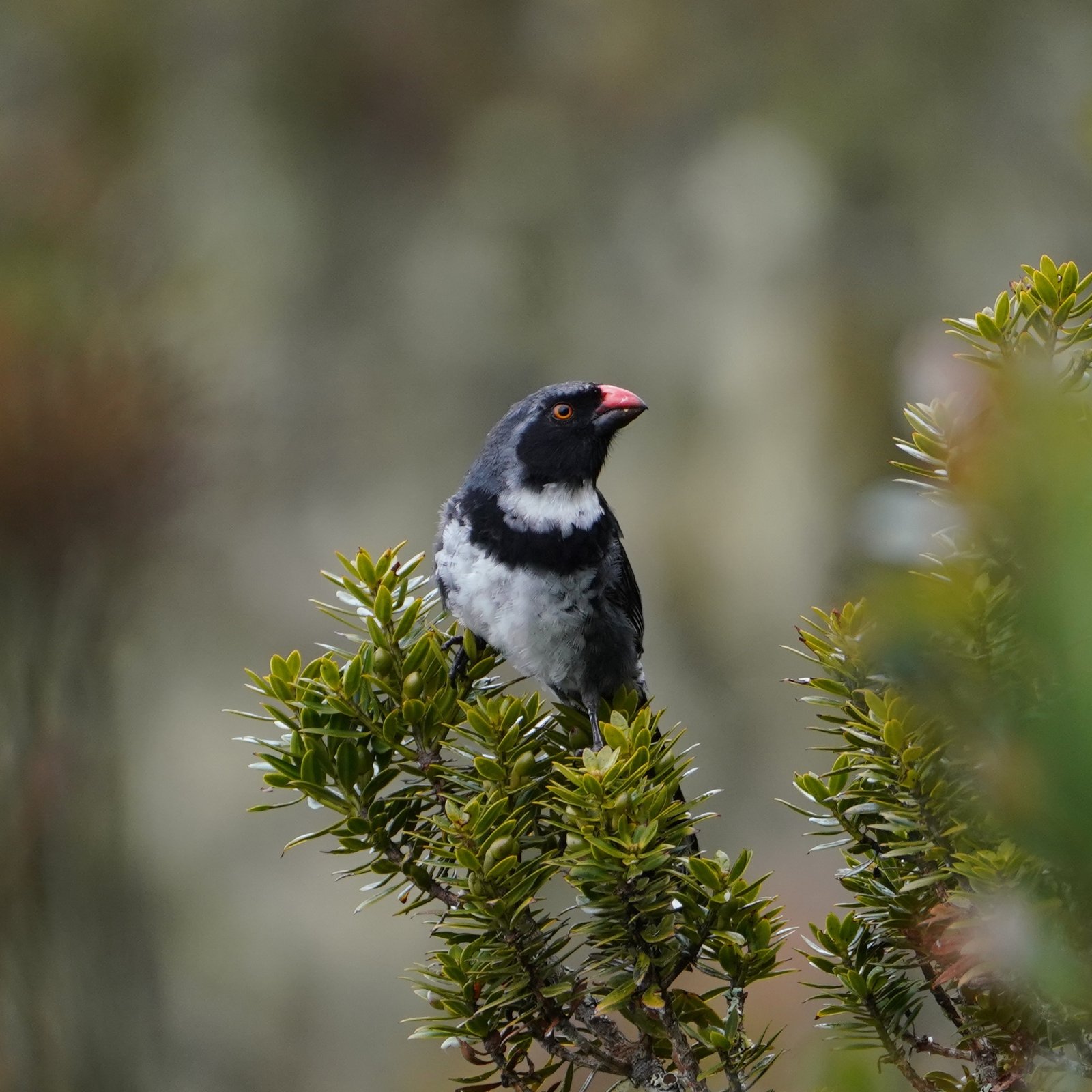
The Masked Saltator is a blue-grey saltator with a black mask, a black breast band and a long, white-tipped tail, of cloud forest on the slopes of the northern and central Andes. It is scarce and local, found mainly in forest with Podocarpus or bamboo. It often sits quietly and inconspicuously at mid-levels in the forest.
Voice
Rather quiet. The song is a short series of clear, whistled notes; also a sharp, metallic tick.
Recording: Jonas Nilsson — CC BY-NC-SA 4.0 · xeno-canto
Identification
21–22 cm, with a long, graduated tail. The bill is heavy and in adults largely red, with a variable amount of black at the base and on the ridge. The upperparts are blue-grey. The forehead, lores, area around the eye and chin are black. The throat and centre of the belly are white, separated by a black band across the breast; the flanks are grey. The tail feathers are black with broad white tips. The sexes are alike. Young birds have a darker bill and a fainter pattern.
Confusion species
Golden-billed Saltator Saltator aurantiirostris also has a black mask and breast band, but an orange bill, a white stripe behind the eye and a shorter tail, and lives in dry scrub in Peru and Bolivia. Slate-colored Grosbeak Saltator grossus is slate-grey with a white throat and a red bill, but lacks the black mask and white tail tips and lives in lowland forest. Buff-throated Saltator Saltator maximus has a green back and an ochre throat centre.
Habitat
Humid cloud forest and upper montane forest, often with Podocarpus or dense bamboo (Chusquea), and their edges, roughly between 1600 and 3000 m. It lives alone or in pairs at mid-levels and in the lower canopy, sometimes with mixed flocks. It eats fruit, including that of Podocarpus, seeds, buds and insects. The nest is poorly described.
Where the bird is most at home, classified by the vegetation units of the Andes and the west coast.


Range and movements
In Colombia locally in the Central Andes and on the eastern slope in the south. In Ecuador locally on the eastern slope of the Andes, mainly in the south. In Peru on the eastern slope in the north and centre of the country. Absent from Bolivia and the Galápagos. Does not occur outside the guide area.
- Resident
- dark = core range, pale = thinly spread
How and when to look
Search cloud forest with Podocarpus and bamboo on the eastern slope, as in southern Ecuador; look for a quiet, blue-grey bird with a long, white-tipped tail at mid-levels.
Conservation status
Least Concern, but scarce and locally distributed. Loss and fragmentation of cloud forest on the Andean slopes are the main threat.
Scientific name
Saltator cinctus | Zimmer, 1943
Zimmer described the species in 1943 and placed it straight away in the genus where it still stands. The genus Saltator was introduced in 1816 by Vieillot. The genus name comes from Latin saltator, 'dancer'. The species name comes from Latin cinctus, 'girdled, banded', for the breast band. The specimen the first description was based on came from Cordillera de Cutucú, Morona Santiago, Ecuador.