All species › Passerines › Tanagers and allies › Slate-colored Grosbeak
Slate-colored Grosbeak | Saltator grossus
Witkeelsaltator | Picogrueso piquirrojo | Bico-encarnado
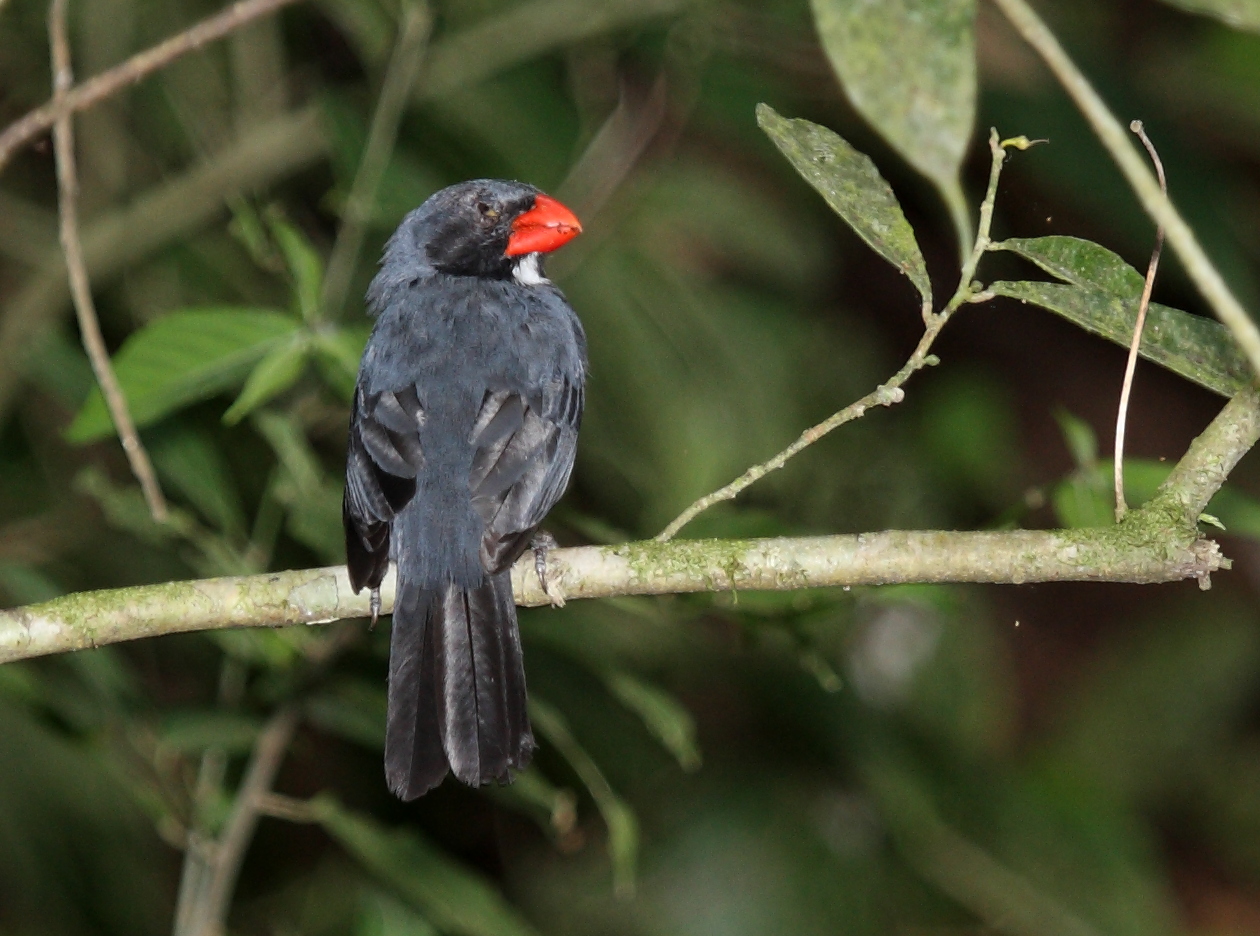
The Slate-colored Grosbeak is a robust, slate-grey saltator of humid lowland forest on both sides of the Andes. The coral-red bill and the black-bordered white throat are distinctive for this species in the guide area. It usually stays high in the canopy and often joins mixed flocks of tanagers and other birds.
Voice
The song is a series of clear, rich, whistled phrases of two to four notes, often repeated several times. The call is a short, metallic chik.
Recording: Juan Freile — CC BY-NC-SA 4.0 · xeno-canto
Identification
20 cm, with a thick, coral-red bill. The male is plain slate-grey with a small white throat patch broadly bordered black; forehead and lores are black. The female is paler and duller grey, with a white throat with little or no black border. Young birds are browner grey and have a duller, more orange bill.
Confusion species
Amazonian Grosbeak Cyanoloxia rothschildii (east of the Andes) and Blue-black Grosbeak Cyanoloxia cyanoides (west of them) have a heavy, blackish bill; the male is blue-black and the female brown, and both live lower in the understorey. Bluish-grey Saltator Saltator coerulescens has a dark bill, a white supercilium and an ochre belly and lives in semi-open country.
Habitat
Humid terra firme rainforest, also várzea, foothill forest, old secondary forest and forest edge, from sea level to about 1200 m. It forages in the middle and upper canopy for fruit, seeds and insects, often in mixed flocks. The nest is a loose cup of twigs and tendrils in a tree or shrub.
Where the bird is most at home, classified by the vegetation units of the Andes and the west coast.


Range and movements
In Colombia in the Pacific lowlands and the north-west, and east of the Andes in the Amazonian lowlands and foothills. In Ecuador in the north-west (mainly Esmeraldas) and in the eastern lowlands. In Peru widespread in the Amazonian lowlands and foothills. In Bolivia in the lowlands of the north and centre and along the base of the Andes. Absent from the Galápagos. Outside the guide area from Honduras to Panama and in Venezuela, the Guianas and Amazonian Brazil.
- Resident
- dark = core range, pale = thinly spread
How and when to look
In mixed canopy flocks, look for a grey bird with a red bill; it often gives its whistled song from a perch among the foliage.
Conservation status
Least Concern. Widespread and fairly common in continuous forest; it disappears where forest is cleared on a large scale.
Scientific name
Saltator grossus | (Linnaeus, 1766)
Linnaeus described the species in 1766 as Loxia grossa; because it was later moved to another genus, the author and year stand in brackets. The genus Saltator was introduced in 1816 by Vieillot. The genus name comes from Latin saltator, 'dancer'. The species name comes from Latin grossus, 'thick, large', probably for the heavy bill. The specimen the first description was based on came from Cayenne, French Guiana.