All species › Passerines › Tanagers and allies › Wedge-tailed Grass Finch
Wedge-tailed Grass Finch | Emberizoides herbicola
Wigstaartgrasgors | Sabanero coludo | Canário-do-campo
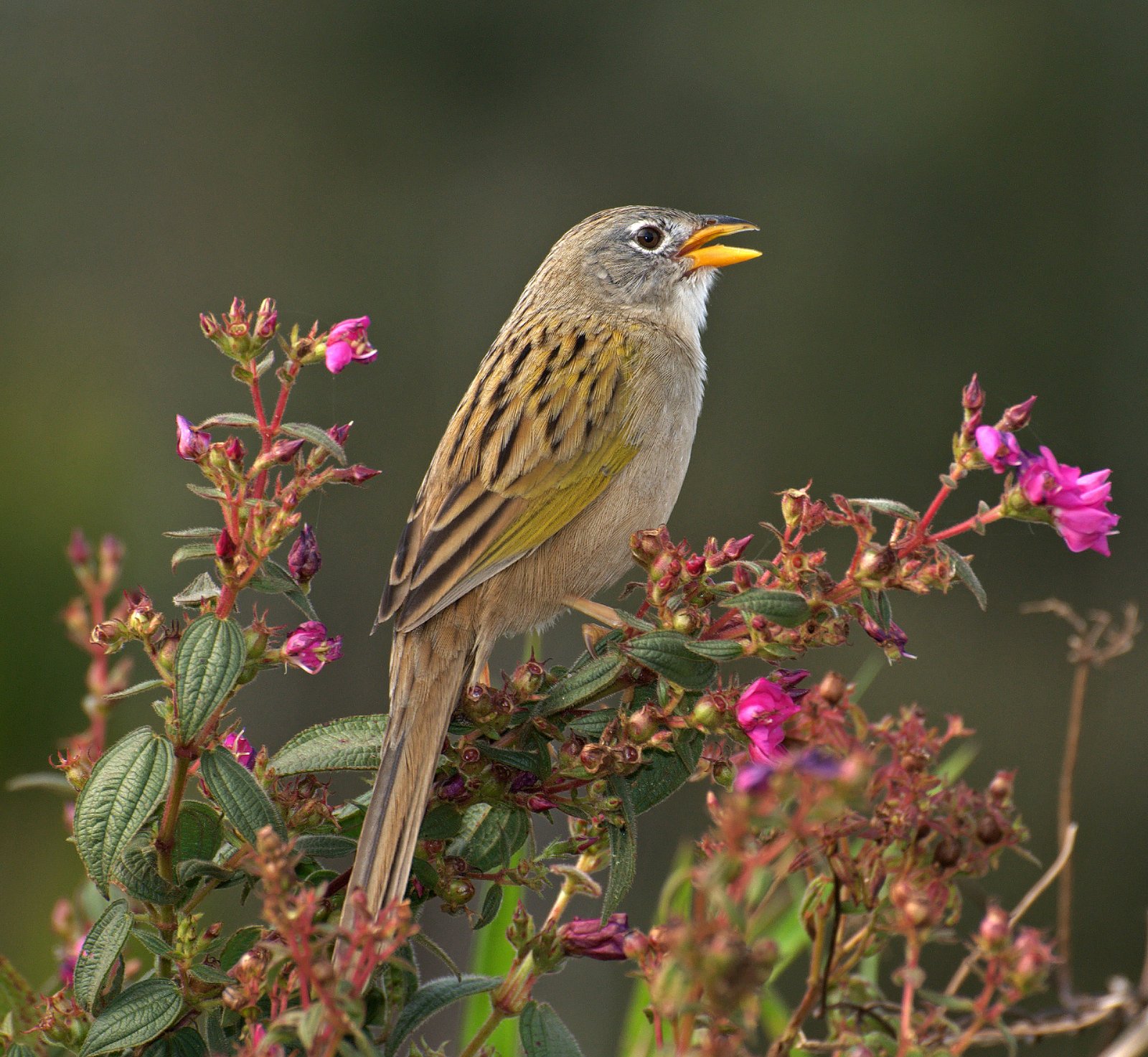
The Wedge-tailed Grass Finch is a slim, streaked finch of open savannas with tall grass, from Costa Rica to Argentina. The long, graduated tail with pointed feathers explains its name. It lives hidden in the grass and sings mainly at dawn and dusk from a grass stem or small shrub.
Voice
The song is a short series of clear, whistled notes, such as tsee-choo-tsiweet, mainly at dawn and dusk. The call is a short, harsh chip.
Recording: Paul Lenrumé — CC BY-NC-SA 4.0 · xeno-canto
Identification
19 cm, almost half of it tail. The upperparts are ochre-brown with heavy black streaks, the underparts whitish with an ochre breast and flanks. It has a narrow white eye-ring, a pale supercilium, yellow at the bend of the wing and a bill with a yellow lower mandible. The sexes are alike. Young birds are yellower below and faintly streaked on the breast.
Confusion species
Pampa Finch Embernagra platensis is more robust, with olive-green upperparts, a grey breast and a thick, orange-yellow bill. Grassland Sparrow Ammodramus humeralis is smaller, with a short tail and a yellow loral spot. Black-masked Finch Coryphaspiza melanotis is smaller and the male has a black head with a white supercilium. Long-tailed Reed Finch Donacospiza albifrons has plain ochre underparts and a grey supercilium.
Habitat
Savanna with tall grass, often with scattered shrubs, wet grassland and grassy clearings in forest, from the lowlands up to about 1500 m, locally higher. It forages low in the grass for insects and seeds. The nest is a cup of grass, low in a grass tussock.
Where the bird is most at home, classified by the vegetation units of the Andes and the west coast.


Range and movements
In Colombia mainly in the llanos east of the Andes and locally in savannas in the north. In Ecuador not or barely known. In Peru locally in savannas in the south-east, such as the Pampas del Heath. In Bolivia in the savannas of Beni and Santa Cruz and in grassland along the base of the Andes. Absent from the Galápagos. Outside the guide area from Costa Rica to Venezuela and the Guianas, in Brazil, Paraguay and north-eastern Argentina.
- Resident
- dark = core range, pale = thinly spread
How and when to look
At dawn, listen in tall savanna grass for the clear, whistled song, then look for a slim, streaked bird with a long tail on a grass stem.
Conservation status
Least Concern. Widespread; it disappears locally through conversion of savanna to cropland and through intensive grazing.
Scientific name
Emberizoides herbicola | (Vieillot, 1817)
Vieillot described the species in 1817 as Sylvia herbicola; because it was later moved to another genus, the author and year stand in brackets. The genus Emberizoides was introduced in 1822 by Temminck. The genus name combines the bunting genus Emberiza with Greek -oidēs, 'resembling'. The species name comes from Latin herba, 'grass, herb', and -cola, 'dweller': grass-dweller. The specimen the first description was based on came from Paraguay.