All species › Passerines › New World sparrows › Moss-backed Sparrow
Moss-backed Sparrow | Arremon dorbignii
Wenkbrauwgeelsnavelgors | Cerquero yungueño | Tico-tico-de-dorso-musgo
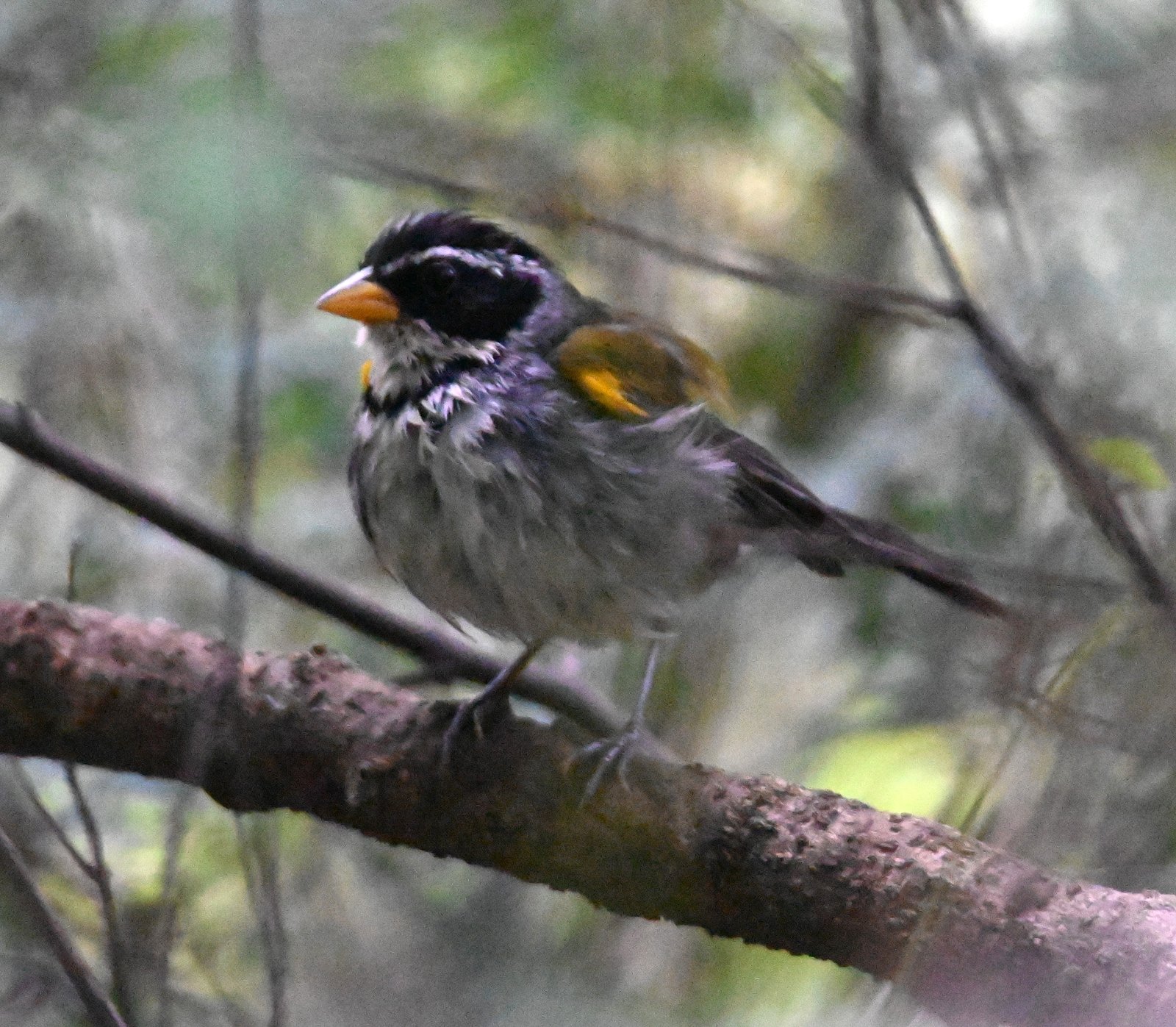
The Moss-backed Sparrow is an orange-yellow-billed sparrow of the Andean foothills of Bolivia and north-western Argentina. It was long treated as a subspecies of Saffron-billed Sparrow, but differs in back colour, head pattern and song. It lives in pairs close to the ground in the forest undergrowth.
Voice
The song is a varied series of high, thin notes and short trills, without the series of repeated notes of Saffron-billed Sparrow. The call is a high tseep.
Recording: Oscar Coria — CC BY-NC-SA 4.0 · xeno-canto
Identification
15–16 cm, with a conical, orange-yellow bill. The head is black, with a narrow grey median crown stripe and a long white supercilium that starts in front of the eye and runs back to the nape. The nape and sides of the neck are grey, the back, wings and tail olive-green. There is yellow at the bend of the wing. The underparts are white, with a narrow black breast band and grey flanks. The female is duller, with an olive median crown stripe and buffy flanks. Juveniles are duller and browner, with a darker bill.
Confusion species
Saffron-billed Sparrow Arremon flavirostris lives in the eastern lowlands of Bolivia; in the guide area it has a greyer back, a shorter supercilium starting only behind the eye and a broader breast band, and its song consists of repeated, piercing notes. Pectoral Sparrow Arremon taciturnus has a black bill and lives in humid lowland forest. Chestnut-capped Brushfinch Arremon brunneinucha does not occur in Bolivia.
Habitat
Undergrowth of humid to semi-evergreen forest in the foothills and on the lower slopes of the Yungas, also in riparian woodland, secondary forest and forest edges, roughly between 400 and 1500 m. Forages on the ground among fallen leaves for insects and seeds. Little is known of the nest in the guide area.
Where the bird is most at home, classified by the vegetation units of the Andes and the west coast.


Range and movements
Only in Bolivia, on the eastern slope of the Andes from La Paz through Cochabamba and Santa Cruz south to Chuquisaca and Tarija. Absent from Colombia, Ecuador, Peru and the Galápagos. Outside the guide area in north-western Argentina, south to Catamarca.
- Resident
- dark = core range, pale = thinly spread
How and when to look
Search the undergrowth along forest edges and stream valleys in the foothills, for example at Amboró in Santa Cruz. Listen for the high song in the morning and look low among the shrubs; the orange-yellow bill stands out in the dark undergrowth.
Conservation status
Least Concern. The population appears stable; locally habitat is lost to forest clearance in the foothills.
Scientific name
Arremon dorbignii | Sclater, 1856
Sclater described the species in 1856 and placed it straight away in the genus where it still stands. The genus Arremon was introduced in 1816 by Vieillot. The genus name comes from Greek arrhēmōn, 'silent, without speech'. The species name honours Alcide d'Orbigny (1802–1857), French naturalist who travelled and collected in South America from 1826 to 1834. The specimen the first description was based on came from Yungas, Bolivia.