All species › Passerines › New World sparrows › Pectoral Sparrow
Pectoral Sparrow | Arremon taciturnus
Olijfruggors | Cerquero pectoral | Tico-tico-de-bico-preto
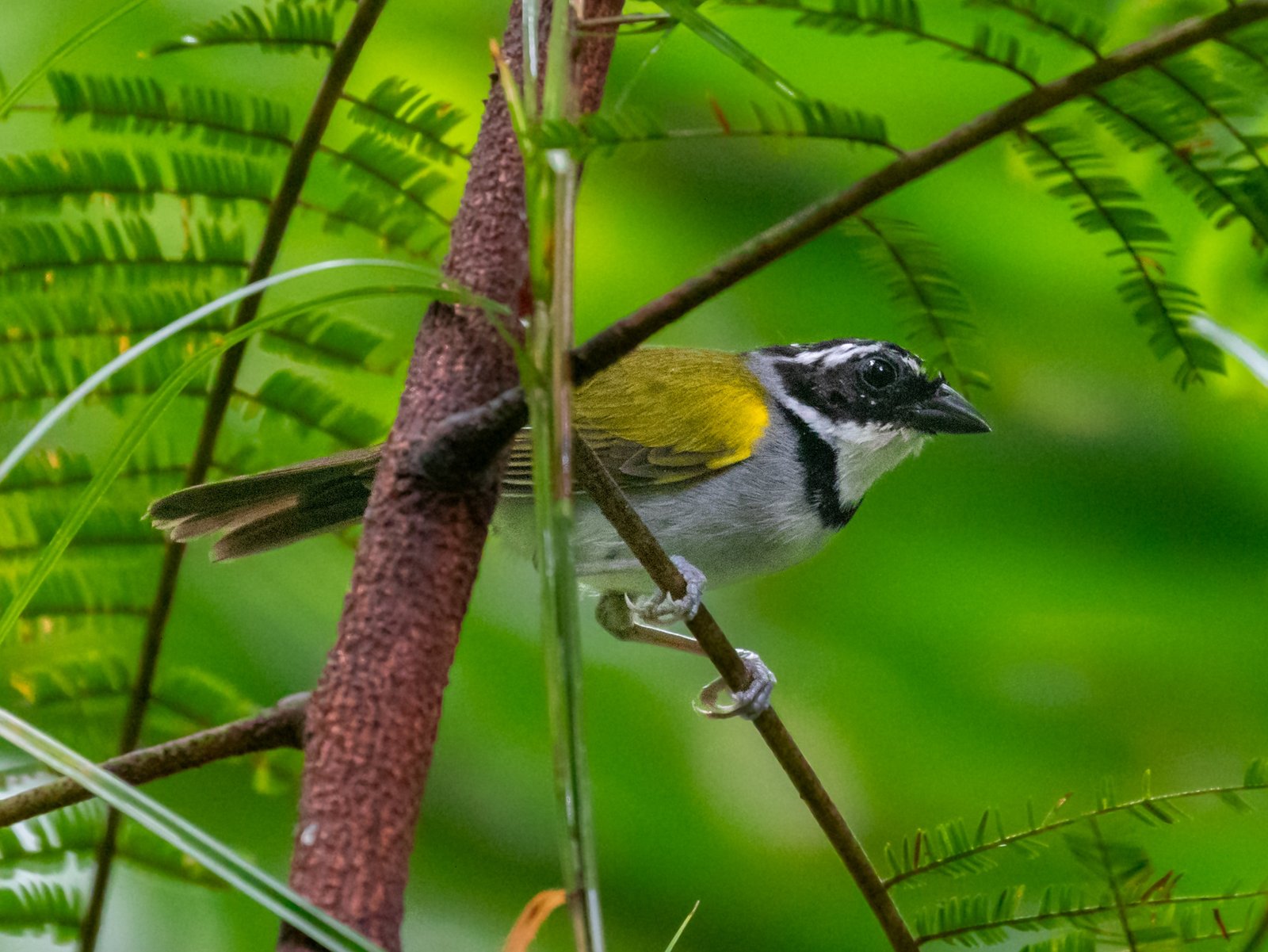
The Pectoral Sparrow is a sparrow with a black-and-white striped head of the undergrowth of Amazonian lowland forest. It lives in pairs on or just above the forest floor and mostly gives itself away by its high, thin song. Within the genus Arremon it is identified by its all-black bill.
Voice
The song is a series of very high, thin, hissing notes, roughly tsee tsee tsee tsee, often on a single pitch. The call is a high, sharp tseet.
Recording: JAYRSON ARAUJO DE OLIVEIRA — CC BY-NC-SA 4.0 · xeno-canto
Identification
15 cm, with a fairly short, conical, black bill. The head is black, with a narrow grey median crown stripe and a white supercilium behind the eye. The nape and sides of the neck are grey, the back, wings and tail olive-green. There is a yellow patch at the bend of the wing. The underparts are white, with a black patch or narrow band on each side of the breast and grey flanks. The female is duller, with a buffy wash on the breast and flanks and a smaller or broken breast band. Juveniles are olive-brown, with a less distinct head pattern.
Confusion species
Orange-billed Sparrow Arremon aurantiirostris lives in the same forest in eastern Ecuador and northern Peru, but has a bright orange bill and a complete black breast band. Saffron-billed Sparrow Arremon flavirostris in eastern Bolivia has an orange-yellow bill and lives in drier forest. Chestnut-capped Brushfinch Arremon brunneinucha is larger, with a chestnut crown, and lives in montane forest.
Habitat
Undergrowth of humid terra firme forest and older secondary forest in the lowlands, locally also in várzea and up to about 1000 m in the foothills. Forages on the ground and in low branches for insects and seeds, often among fallen leaves. The nest is a domed structure on or just above the ground.
Where the bird is most at home, classified by the vegetation units of the Andes and the west coast.


Range and movements
In Colombia in the lowlands east of the Andes, in Amazonia and along the edge of the Llanos. In Ecuador scarce and local in the eastern lowlands. In Peru widespread in the Amazonian lowlands. In Bolivia in the north and east, in Pando, Beni, La Paz, Cochabamba and Santa Cruz. Absent from the Galápagos. Outside the guide area in Venezuela, the Guianas and Brazilian Amazonia.
- Resident
- dark = core range, pale = thinly spread
How and when to look
Listen in the early morning in the undergrowth of terra firme forest for the high, hissing song and look low along forest trails. The birds usually stay in dense cover; a pair sometimes shows briefly on a fallen log.
Conservation status
Least Concern. The range is large; locally the species disappears where lowland forest is cleared.
Scientific name
Arremon taciturnus | (Hermann, 1783)
Hermann described the species in 1783 as Tanagra taciturna; because it was later moved to another genus, the author and year stand in brackets. The genus Arremon was introduced in 1816 by Vieillot. The genus name comes from Greek arrhēmōn, 'silent, without speech'. The species name is Latin for 'silent', in line with the genus name. The specimen the first description was based on came from Cayenne, French Guiana.