All species › Passerines › Tanagers and allies › Multicolored Tanager
Multicolored Tanager | Chlorochrysa nitidissima
Veelkleurige tangare | Tangara multicolor | Saíra-multicolorida
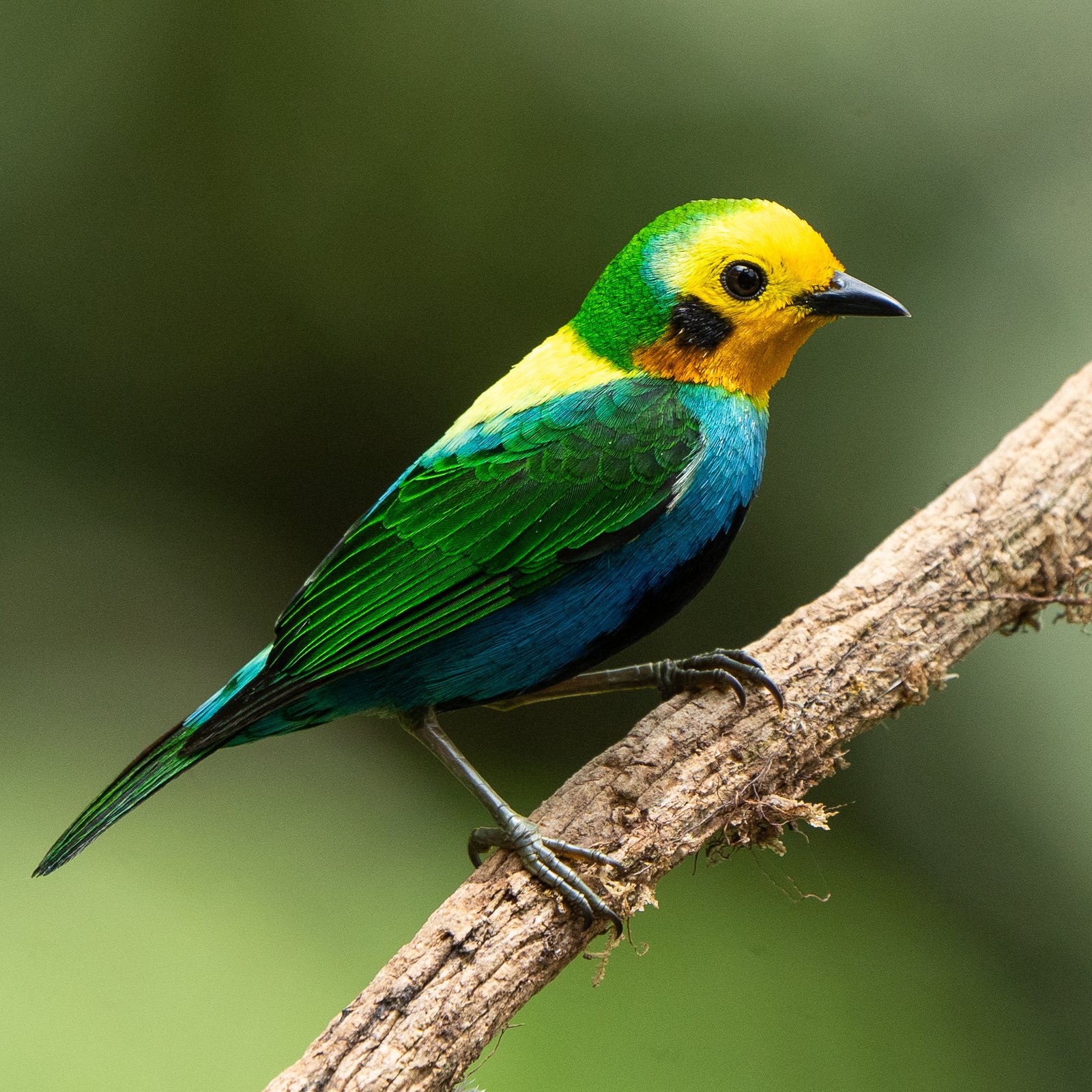
The Multicolored Tanager is a small tanager endemic to the montane forest of the Western and Central Andes of Colombia. The male combines a yellow head with a black ear patch, a yellow mantle, green wings and blue underparts with a black belly patch.
Voice
Rather quiet. Calls are thin, high tsit notes; a distinct song is poorly known.
Recording: Jerome Fischer — CC BY-NC-SA 4.0 · xeno-canto
Identification
13 cm, with a short, pointed black bill. The male has a green crown, a golden-yellow face and throat with a black patch on the ear coverts, a yellow upper back, a green lower back and rump, and green wings and tail. The underparts are cobalt-blue with a black patch in the centre of the belly. The female is greener and duller, with less yellow and blue and no black belly patch. Juveniles resemble the female.
Confusion species
Golden Tanager Tangara arthus is larger, mostly golden-yellow with a black ear patch and black wings, and has no blue below. Silver-throated Tanager Tangara icterocephala is yellow with a silvery-white throat and a green-streaked back. Saffron-crowned Tanager Tangara xanthocephala has a saffron-yellow head with a black mask and a blue-green body.
Habitat
Humid, mossy lower montane forest and cloud forest, forest edge and old secondary growth, also woodlots in coffee country, mostly from about 1300 to 2200 m. It forages in pairs in the middle and upper canopy along mossy branches for insects and also eats fruit; it travels with mixed tanager flocks. The nest is a cup of moss.
Where the bird is most at home, classified by the vegetation units of the Andes and the west coast.


Range and movements
Endemic to Colombia: on both slopes of the Western Andes and on the western slope of the Central Andes, from Antioquia south to Valle del Cauca and Cauca. Does not occur in Ecuador, Peru, Bolivia or on the Galápagos. Not known outside the guide area.
- Resident
- dark = core range, pale = thinly spread
How and when to look
Search mixed flocks in forest reserves such as Km 18 and San Antonio near Cali, along the road to Montezuma (Tatamá) and in the forests around Jardín in Antioquia; the birds often perch in the outer crown.
Conservation status
Near Threatened. The range is small and heavily fragmented by clearing for agriculture and cattle ranching; the species persists in forest remnants and reserves.
Scientific name
Chlorochrysa nitidissima | Sclater, 1874
Sclater described the species in 1874 and placed it straight away in the genus where it still stands. The genus Chlorochrysa was introduced in 1851 by Bonaparte. The genus name comes from Greek khlōros, 'green', and khrusos, 'gold'. The species name is Latin nitidissimus, 'most shining', superlative of nitidus. The specimen the first description was based on came from Antioquia, Colombia.