All species › Passerines › Tanagers and allies › Orange-eared Tanager
Orange-eared Tanager | Chlorochrysa calliparaea
Oranjeoortangare | Tangara orejinaranja | Saíra-de-orelha-laranja
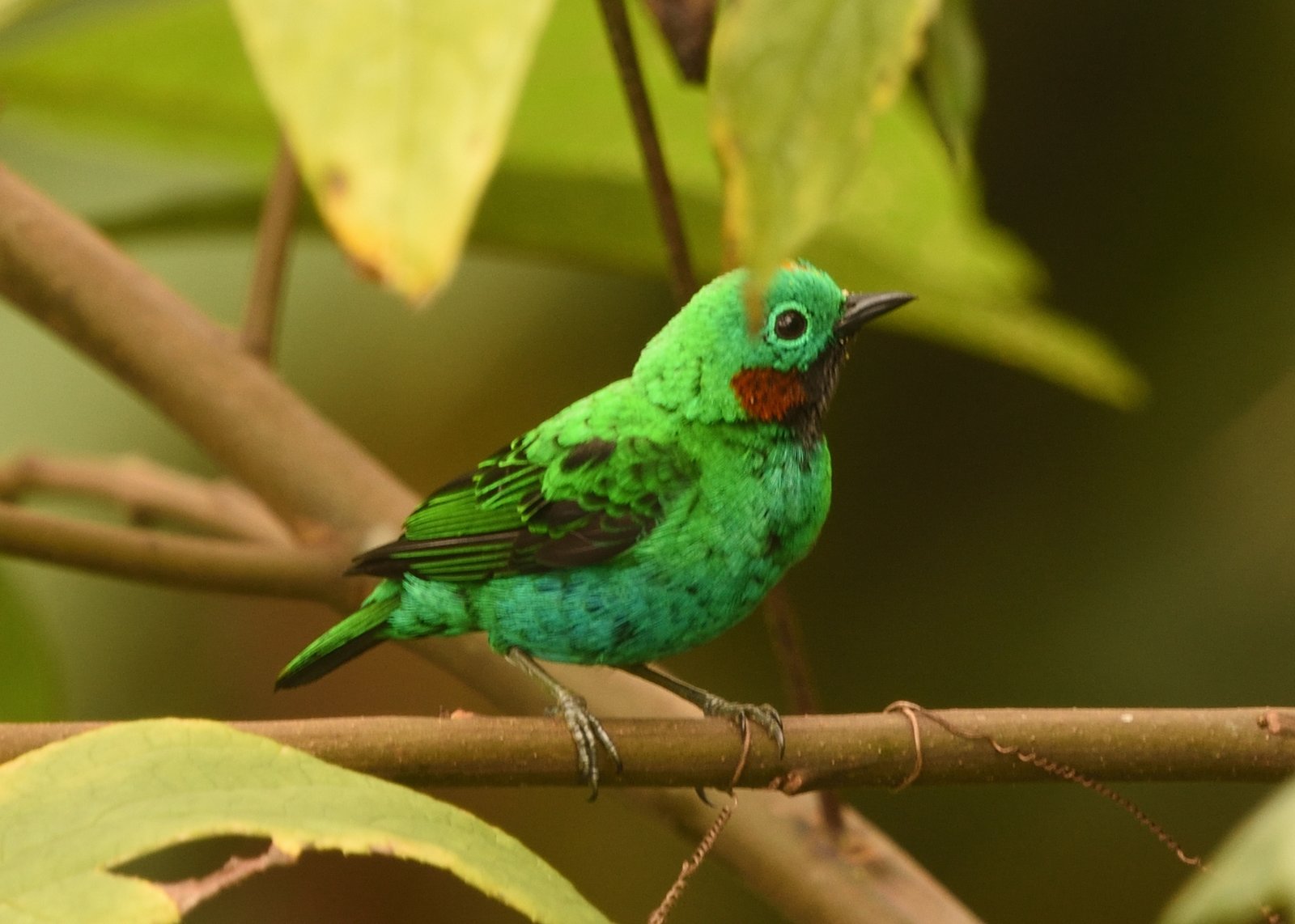
The Orange-eared Tanager is a small, glossy green tanager of the foothills and lower montane forest on the eastern slope of the Andes, from Colombia to Bolivia. The male has an orange ear spot, an orange-yellow crown patch and an orange rump.
Voice
Rather quiet. Calls are high, thin tsit notes, often in short series while foraging.
Recording: Jacob Wijpkema — CC BY-NC-SA 4.0 · xeno-canto
Identification
13 cm, with a short, pointed black bill. The male is glossy emerald-green, with an orange-yellow patch on the crown, a small orange spot on the ear coverts and a coppery-orange rump. The throat is dark, from blue-black to black, and the centre of the belly is blue; the extent varies by subspecies. The female is a duller green, with smaller orange marks and little or no crown patch. Juveniles resemble the female.
Confusion species
Golden-eared Tanager Tangara chrysotis is larger, with a golden-yellow ear patch, black facial stripes and a rufous belly. Green-and-gold Tanager Tangara schrankii lives lower in the Amazonian lowlands and foothills and has a black mask and a yellow centre to the underparts. Green Honeycreeper Chlorophanes spiza is larger, with a curved yellow bill and no orange.
Habitat
Humid foothill forest and lower montane forest on the eastern slope, forest edge and tall secondary growth, mostly from about 900 to 2000 m. It forages in pairs in the middle and upper canopy along mossy branches for insects and also takes small fruit; almost always in mixed tanager flocks. The nest is a cup of moss.
Where the bird is most at home, classified by the vegetation units of the Andes and the west coast.


Range and movements
In Colombia on the eastern slope of the Eastern Andes and locally in the Central Andes. In Ecuador on the eastern slope of the Andes from north to south. In Peru on the eastern slope along the entire length of the country. In Bolivia on the eastern slope in La Paz and Cochabamba. Does not occur on the Galápagos. Not known outside the guide area.
- Resident
- dark = core range, pale = thinly spread
How and when to look
Search mixed flocks along forest edges and roads in the foothills of the eastern slope, for example around Wild Sumaco and along the Loreto road in Ecuador and on the lower part of the road to Manu in Peru; look for the orange rump when a green tanager flies off.
Conservation status
Not evaluated in this circumscription; in a broader treatment the species was rated Least Concern. Fairly common in suitable forest; sensitive to deforestation in the foothills.
Scientific name
Chlorochrysa calliparaea | (Tschudi, 1844)
Tschudi described the species in 1844 as C[allospiza] calliparaea; because it was later moved to another genus, the author and year stand in brackets. The genus Chlorochrysa was introduced in 1851 by Bonaparte. The genus name comes from Greek khlōros, 'green', and khrusos, 'gold'. The species name comes from Greek kallos, 'beauty', and pareia, 'cheek', referring to the orange ear patch. The specimen the first description was based on came from Junín, Peru.