All species › Passerines › Tanagers and allies › Glistening-green Tanager
Glistening-green Tanager | Chlorochrysa phoenicotis
Zilvergroene tangare | Tangara verde reluciente | Saíra-verde-reluzente
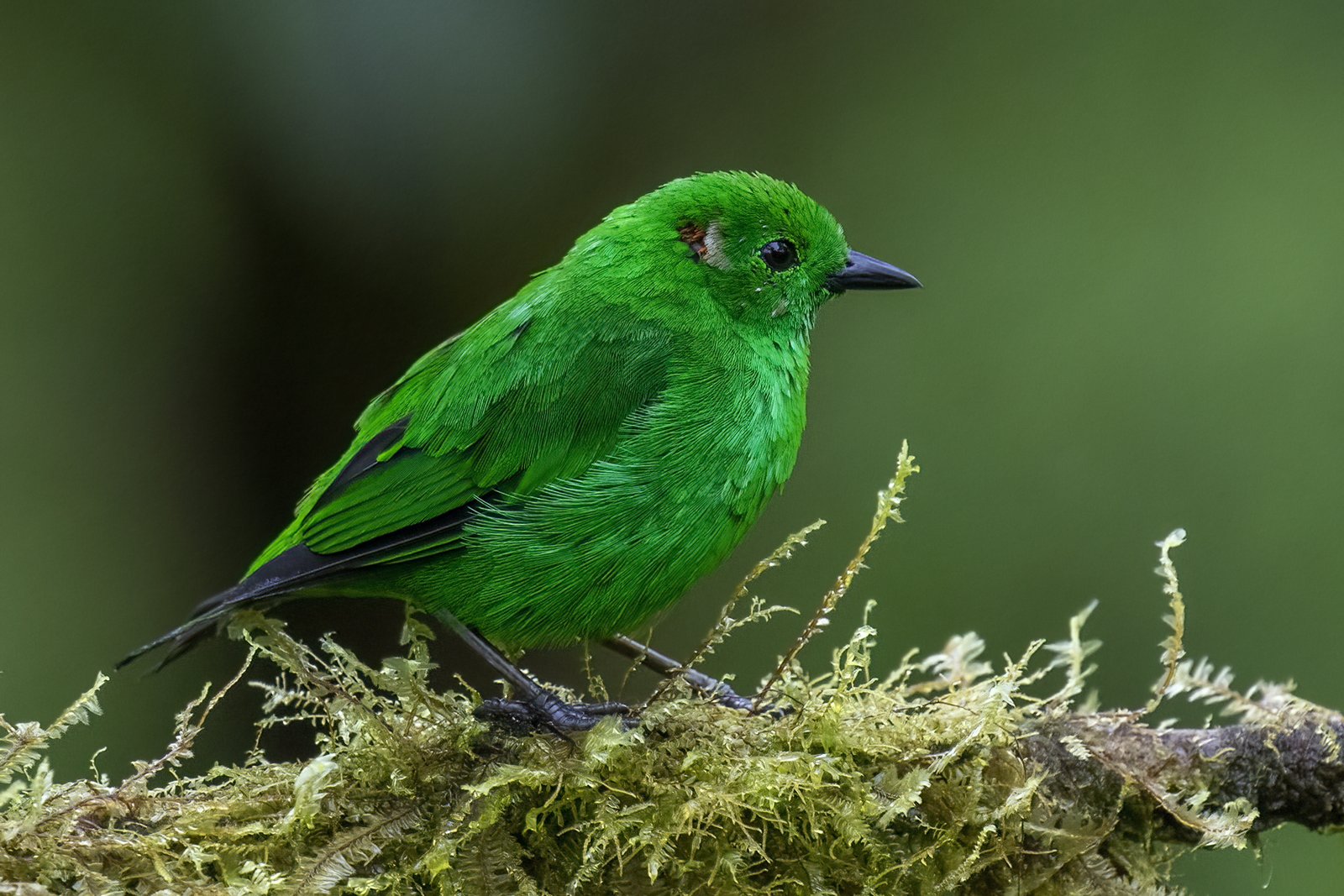
The Glistening-green Tanager is a small, almost entirely glossy emerald-green tanager of the wet, mossy forest on the Pacific slope of the Andes in Colombia and Ecuador. The Dutch name refers to the silvery-grey spots on the wing and behind the eye.
Voice
Rather quiet. Calls are thin, high tsit or tseep notes, often given while foraging in mixed flocks.
Recording: Ross Gallardy — CC BY-NC-SA 4.0 · xeno-canto
Identification
13 cm, with a short, pointed black bill. The plumage is glossy emerald-green, with a small orange tuft behind the eye and a silvery-grey patch on the ear coverts. The lesser wing coverts have silvery-grey, glossy spots. The female is slightly duller, with less grey on the wing. Juveniles are a duller green.
Confusion species
Emerald Tanager Tangara florida lives lower in the same area and is green with a yellow crown, a black ear patch and black spots on the back. Green Honeycreeper Chlorophanes spiza is larger, with a longer, curved yellow bill; the male has a black head. Metallic-green Tanager Tangara labradorides is blue-green with a black crown stripe and black shoulders.
Habitat
Very humid, mossy montane forest and cloud forest on the Pacific slope and forest edge, mostly from about 700 to 2200 m, most numerous around 1000–1800 m. It forages in pairs or small groups in the middle and upper canopy along mossy branches for insects and also takes small fruit; it travels with mixed tanager flocks. The nest is a cup set in moss.
Where the bird is most at home, classified by the vegetation units of the Andes and the west coast.


Range and movements
In Colombia on the Pacific slope of the Western Andes from Antioquia and Chocó south to Nariño. In Ecuador on the western slope of the Andes in the northwest, south to Pichincha and Cotopaxi. Does not occur in Peru, Bolivia or on the Galápagos. Not known outside the guide area.
- Resident
- dark = core range, pale = thinly spread
How and when to look
Search mixed flocks in wet forest on the Pacific slope, for example along the road to Montezuma (Tatamá) in Colombia and at Mashpi and Mindo in Ecuador; the birds often perch high along mossy branches and look dark in shade.
Conservation status
Least Concern. Rather scarce to locally fairly common within a small range; sensitive to deforestation on the Pacific slope.
Scientific name
Chlorochrysa phoenicotis | (Bonaparte, 1851)
Bonaparte described the species in 1851 as Calliste phoenicotis; because it was later moved to another genus, the author and year stand in brackets. The genus Chlorochrysa was introduced in 1851 by Bonaparte. The genus name comes from Greek khlōros, 'green', and khrusos, 'gold'. The species name comes from Greek phoinix, 'red', and -ōtis, '-eared', referring to the reddish ear patch. The specimen the first description was based on came from Nanegal, Pichincha, Ecuador.