All species › Passerines › Tanagers and allies › Hooded Tanager
Hooded Tanager | Nemosia pileata
Kaptangare | Tangara encapuchada | Saíra-de-chapéu-preto
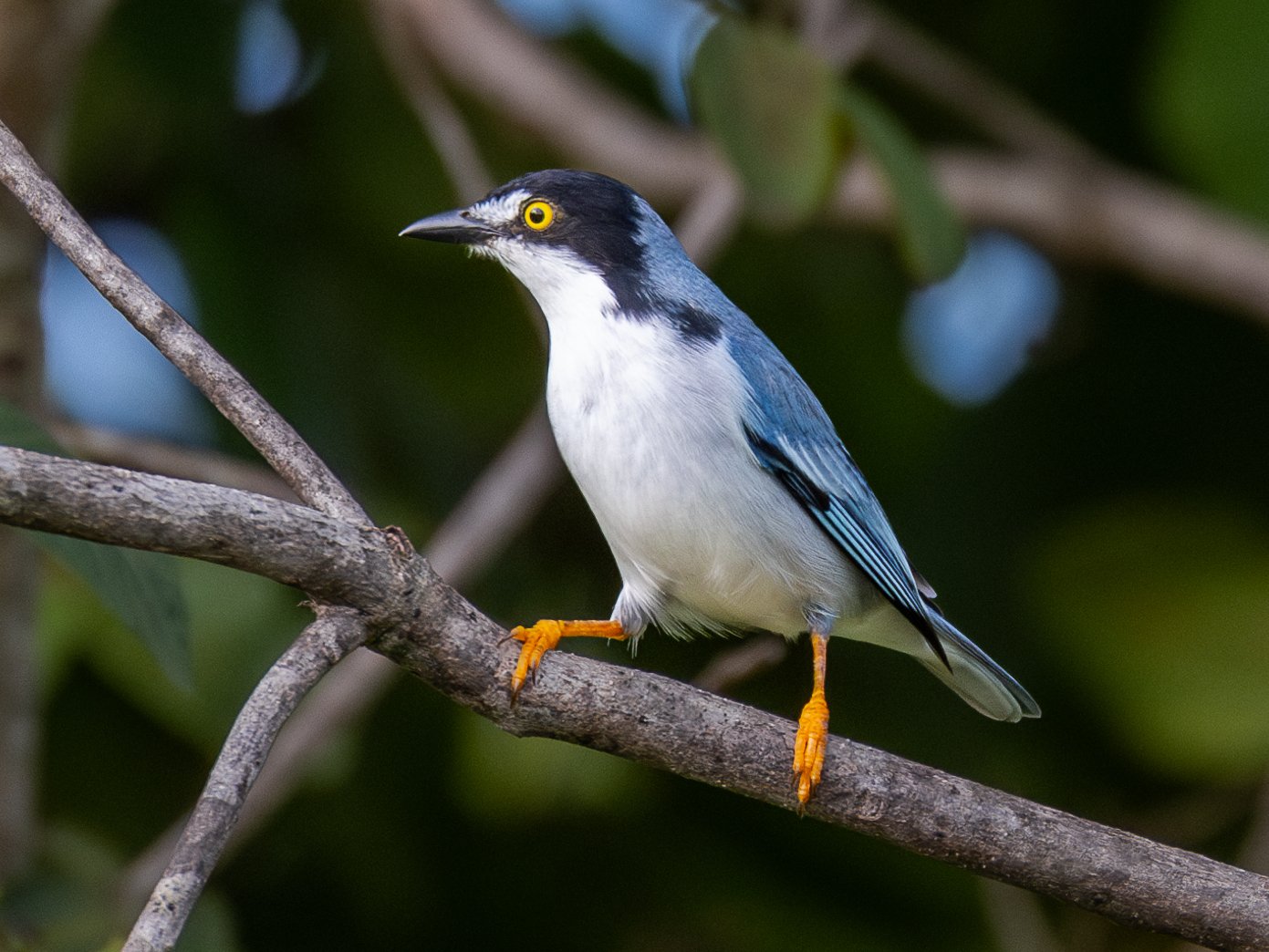
The Hooded Tanager is a small blue-grey and white tanager of open woodland, riverine forest and forest edge in the lowlands. The male has a black hood and both sexes have a striking pale yellow iris. Pairs and small groups forage quietly in the canopy for insects, often in mixed flocks.
Voice
Gives high, thin tsit notes, often in rapid series; the song is a short, dry series of high chip notes.
Recording: JAYRSON ARAUJO DE OLIVEIRA — CC BY-NC-SA 4.0 · xeno-canto
Identification
13 cm, with a short, pointed bill. The male is blue-grey above, with a black crown that extends over the cheeks and sides of the neck; the lores are white. The underparts are white. The female lacks the black: head and upperparts are grey, the underparts white with an ochre wash on the breast and flanks. Both sexes have a pale yellow iris and pale legs. Juveniles resemble the female.
Confusion species
Bicolored Conebill Conirostrum bicolor also lives on river islands, but is greyish to pale ochre below, without a black hood, and has a red iris. Male Chestnut-vented Conebill Conirostrum speciosum is blue-grey with chestnut undertail coverts and a white wing patch. Blue-grey Tanager Thraupis episcopus is larger and uniformly blue-grey, without white below.
Habitat
Canopy and edges of open, dry and semi-humid woodland, riverine forest, trees on river islands and in várzea, gallery forest in savannas and trees in parks and gardens, mainly in the lowlands up to about 500 m. It searches leaves and twigs in the canopy for insects and also eats small fruits. The nest is a small cup in a tree.
Where the bird is most at home, classified by the vegetation units of the Andes and the west coast.


Range and movements
In Colombia in the Caribbean lowlands in the north, the Magdalena Valley, the llanos and locally in the far south along the Amazon. Not known from Ecuador. In Peru mainly in the north-east along the Amazon and large rivers, and in the south-east in Madre de Dios. In Bolivia widespread in the lowlands of the north and east, into the Chaco. Does not occur on the Galápagos. Outside the guide area in Venezuela, the Guianas, much of Brazil, Paraguay and northern Argentina.
- Resident
- dark = core range, pale = thinly spread
How and when to look
Search river islands and riverside trees along the Amazon near Iquitos and Leticia, and dry forest and forest edges in northern Colombia; in mixed flocks, look for a small grey bird with white underparts and a pale yellow iris.
Conservation status
Least Concern. Widespread and locally fairly common; tolerates semi-open and disturbed woodland.
Scientific name
Nemosia pileata | (Boddaert, 1783)
Boddaert described the species in 1783 as Tanagra pileata; because it was later moved to another genus, the author and year stand in brackets. The genus Nemosia was introduced in 1816 by Vieillot. The genus name comes from Greek nemos, 'glade, dell'. The species name comes from Latin pileatus, 'capped', after the male's black cap. The specimen the first description was based on came from Cayenne, French Guiana.