All species › Passerines › Tanagers and allies › Vegetarian Finch
Vegetarian Finch | Platyspiza crassirostris
Vegetarische boomvink | Pinzón vegetariano | Tentilhão-vegetariano
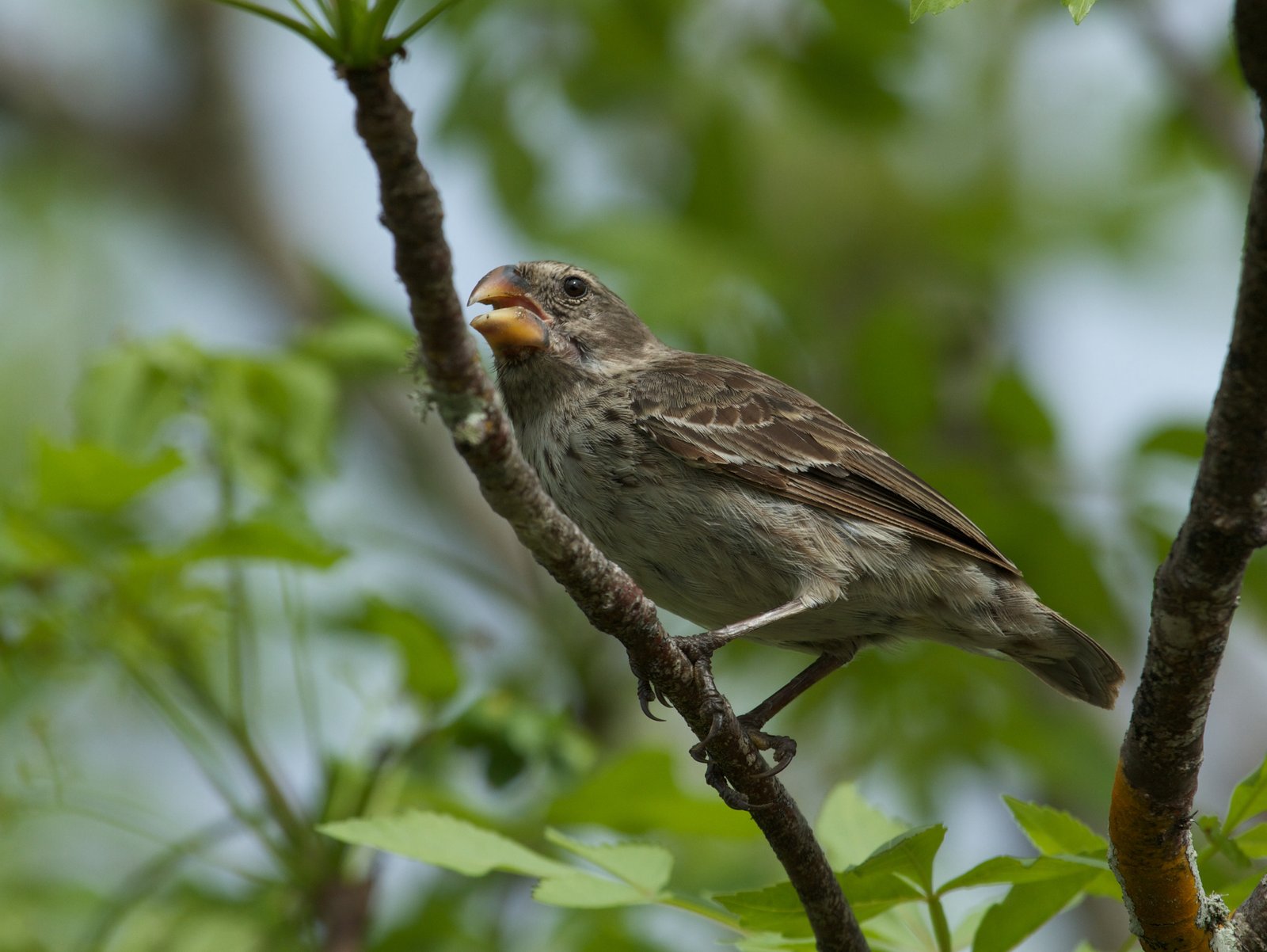
The Vegetarian Finch is one of the largest Darwin's finches, with a very short, deep, parrot-like bill. Unlike most of its relatives it feeds mainly on plant material: buds, leaves, flowers and fruit. It lives in the trees of the transition zone and highland forest of the larger islands.
Voice
The song is a drawn-out, nasal whistle lasting about two seconds, such as whee-ee-oo. The call is high and squealing, and there is also a whining pheep.
Recording: Edison Ocaña — CC BY-NC-SA 4.0 · xeno-canto
Identification
16 cm, bulky, with a short, very thick and deep bill with a curved culmen. The adult male has a black head, throat and breast and a dark olive-brown back; the belly is dingy white to pale yellow, and the bill is black in the breeding season. The female and juveniles are olive-brown above and paler below, with brown streaking on the breast and flanks, and have a pale, horn-coloured bill. Young males gradually become blacker.
Confusion species
Large Tree Finch Camarhynchus psittacula also has a parrot-like bill, but it is less deep and short; males have at most a blackish head and throat and plain, unstreaked underparts. Small Tree Finch Camarhynchus parvulus is much smaller. Medium Ground Finch Geospiza fortis has a conical bill without a strongly curved culmen, and males are entirely black.
Habitat
Mainly the transition zone and evergreen highland forest, including Scalesia forest, but also the humid zone and the arid lowland zone, from sea level to about 500 m. It usually forages in trees and shrubs for buds, leaves, flowers and fruit, strips bark from twigs to reach the tissue beneath and occasionally eats caterpillars; it sometimes feeds on the ground.
Where the bird is most at home, classified by the vegetation units of the Andes and the west coast.


Range and movements
Endemic to the Galápagos, on San Cristóbal, Santa Cruz, Isabela, Fernandina, Santiago, Marchena and Pinta. It has disappeared from Pinzón, Santa Fe and Floreana; on Floreana the last single birds were reported in 2004 and 2008. Absent from mainland Colombia, Ecuador, Peru and Bolivia.
- Resident
How and when to look
In the transition zone and highlands of Santa Cruz, for example around Los Gemelos, where birds move slowly through trees and shrubs eating buds and leaves. The drawn-out, nasal song often reveals them before they are seen.
Conservation status
Least Concern. The population appears stable but has not been counted; threats include fires, overgrazing by domestic and feral animals and introduced species.
Scientific name
Platyspiza crassirostris | (Gould, 1837)
Gould described the species in 1837 as Camarhynchus crassirostris; because it was later moved to another genus, the author and year stand in brackets. The genus Platyspiza was introduced in 1897 by Ridgway. The genus name comes from Ancient Greek platus, 'broad', and spiza, 'finch'. The species name comes from Latin crassus, 'thick', and -rostris, '-billed', referring to the heavy bill. The specimen the first description was based on came from Galápagos Islands.