All species › Passerines › Tanagers and allies › Scarlet-breasted Dacnis
Scarlet-breasted Dacnis | Dacnis berlepschi
Roodborstpitpit | Dacnis pechiescarlata | Saí-de-peito-escarlate
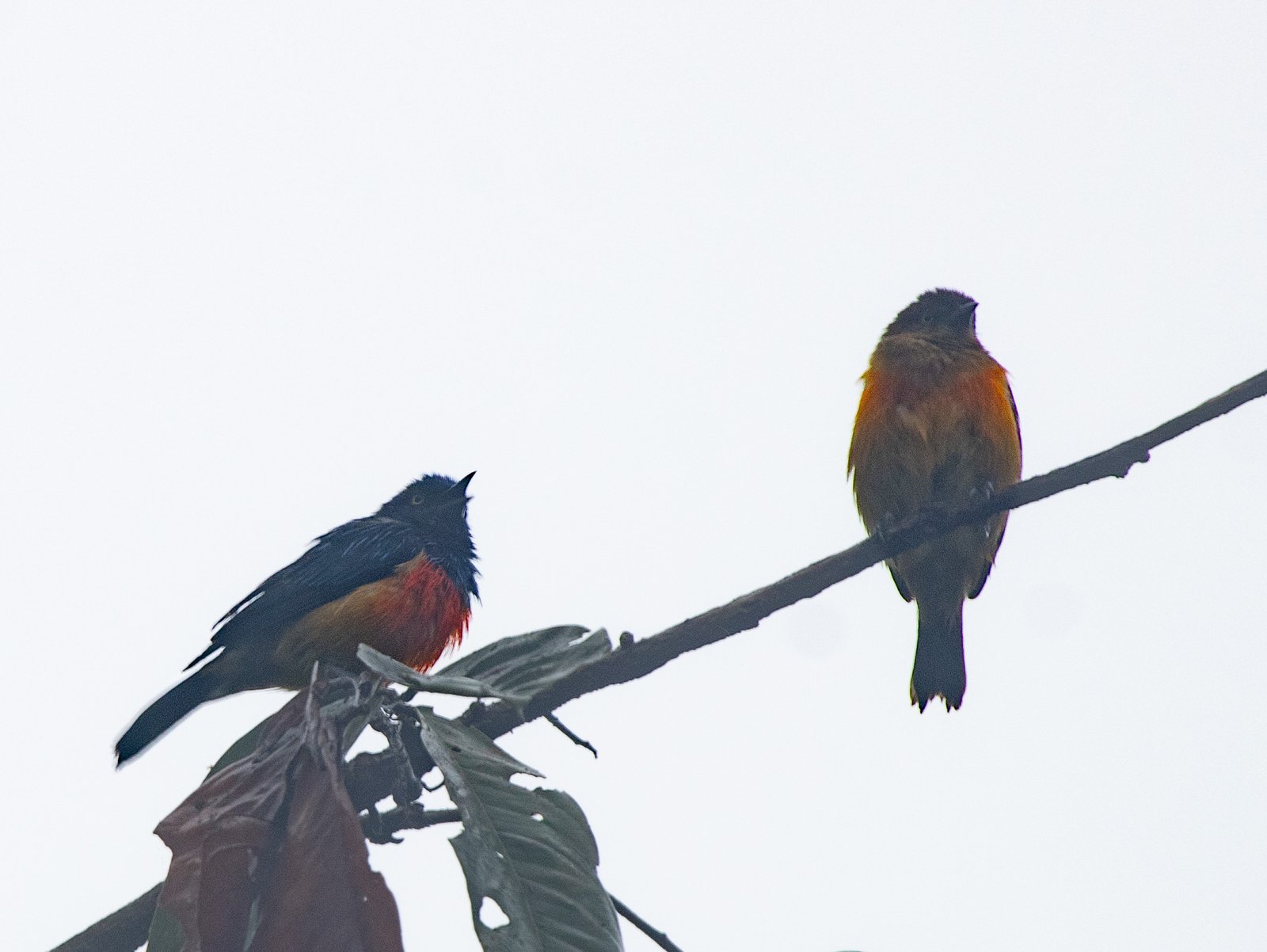
The Scarlet-breasted Dacnis lives only in the Chocó lowlands of south-western Colombia and north-western Ecuador. The male combines a blue head and back with silvery streaks, a broad red breast band and a pale belly; the brown female also has a red breast. Pairs and small groups forage in the canopy, often with mixed tanager flocks.
Voice
High, thin tsit calls; the song is a short series of high notes and is inconspicuous.
Recording: Iván Lau — CC BY-NC-SA 4.0 · xeno-canto
Identification
12 cm, with a short, pointed, dark bill and yellow eyes. The male has a hyacinth-blue head with a small black mask from the lores to just behind the eye; the back and scapulars are blue with silvery streaks, the rump paler blue and unstreaked. A broad red band crosses the breast, fading to yellow below; the belly is whitish buff. The female is brown to dark sepia-brown above, with a red to reddish-orange wash on the breast, rusty buff on the lower belly, rusty-brown flanks and a buffy-white belly.
Confusion species
Unmistakable because of the red breast in both sexes. Male Scarlet-thighed Dacnis Dacnis venusta is black below, with red only on the thighs. Male Blue Dacnis Dacnis cayana is turquoise-blue without red and the female is green.
Habitat
Canopy and edges of humid lowland and foothill forest, tall secondary forest and trees in clearings, in Colombia up to about 1000 m and in Ecuador up to about 600 m. It eats small fruits and insects, often in mixed canopy flocks. Little is known about its breeding biology.
Where the bird is most at home, classified by the vegetation units of the Andes and the west coast.


Range and movements
In Colombia only in the south-west, in Nariño. In Ecuador in the north-west, south to central Los Ríos province. Absent from Peru and Bolivia and from the Galápagos. Does not occur outside the guide area.
- Resident
- dark = core range, pale = thinly spread
How and when to look
Search forest remnants and edges in the lowlands and foothills of Esmeraldas in north-western Ecuador, at fruiting trees where mixed tanager flocks feed.
Conservation status
Least Concern according to the 2025 assessment; the species was previously listed as Vulnerable. The population is unknown and probably declining because of extensive deforestation in the Chocó lowlands of Ecuador and Colombia.
Scientific name
Dacnis berlepschi | Hartert, 1900
Hartert described the species in 1900 and placed it straight away in the genus where it still stands. The genus Dacnis was introduced in 1816 by Cuvier, GLCFD. The genus name comes from Greek daknis, an unidentified bird from Egypt mentioned by Hesychius of Alexandria and Festus. The specific name honours Hans Hermann Carl Ludwig Graf von Berlepsch (1850–1915), German ornithologist and collector specialising in Neotropical birds. The specimen the first description was based on came from Lita, Ecuador.