All species › Passerines › Tanagers and allies › Viridian Dacnis
Viridian Dacnis | Dacnis viguieri
Blauwgroene pitpit | Dacnis verdoso | Saí-verde-azulado
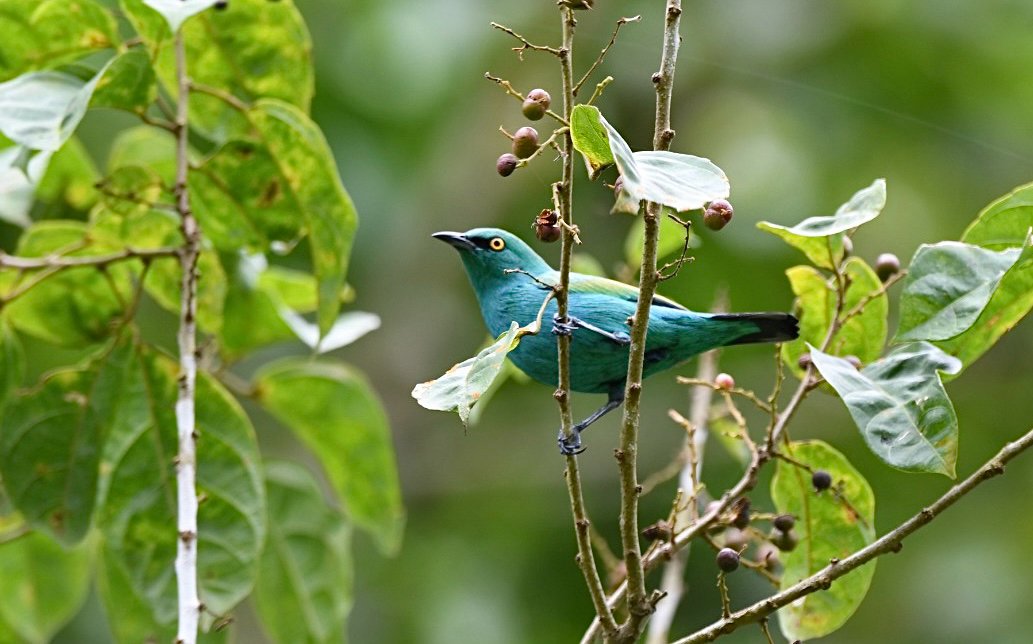
The Viridian Dacnis is a dacnis with a small range in eastern Panama and the extreme north-west of Colombia. The male is a shining greenish turquoise, with a black mask, black back and yellow eyes. Within the guide area it is known only from the Colombian Chocó and the area around the Gulf of Urabá, where it is scarce.
Voice
Poorly known. Thin, high tsip calls, similar to those of other dacnises.
Recording: Carlos Bran — CC BY-NC-SA 4.0 · xeno-canto
Identification
11–12 cm, with a short, pointed, dark bill and yellow eyes. The male is shining greenish turquoise, with black lores, a black centre to the back and black wings and tail; the wing coverts are edged turquoise. The female is green above and paler yellowish green below, without a blue head, with dark wings edged green, and also has pale eyes.
Confusion species
Male Blue Dacnis Dacnis cayana is bluer, has a black throat patch and dark eyes; the female has a blue head. Male Scarlet-thighed Dacnis Dacnis venusta is black below. Female Green Honeycreeper Chlorophanes spiza is larger and uniformly green, with a longer, curved, yellowish bill.
Habitat
Canopy and edges of humid lowland and foothill forest and tall secondary forest, up to about 600 m. It eats small fruits and insects, alone, in pairs or in mixed canopy flocks. Little is known about its breeding biology.
Where the bird is most at home, classified by the vegetation units of the Andes and the west coast.


Range and movements
In Colombia only in the extreme north-west: northern Chocó and the area around the Gulf of Urabá. Absent from Ecuador, Peru and Bolivia, and from the Galápagos. Outside the guide area in eastern Panama (Darién).
- Resident
- dark = core range, pale = thinly spread
How and when to look
Only in north-western Colombia, at forest edges and fruiting trees in the lowlands and low foothills. Check greenish dacnises with yellow eyes in mixed flocks carefully.
Conservation status
Least Concern, but with a small range and scarce. Deforestation in north-western Colombia may affect the species locally.
Scientific name
Dacnis viguieri | Oustalet, J-FÉ, 1883
Oustalet, J-FÉ described the species in 1883 and placed it straight away in the genus where it still stands. The genus Dacnis was introduced in 1816 by Cuvier, GLCFD. The genus name comes from Greek daknis, an unidentified bird from Egypt mentioned by Hesychius of Alexandria and Festus. The specific name honours Dr Camille Viguier (1850–1930), French zoologist and collector in Panama. The specimen the first description was based on came from Gulf of Darién, Panama.