All species › Passerines › Tanagers and allies › Blue Dacnis
Blue Dacnis | Dacnis cayana
Blauwe pitpit | Dacnis azul | Saí-azul
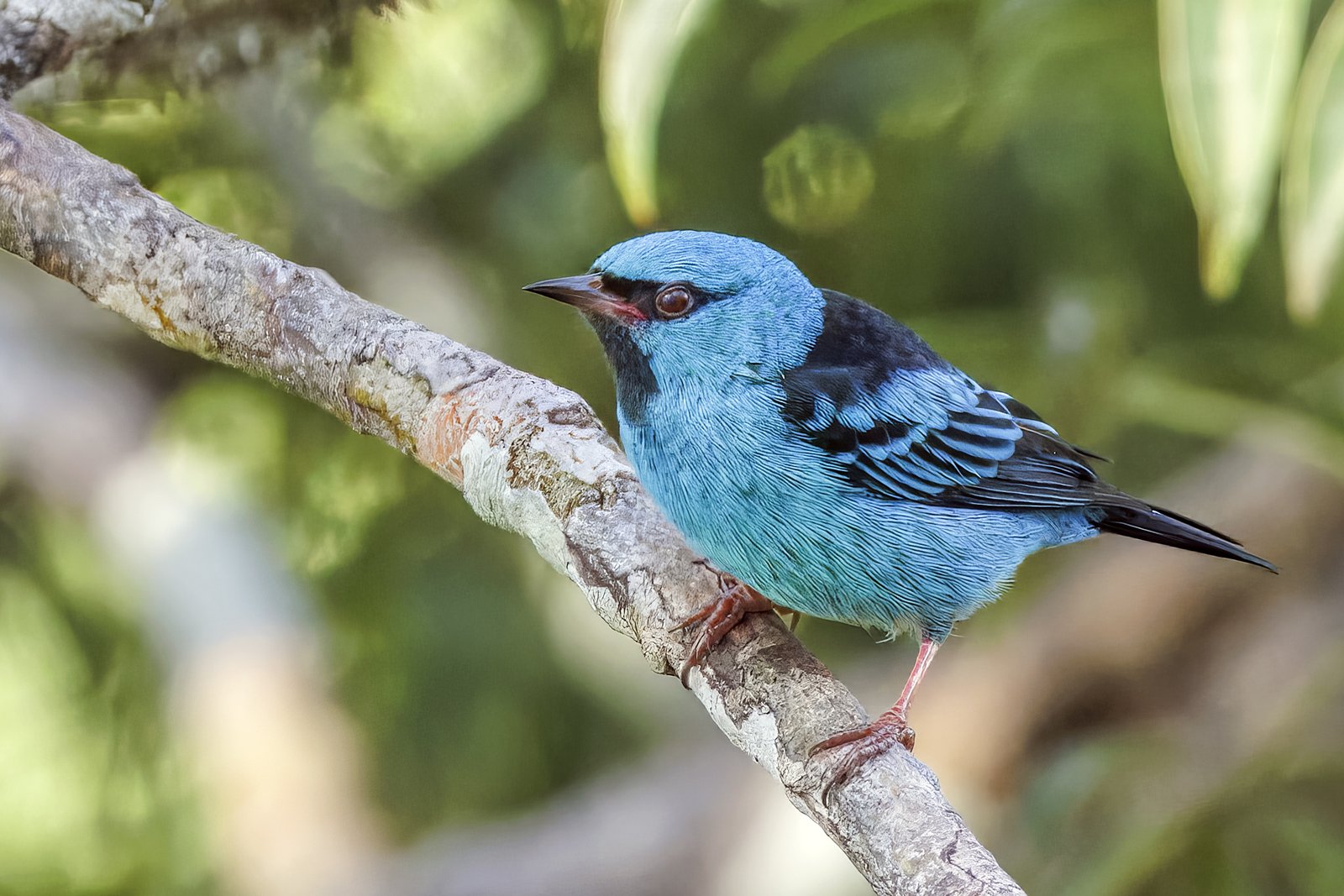
The Blue Dacnis is the most widespread dacnis of the guide area, from the Pacific lowlands to Amazonia. The turquoise-blue male with black throat and back and the green female with a blue head differ strongly. Pairs and small groups forage in the canopy and at forest edges, often in mixed flocks with tanagers and honeycreepers.
Voice
Mainly thin, high tsip and tsee calls. The song is a weak, fast series of high chips and is inconspicuous.
Recording: JAYRSON ARAUJO DE OLIVEIRA — CC BY-NC-SA 4.0 · xeno-canto
Identification
12–13 cm, with a short, pointed, dark bill. The male is bright turquoise-blue with black lores and mask, a black throat patch, a black centre to the back and black wings and tail edged blue. The female is green, paler and yellower below, with a blue-green head and a greyish throat. The eyes are dark to reddish brown. Young birds resemble the female.
Confusion species
Male Turquoise Dacnis Dacnis hartlaubi (only in the Colombian Andes) has yellow eyes and a turquoise rump. Male Scarlet-thighed Dacnis Dacnis venusta is black below with red thighs. Male Red-legged Honeycreeper Cyanerpes cyaneus is purplish blue with a long, curved bill, red legs and a pale blue crown; female honeycreepers are streaked below. Female Viridian Dacnis Dacnis viguieri lacks the blue head.
Habitat
Canopy and edges of humid forest, secondary forest, open woodland, gardens with trees and shade coffee, from sea level to about 1200 m, locally higher. It eats insects, fruit and nectar and searches leaves and twigs. The nest is a small, deep cup high in a tree.
Where the bird is most at home, classified by the vegetation units of the Andes and the west coast.


Range and movements
In Colombia widespread in the lowlands and foothills on both sides of the Andes, including the Magdalena Valley and Amazonia. In Ecuador in the western lowlands and east of the Andes. In Peru in the Amazonian lowlands and the foothills of the eastern slope. In Bolivia in the north and east of the lowlands. Absent from the Galápagos. Outside the guide area from Honduras to north-eastern Argentina and south-eastern Brazil.
- Resident
- dark = core range, pale = thinly spread
How and when to look
At forest edges, fruiting trees and lodge gardens, watch for groups of small birds in the canopy; the Blue Dacnis often travels with tanagers and honeycreepers there.
Conservation status
Least Concern. Widespread and fairly common; it tolerates secondary forest and semi-open country with trees.
Scientific name
Dacnis cayana | (Linnaeus, 1766)
Linnaeus described the species in 1766 as Motacilla cayana; because it was later moved to another genus, the author and year stand in brackets. The genus Dacnis was introduced in 1816 by Cuvier, GLCFD. The genus name comes from Greek daknis, an unidentified bird from Egypt mentioned by Hesychius of Alexandria and Festus. The specific name refers to Cayenne in French Guiana. The specimen the first description was based on came from Cayenne, French Guiana.