All species › Passerines › Tanagers and allies › Scarlet-thighed Dacnis
Scarlet-thighed Dacnis | Dacnis venusta
Rooddijpitpit | Dacnis muslirrojo | Saí-de-coxa-escarlate
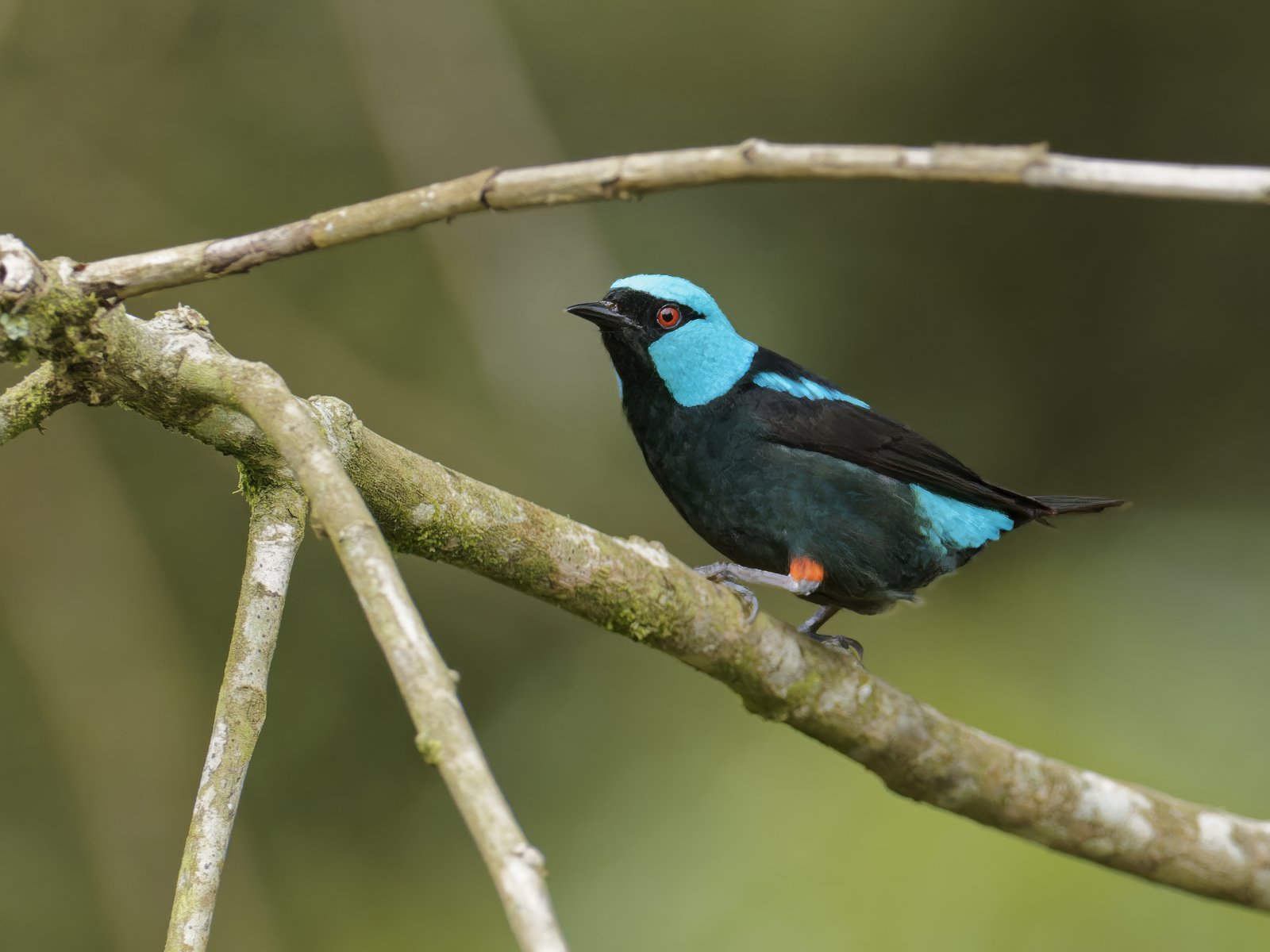
The Scarlet-thighed Dacnis is the largest dacnis of the guide area and occurs west of the Andes, in Colombia and Ecuador. The male is turquoise-blue above and black below, with red thighs that are often hidden under the wings. Pairs forage in the canopy and at forest edges, regularly in mixed flocks with tanagers.
Voice
Thin, high tsip calls; the song is a short series of high, fast notes and is inconspicuous.
Recording: William Adsett — CC BY-NC-SA 4.0 · xeno-canto
Identification
12–13 cm, with a short, pointed, dark bill and red eyes. The male has a bright turquoise-blue crown, nape, sides of the back, scapulars and rump; the lores, throat and underparts are black, the thighs scarlet. The wings and tail are black. The female is dull blue-green above, with a blue tinge on the head and back, and dingy buff to greyish buff below; the thighs are pinkish red but rarely visible. Young birds resemble the female.
Confusion species
Male Blue Dacnis Dacnis cayana is blue rather than black below and lacks red thighs. Male Scarlet-breasted Dacnis Dacnis berlepschi has a red breast band and a pale belly. Male Red-legged Honeycreeper Cyanerpes cyaneus is purplish blue with red legs and a long, curved bill.
Habitat
Canopy and edges of humid forest, lower cloud forest, tall secondary forest and trees in semi-open country, from the lowlands to about 1500 m. It eats small fruits and insects, often in mixed canopy flocks, and visits fruiting trees. The nest is a small cup in a tree.
Where the bird is most at home, classified by the vegetation units of the Andes and the west coast.


Range and movements
In Colombia west of the Andes: in the Pacific lowlands, on the western slope of the Western Andes and in the north-west of the country. In Ecuador in the north-west, in the lowlands and foothills. Absent east of the Andes, from Peru and Bolivia and from the Galápagos. Outside the guide area in Costa Rica and Panama.
- Resident
- dark = core range, pale = thinly spread
How and when to look
Search forest edges and fruiting trees in the foothills of north-western Ecuador and western Colombia, where mixed tanager flocks move through the canopy.
Conservation status
Least Concern. Locally fairly common, but dependent on forest and affected by deforestation in the lowlands and foothills west of the Andes.
Scientific name
Dacnis venusta | Lawrence, 1862
Lawrence described the species in 1862 and placed it straight away in the genus where it still stands. The genus Dacnis was introduced in 1816 by Cuvier, GLCFD. The genus name comes from Greek daknis, an unidentified bird from Egypt mentioned by Hesychius of Alexandria and Festus. The specific name comes from Latin venustus, 'lovely, charming', from venus, 'loveliness'. The specimen the first description was based on came from Panama Railroad, Panama.