All species › Passerines › Tanagers and allies › Turquoise Dacnis
Turquoise Dacnis | Dacnis hartlaubi
Turkooispitpit | Dacnis turquesa | Saí-turquesa
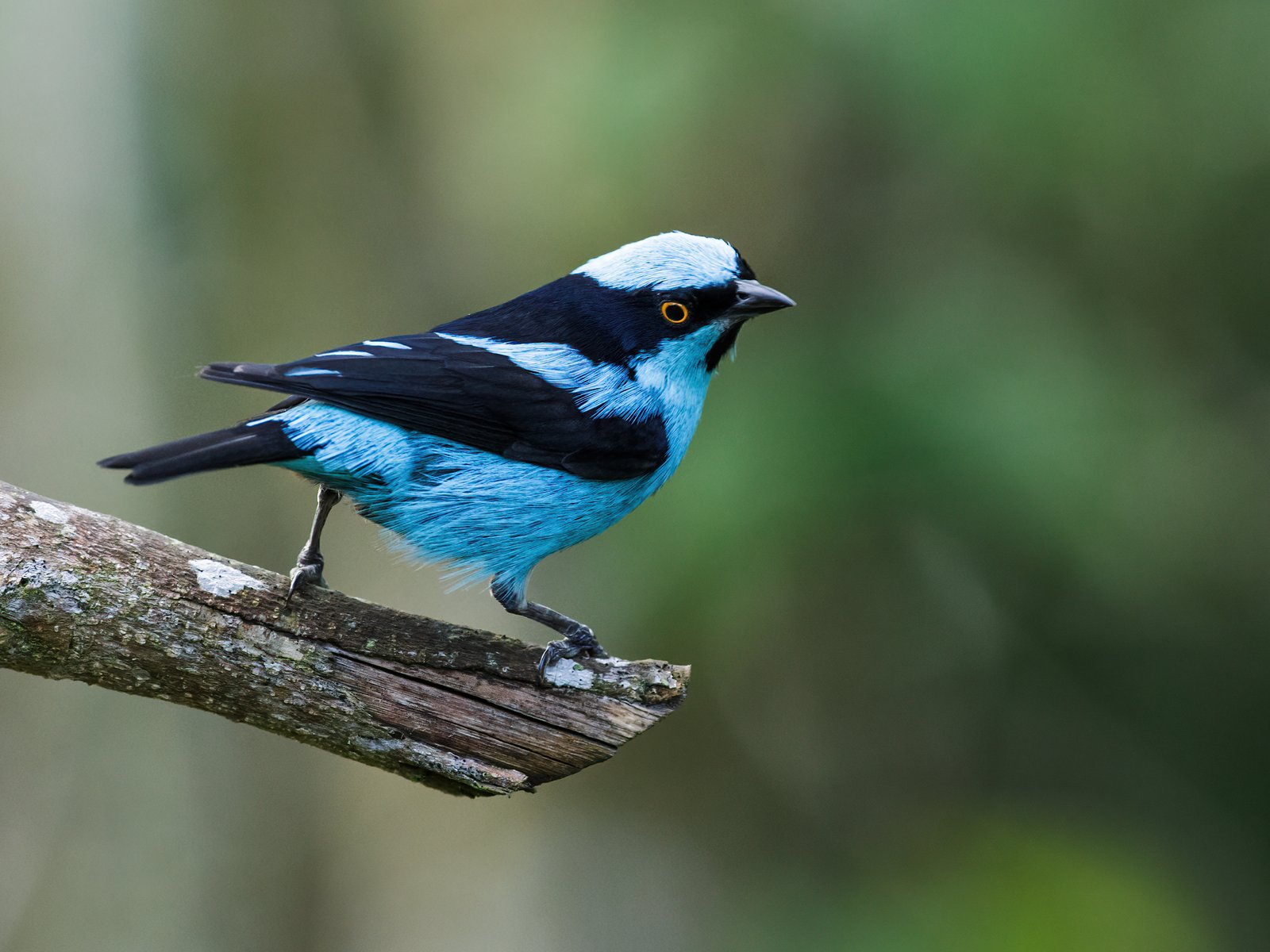
The Turquoise Dacnis occurs only in Colombia, scattered at a few sites in the three Andean ranges. The male is turquoise with a black mask, a black mantle and bright yellow eyes. The species lives mainly at forest edges and in shade coffee at middle elevations, a zone that has largely been deforested.
Voice
The song begins with three high, thin, buzzy notes followed by a high trill. The call is a high, flat, single note.
Recording: Julian Andres Zuleta Marín — CC BY-NC-SA 3.0 · xeno-canto
Identification
11–11.5 cm, with a short, blackish bill. The male has a black mask from the base of the bill to behind the eye and around the hindneck, a thin black throat patch and a black mantle; the rest of the head, the scapulars, the sides of the back, the rump and the underparts are turquoise. The wings and tail are black with blue edges. The eyes are bright yellow. The female is brownish above, pale greyish buff on the throat and breast and slightly yellower on the belly, with orange-yellow eyes.
Confusion species
Male Blue Dacnis Dacnis cayana has dark eyes, a larger black throat patch and a black centre to the back down to the rump; the female is green with a blue head. Male Black-faced Dacnis Dacnis lineata lives lower, has a black back and a white or yellow belly. The female resembles female conebills such as Chestnut-vented Conebill Conirostrum speciosum, but the eyes are paler.
Habitat
Edges of humid evergreen montane forest, secondary forest, tree lines and shade coffee, between about 1000 and 2200 m. It forages in the canopy for small fruits and insects, often in pairs and sometimes in mixed flocks.
Where the bird is most at home, classified by the vegetation units of the Andes and the west coast.


Range and movements
Only in Colombia, locally on the slopes of the Western, Central and Eastern Andes. Absent from Ecuador, Peru and Bolivia, and from the Galápagos. Does not occur outside the guide area.
- Resident
- dark = core range, pale = thinly spread
How and when to look
Search forest edges and shade coffee plantations at middle elevations in the Colombian Andes, at fruiting trees where tanagers feed. Note the yellow eyes of both sexes.
Conservation status
Near Threatened. The population is estimated at 2500 to 10,000 mature individuals and is declining through loss and degradation of mid-elevation forest. The species occurs in a few protected areas.
Scientific name
Dacnis hartlaubi | Sclater, 1855
Sclater described the species in 1855 and placed it straight away in the genus where it still stands. The genus Dacnis was introduced in 1816 by Cuvier, GLCFD. The genus name comes from Greek daknis, an unidentified bird from Egypt mentioned by Hesychius of Alexandria and Festus. The specific name honours Carl Johann Gustav Hartlaub (1814–1900), German physician, ornithologist and collector, co-founder of the Journal für Ornithologie. The specimen the first description was based on came from La Cumbre, Valle del Cauca, Colombia.