All species › Passerines › Tanagers and allies › Yellow-bellied Dacnis
Yellow-bellied Dacnis | Dacnis flaviventer
Geelbuikpitpit | Dacnis ventriamarillo | Saí-amarela
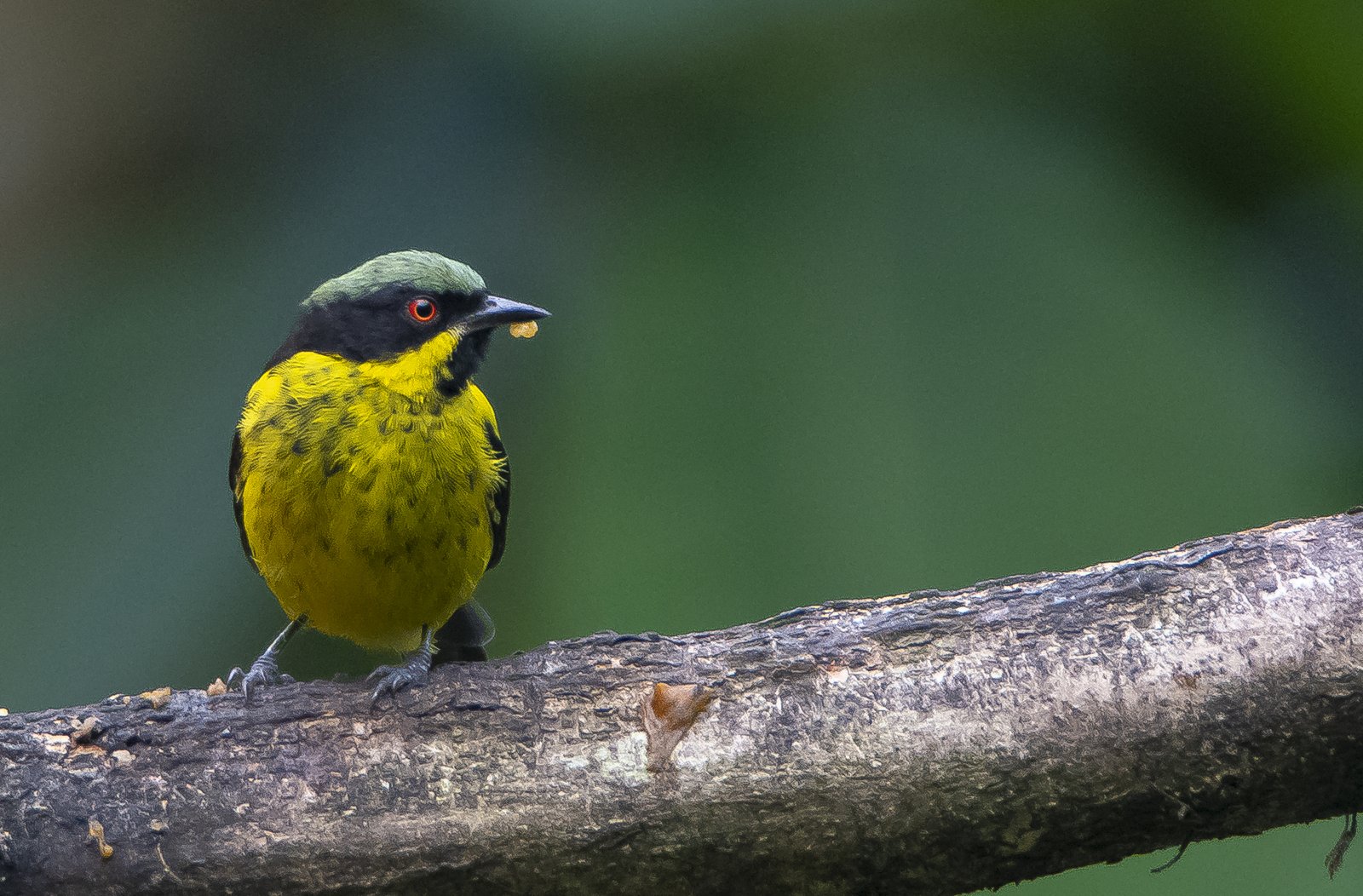
The Yellow-bellied Dacnis is a dacnis of Amazonian flooded forest and riverbanks, the male of which is black and yellow rather than blue. It has red eyes, unlike the yellow eyes of several relatives. Pairs forage in the canopy and at forest edges, often in mixed flocks.
Voice
Thin, high tsip calls and a soft, fast series of chips.
Recording: JAYRSON ARAUJO DE OLIVEIRA — CC BY-NC-SA 4.0 · xeno-canto
Identification
12–13 cm, with a short, pointed, dark bill and red eyes. The male has a dull olive crown, a black face and throat, a black back, wings and tail, and yellow shoulders and rump. The underparts are bright yellow with black mottling on the sides of the breast. The female is dull olive-brown above and dingy yellowish brown below, with faint mottling on the breast, and also has red eyes. Young birds resemble the female.
Confusion species
Among the dacnises the male is unmistakable because of the black-and-yellow plumage with red eyes. Yellow-backed Tanager Hemithraupis flavicollis has a yellow throat and dark eyes and is greyish white below. Females can be confused with those of Black-faced Dacnis Dacnis lineata, which have yellow eyes, and of Blue Dacnis Dacnis cayana, which are green with a blue head.
Habitat
Canopy and edges of várzea and flooded forest, forest on river islands, riverine woodland and secondary forest, less in terra firme, mostly below 600 m. It eats small fruits and insects, alone or in pairs and often in mixed flocks. Little is known about its breeding biology.
Where the bird is most at home, classified by the vegetation units of the Andes and the west coast.


Range and movements
In Colombia in the lowlands east of the Andes, in Amazonia and the southern Orinoco plains. In Ecuador and Peru in the Amazonian lowlands. In Bolivia in the north and centre of the lowlands. Absent from the Galápagos. Outside the guide area in southern and eastern Venezuela and Amazonian Brazil.
- Resident
- dark = core range, pale = thinly spread
How and when to look
Along Amazonian rivers, on boat trips past várzea and river islands, and from canopy towers at riverside lodges. Watch the tops of trees at the water's edge.
Conservation status
Least Concern. Widespread but mostly scarce to fairly common; riverine forests are under pressure from logging and farming in parts of Amazonia.
Scientific name
Dacnis flaviventer | d'Orbigny, ACVMD & de Lafresnaye, 1837
D'Orbigny, ACVMD & de Lafresnaye described the species in 1837 and placed it straight away in the genus where it still stands. The genus Dacnis was introduced in 1816 by Cuvier, GLCFD. The genus name comes from Greek daknis, an unidentified bird from Egypt mentioned by Hesychius of Alexandria and Festus. The specific name comes from Latin flavus, 'yellow', and venter, 'belly': yellow-bellied. The specimen the first description was based on came from Yuracarés, Bolivia.