All species › Passerines › Tanagers and allies › Black-faced Dacnis
Black-faced Dacnis | Dacnis lineata
Zwartmaskerpitpit | Dacnis carinegro | Saí-de-máscara-preta
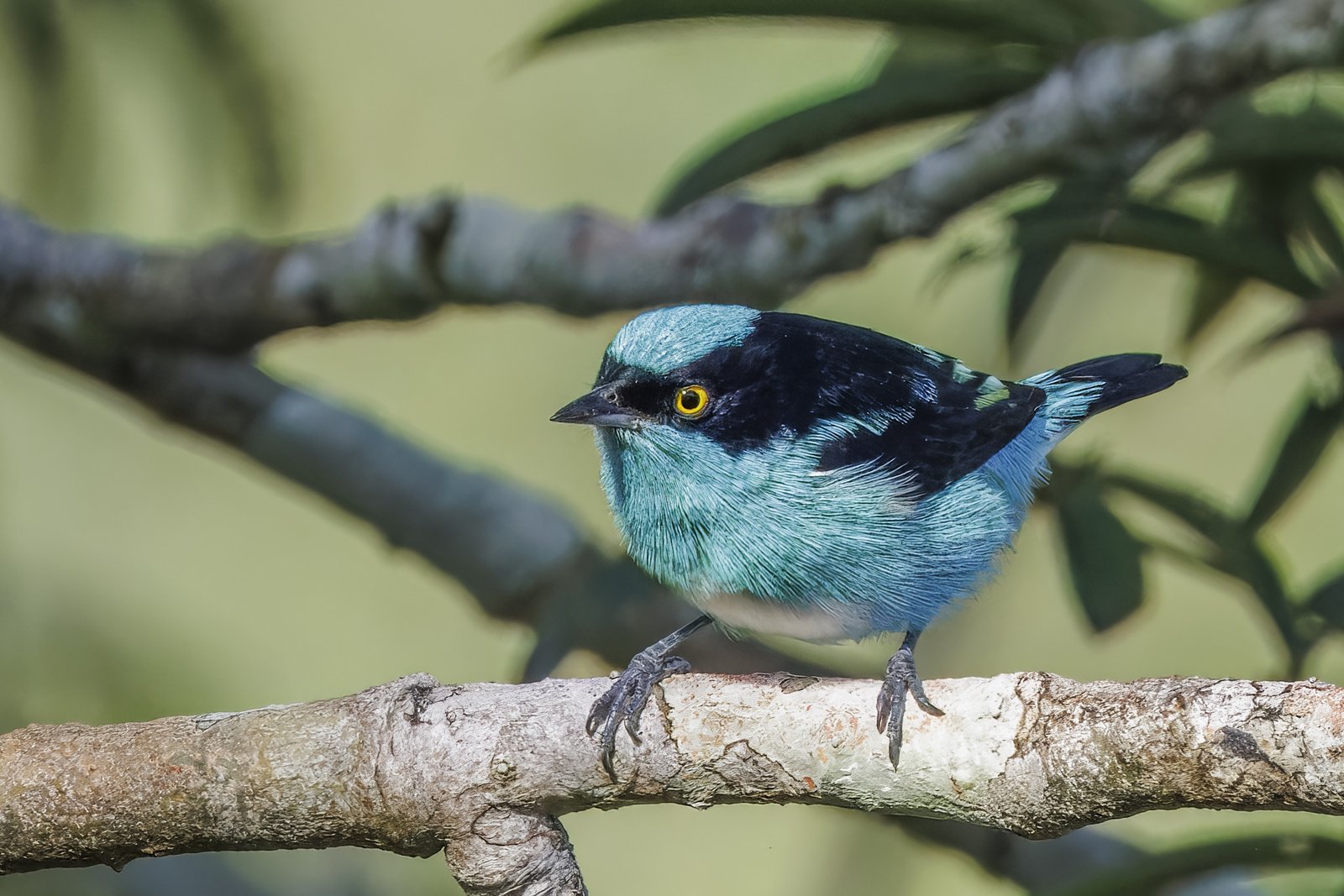
The Black-faced Dacnis is a small canopy dacnis with bright yellow eyes that occurs both in Amazonia and west of the Andes. Birds east of the Andes have a white belly; those to the west have a yellow belly with yellow tufts on the sides of the breast and are sometimes treated as a separate species (Dacnis egregia). Pairs travel with mixed flocks in the canopy.
Voice
Thin, high tsit calls; the song is a series of fast, high chips and is inconspicuous.
Recording: JAYRSON ARAUJO DE OLIVEIRA — CC BY-NC-SA 4.0 · xeno-canto
Identification
11–12 cm, with a short, pointed bill and yellow eyes. The male has a black mask, a black back, and black wings and tail; the crown, nape, shoulders and rump are turquoise-blue. The belly is white in birds east of the Andes and yellow, with yellow tufts on the sides of the breast, in birds to the west. The female is dull olive-brown above and greyish olive below, with a paler belly (yellowish in the west) and also has yellow eyes.
Confusion species
Male Blue Dacnis Dacnis cayana is mostly blue with dark eyes and a black throat patch, without a black mask across the whole face. White-bellied Dacnis Dacnis albiventris has an entirely blue head, back and breast. Male Yellow-bellied Dacnis Dacnis flaviventer has red eyes, a black throat and an olive crown. The female resembles females of other dacnises, but the yellow eyes help.
Habitat
Canopy and edges of humid lowland forest, both terra firme and várzea, and of foothill forest; also tall secondary forest and trees in clearings, up to about 1000 m. It eats small fruits and insects and visits flowering and fruiting trees. The nest is a small cup high in a tree.
Where the bird is most at home, classified by the vegetation units of the Andes and the west coast.


Range and movements
In Colombia east of the Andes in Amazonia, and west of the Andes in the north and west of the country, including the Magdalena Valley (yellow-bellied form). In Ecuador in the western lowlands (yellow-bellied form) and east of the Andes. In Peru and Bolivia in the Amazonian lowlands and the foothills of the eastern slope. Absent from the Galápagos. Outside the guide area in Venezuela, the Guianas and Amazonian Brazil.
- Resident
- dark = core range, pale = thinly spread
How and when to look
Search from canopy towers and at forest edges near fruiting trees; the yellow eyes and black mask of the male stand out first in the canopy.
Conservation status
Not Evaluated in the current species limits. The species is widespread and locally fairly common; the western form suffers from lowland deforestation in western Colombia and western Ecuador.
Scientific name
Dacnis lineata | (Gmelin, 1789)
Gmelin described the species in 1789 as Motacilla lineata; because it was later moved to another genus, the author and year stand in brackets. The genus Dacnis was introduced in 1816 by Cuvier, GLCFD. The genus name comes from Greek daknis, an unidentified bird from Egypt mentioned by Hesychius of Alexandria and Festus. The specific name comes from Latin lineatus, 'lined, striped'. The specimen the first description was based on came from Cayenne, French Guiana.