All species › Passerines › Tanagers and allies › White-bellied Dacnis
White-bellied Dacnis | Dacnis albiventris
Witbuikpitpit | Dacnis ventriblanco | Saí-de-barriga-branca
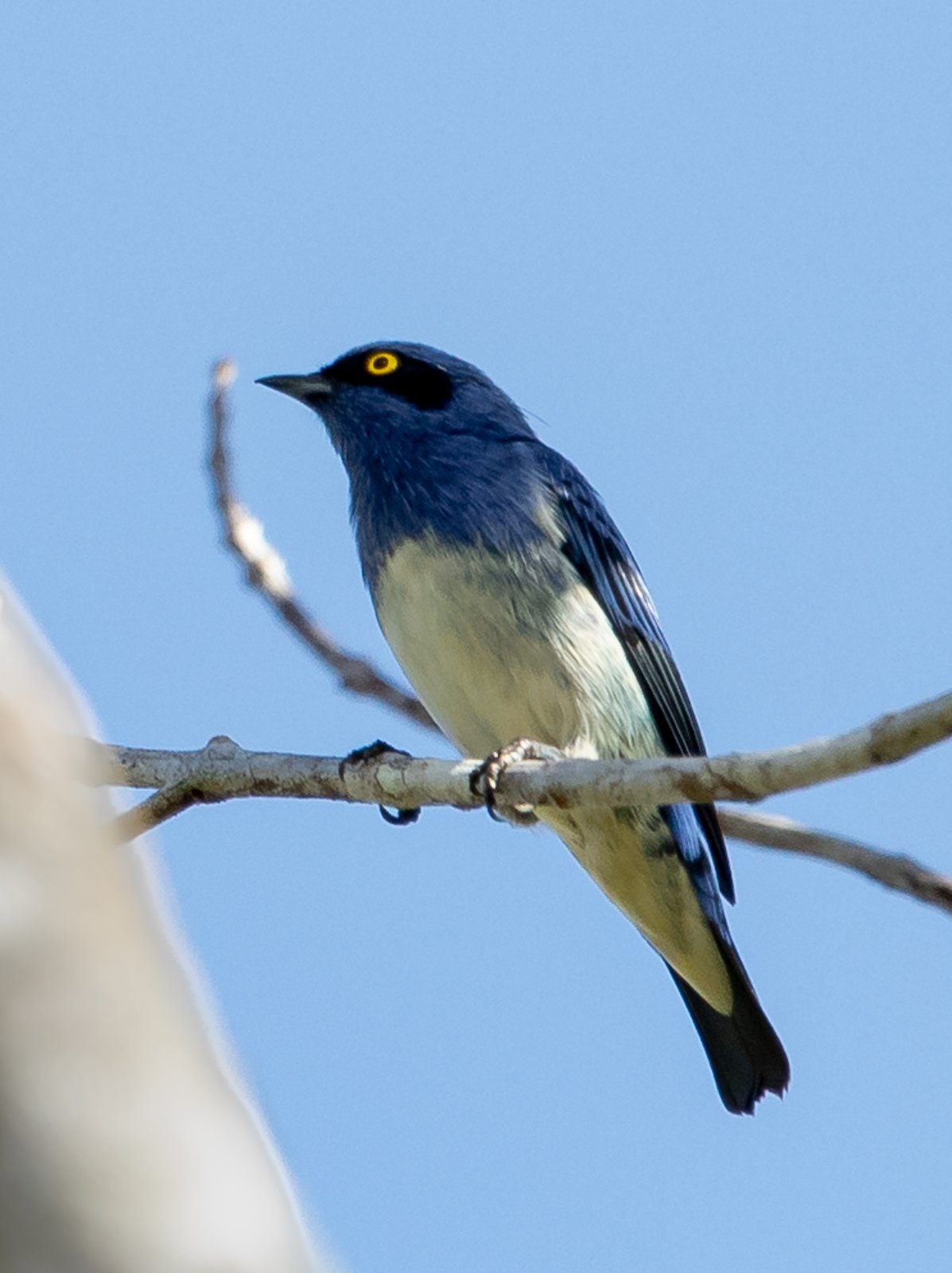
The White-bellied Dacnis is a small, rarely recorded dacnis of the Amazonian forest canopy. The male is deep cobalt blue with a black mask, yellow eyes and a white belly. It is reported sporadically and irregularly and seems to wander locally, possibly following flowering or fruiting trees.
Voice
Poorly known. Thin, high tsip calls, similar to those of other dacnises.
Recording: Daniel F. Lane — CC BY-NC-SA 4.0 · xeno-canto
Identification
11–12 cm, with a short, pointed, dark bill. The male has a deep cobalt-blue head, back, throat and breast, a narrow black mask through the yellow eyes, a white belly with greyish flanks and black wings and tail edged blue. The female is green above and yellowish green below, with a paler throat and belly and pale eyes. Young birds resemble the female.
Confusion species
Male Black-faced Dacnis Dacnis lineata has a black back and a larger black mask, with turquoise-blue only on the crown, shoulders and rump. Male Blue Dacnis Dacnis cayana is paler turquoise-blue with a black throat and dark eyes, and is blue throughout below. The female resembles female Blue Dacnis but lacks the blue head.
Habitat
Canopy and edges of humid lowland forest on terra firme and in várzea, also tall secondary forest and trees at forest edges and along rivers, mostly below 800 m. It eats small fruits, insects and probably nectar, often in mixed canopy flocks. Little is known about its breeding biology.
Where the bird is most at home, classified by the vegetation units of the Andes and the west coast.


Range and movements
In Colombia in Amazonia in the south-east. In Ecuador in the lowlands east of the Andes. In Peru at scattered sites in the Amazonian lowlands. Only a few records are known from Bolivia. Absent from the Galápagos. Outside the guide area in southern Venezuela and Amazonian Brazil. Scarce and local throughout; records vary from year to year.
- Resident
- dark = core range, pale = thinly spread
How and when to look
From canopy towers and walkways in the Amazonian lowlands of Ecuador and Peru, at flowering and fruiting trees where dacnises and honeycreepers gather. Check every cobalt-blue male with a white belly carefully.
Conservation status
Least Concern. Scarce and scattered throughout; because of its large range in largely intact forest it is not considered threatened.
Scientific name
Dacnis albiventris | (Sclater, 1852)
Sclater described the species in 1852 as Pipraeidea albiventris; because it was later moved to another genus, the author and year stand in brackets. The genus Dacnis was introduced in 1816 by Cuvier, GLCFD. The genus name comes from Greek daknis, an unidentified bird from Egypt mentioned by Hesychius of Alexandria and Festus. The specific name comes from Latin albus, 'white', and venter, 'belly': white-bellied. The specimen the first description was based on came from Bogotá, Colombia.