All species › Passerines › Tanagers and allies › Orange-throated Tanager
Orange-throated Tanager | Wetmorethraupis sterrhopteron
Oranjekeeltangare | Tangara golinaranja | Sanhaço-de-garganta-laranja
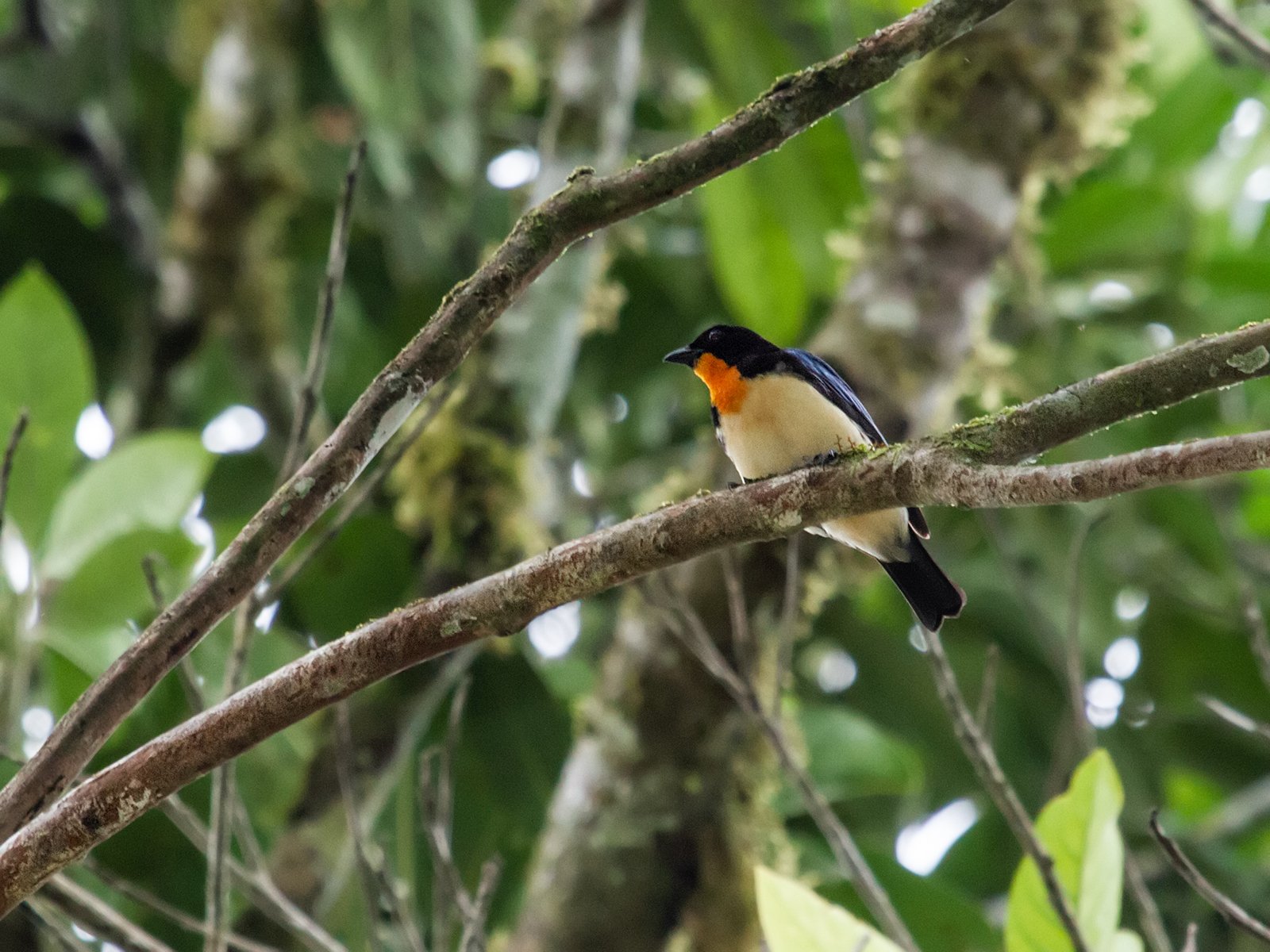
The Orange-throated Tanager is a large, black, blue and orange tanager with a small range in the hills around the Cordillera del Cóndor and the middle Marañón, on the border of Ecuador and Peru. It was described only in 1963 and is the only species of the genus Wetmorethraupis. Pairs and small groups live in the canopy of humid foothill forest.
Voice
Groups give clear, penetrating calls and short series of high notes, often high in the canopy.
Recording: Peter de Rouw — CC BY-NC-SA 4.0 · xeno-canto
Identification
18 cm, with a fairly thick, dark bill. The head, back and tail are black; the wings and shoulders are violet-blue. The throat and upper breast are bright orange, the rest of the underparts yellow to buffy yellow. The sexes are alike.
Confusion species
Within its range no other tanager combines a black back, blue wings and an orange throat. Male Fulvous Shrike-Tanager Lanio fulvus has a black head and an ochre-brown body, but a black throat and no blue in the wings. Masked Crimson Tanager Ramphocelus nigrogularis is red and black and lives lower, along water.
Habitat
Tall, humid terra firme forest and lower montane forest in the foothills, mainly between about 600 and 800 m, locally to about 1000 m. It forages in pairs or groups of up to five birds in the canopy, sometimes with mixed flocks, searching leaves, moss and small bromeliads for insects; it also eats fruit and seeds. Little is known about the nest.
Where the bird is most at home, classified by the vegetation units of the Andes and the west coast.


Range and movements
In Ecuador only in the south-east, in Zamora-Chinchipe, in the upper Nangaritza drainage. In Peru in the north, in Amazonas, in the Cenepa and Comaina valleys and the hills along the middle Marañón. Absent from Colombia, Bolivia and the Galápagos. Endemic to the guide area.
- Resident
- dark = core range, pale = thinly spread
How and when to look
Search foothill forest in the Nangaritza valley in Ecuador or in the hills along the Marañón in Amazonas, Peru; watch for groups high in the canopy and for mixed tanager flocks.
Conservation status
Vulnerable. The species has a small range within which forest is being cleared, mainly along roads; new roads and mining bring further clearance and settlement. Much of the range lies in indigenous Awajún territory.
Scientific name
Wetmorethraupis sterrhopteron | Lowery & O'Neill, 1964
Lowery & O'Neill described the species in 1964 and placed it straight away in the genus where it still stands. He introduced the genus Wetmorethraupis in that same work. The genus name honours the American ornithologist Alexander Wetmore (1886–1978), combined with the genus name Thraupis. The species name combines Greek sterrhos, 'stiff, hard', with pteron, 'feather', for the stiff flight feathers. The specimen the first description was based on came from Río Comaina and Río Cenepa, Amazonas, Peru.