All species › Passerines › Tanagers and allies › Inti Tanager
Inti Tanager | Heliothraupis oneilli
Intitangare | Tangara inti | Sanhaço-inti
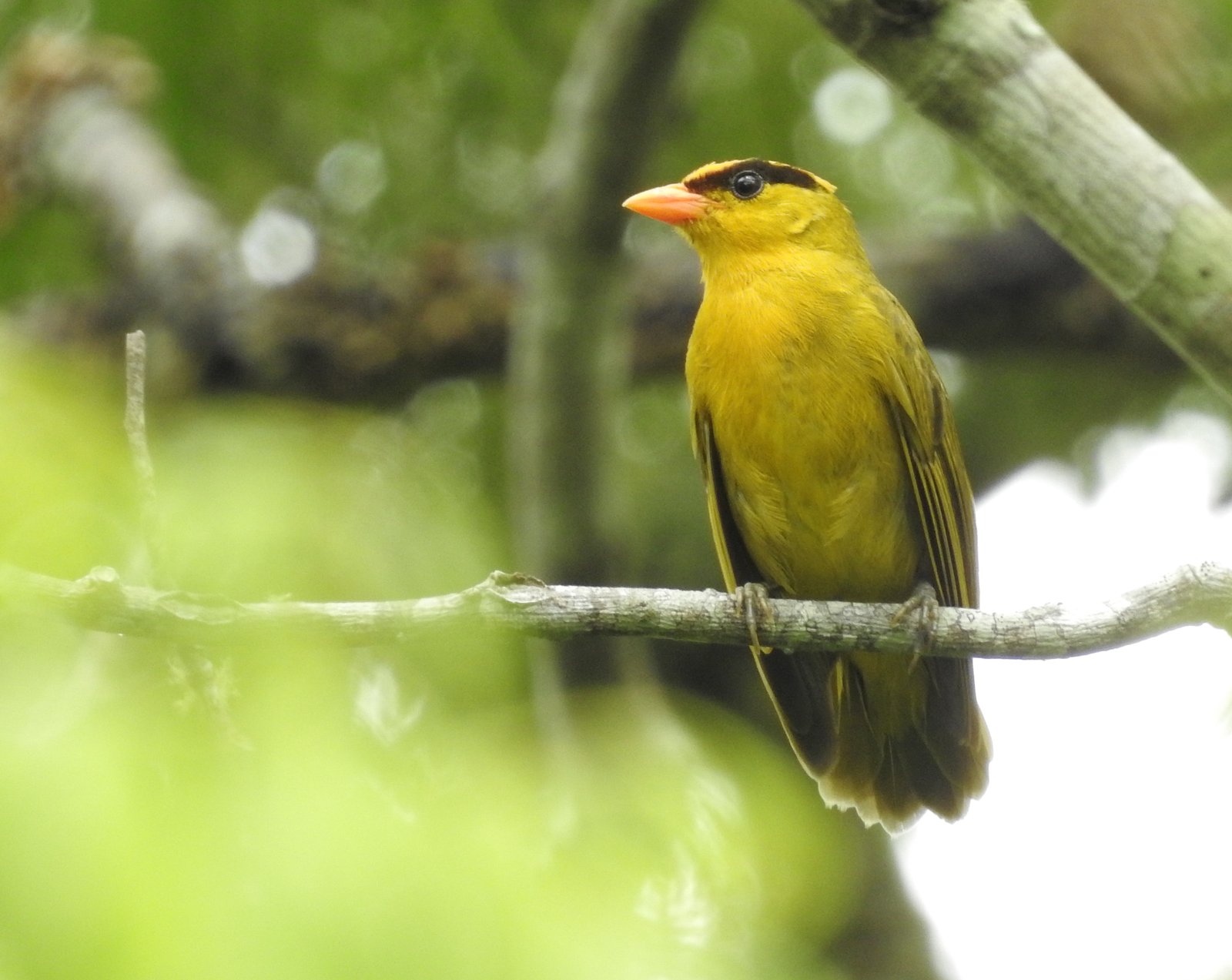
The Inti Tanager was described only in 2021, as the sole species of a new genus. The name refers to Inti, the Quechua word for sun, after its yellow plumage. It is one of the few tanagers that truly migrate: it breeds in the rainy season in a dry valley in Bolivia and then disperses along the bamboo-rich eastern slope of the Andes as far as Peru.
Voice
Both sexes give a loud, distinctive song of clear notes. It often starts singing only late in the morning and continues into the hottest hours of the day, long after the dawn chorus of most other birds.
Recording: Jacob Wijpkema — CC BY-NC-SA 4.0 · xeno-canto
Identification
About 15 cm, with a stout, salmon-pink bill. The male is mostly canary-yellow, slightly more olive on the back and wings, with a broad black supercilium and a short, bushy crest that it can raise. The female is also mostly yellow with a pink to orange bill, but lacks the black supercilium and the crest. Both sexes have yellow underwing coverts. The juvenile plumage is poorly known.
Confusion species
The salmon-pink bill and, in the male, the black supercilium separate it from other yellow birds in its range. Female Hepatic Tanager Piranga flava is larger and more olive, with a dark bill. Rust-and-yellow Tanager Thlypopsis ruficeps is smaller, with a rufous head and a dark bill. Saffron Finch Sicalis flaveola has an orange forehead and a short bill, and feeds on the ground in open country.
Habitat
Breeds in semi-deciduous forest with bamboo (Guadua) in a dry inter-Andean valley; outside the breeding season in the transition zone between lowland rainforest and montane forest on the eastern slope, often in bamboo stands, roughly between 800 and 1600 m. Its food probably consists of insects and fruit. Little is known about the nest.
Where the bird is most at home, classified by the vegetation units of the Andes and the west coast.


Range and movements
In Bolivia it breeds in the Machariapo valley north of Apolo (La Paz). Outside the breeding season it disperses along the lower eastern slope of the Andes as far as south-eastern Peru, including the Kosñipata road in Cusco. Absent from Colombia, Ecuador and the Galápagos. Does not occur outside the guide area.
- Winter visitor (c. Oct–Mar)
- dark = core range, pale = thinly spread
How and when to look
Outside the breeding season, roughly April–October, search bamboo-rich forest along the lower part of the Kosñipata road; in the rainy season it breeds in the Machariapo valley in Bolivia. Listen in particular late in the morning for the loud song.
Conservation status
Least Concern according to the current assessment, but population size, trend and distribution are still almost unknown; a Data Deficient listing has been proposed. The known breeding area in Bolivia is small.
Scientific name
Heliothraupis oneilli | Lane, Aponte J, Rheindt, Rosenberg, Schmitt & Terrill, 2021
Lane, Aponte J, Rheindt, Rosenberg, Schmitt & Terrill described the species in 2021 and placed it straight away in the genus where it still stands. The genus Heliothraupis was introduced in 2021 by Lane, Burns, Klicka & Price-Waldman. The genus name comes from Greek hēlios, 'sun', and thraupis, a small bird, after the orange-yellow plumage and the Inca sun god Inti. The species name honours the American ornithologist John P. O'Neill, who described among others Wetmorethraupis sterrhopteron. The specimen the first description was based on came from (according to the description).