All species › Passerines › Tanagers and allies › Plumbeous Sierra Finch
Plumbeous Sierra Finch | Geospizopsis unicolor
Loodkleurige sierragors | Yal plomizo | Tico-tico-serrano-plúmbeo
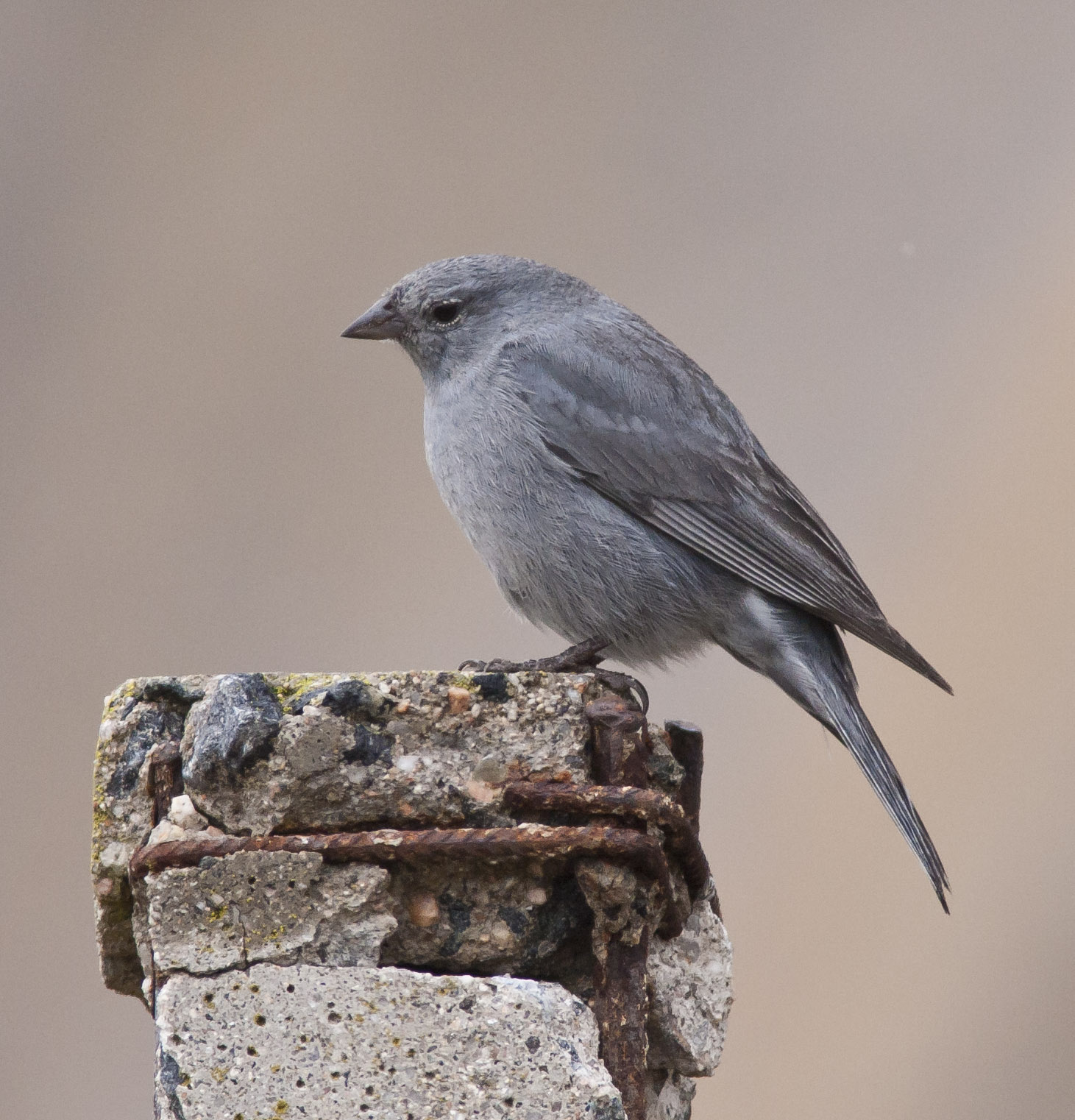
The Plumbeous Sierra Finch is a medium-sized, stocky finch of open highlands, from Colombia to Bolivia. The sexes differ strongly: the male is plain lead-grey, the female brown and heavily streaked. It lives higher than most other sierra finches, up to near the snowline.
Voice
The song is a short series of buzzy, insect-like notes, often followed by a dry trill, sometimes in a short song flight. The call is a short, metallic chip.
Recording: Cristian Pinto — CC BY-NC-SA 4.0 · xeno-canto
Identification
15 cm, with a pointed, conical, dark grey bill. The male is entirely plain slate-grey to lead-grey, slightly paler on the belly, without streaks; the wing and tail feathers are darker grey. The female is greyish brown above and creamy white below, heavily streaked dark brown throughout, including the breast and flanks. Young birds resemble the female; young males are grey with traces of streaking for some time.
Confusion species
Ash-breasted Sierra Finch Geospizopsis plebejus is smaller, with a streaked back and a whitish belly. Slaty Finch Haplospiza rustica is smaller and darker grey, with a thinner, more pointed bill, and lives in montane forest. Plain-colored Seedeater Catamenia inornata has a pink bill and a chestnut vent. The female resembles streaked females of yellow finches Sicalis, but lacks any yellow tone.
Habitat
Páramo, jalca and puna, grassland with rocks, scree slopes and the edges of boggy places, roughly between 3000 and 4800 m, locally higher. It feeds alone or in small groups on the ground on seeds and small insects. The nest is a cup of grass, hidden in a grass tussock or among stones.
Where the bird is most at home, classified by the vegetation units of the Andes and the west coast.


Range and movements
In Colombia in the highlands of all three Andean ranges and in the Sierra Nevada de Santa Marta. In Ecuador along the whole of the Andes on the páramo. In Peru widespread in the highlands. In Bolivia in the Andes and on the altiplano. Absent from the Galápagos. Outside the guide area in western Venezuela, northern Chile and Argentina.
- Resident
- dark = core range, pale = thinly spread
How and when to look
On the páramo and the puna, look for grey finches flushing from among grass tussocks or stones; grey males and streaked females are often in the same group.
Conservation status
Least Concern. Widespread and locally common; the high-altitude habitat where it lives is little converted to farmland.
Scientific name
Geospizopsis unicolor | (d'Orbigny, ACVMD & de Lafresnaye, 1837)
D'Orbigny, ACVMD & de Lafresnaye described the species in 1837 as Emberiza unicolor; because it was later moved to another genus, the author and year stand in brackets. The genus Geospizopsis was introduced in 1856 by Bonaparte. The genus name combines the genus Geospiza with Greek opsis, 'appearance': resembling Geospiza. The species name comes from Latin unicolor, 'one-coloured', after the uniformly plumbeous male. The specimen the first description was based on came from Tacora, Tacna, Peru.