All species › Passerines › Tapaculos › Narino Tapaculo
Narino Tapaculo | Scytalopus vicinior
Nariñotapaculo | Churrín de Nariño | Macuquinho-de-nariño
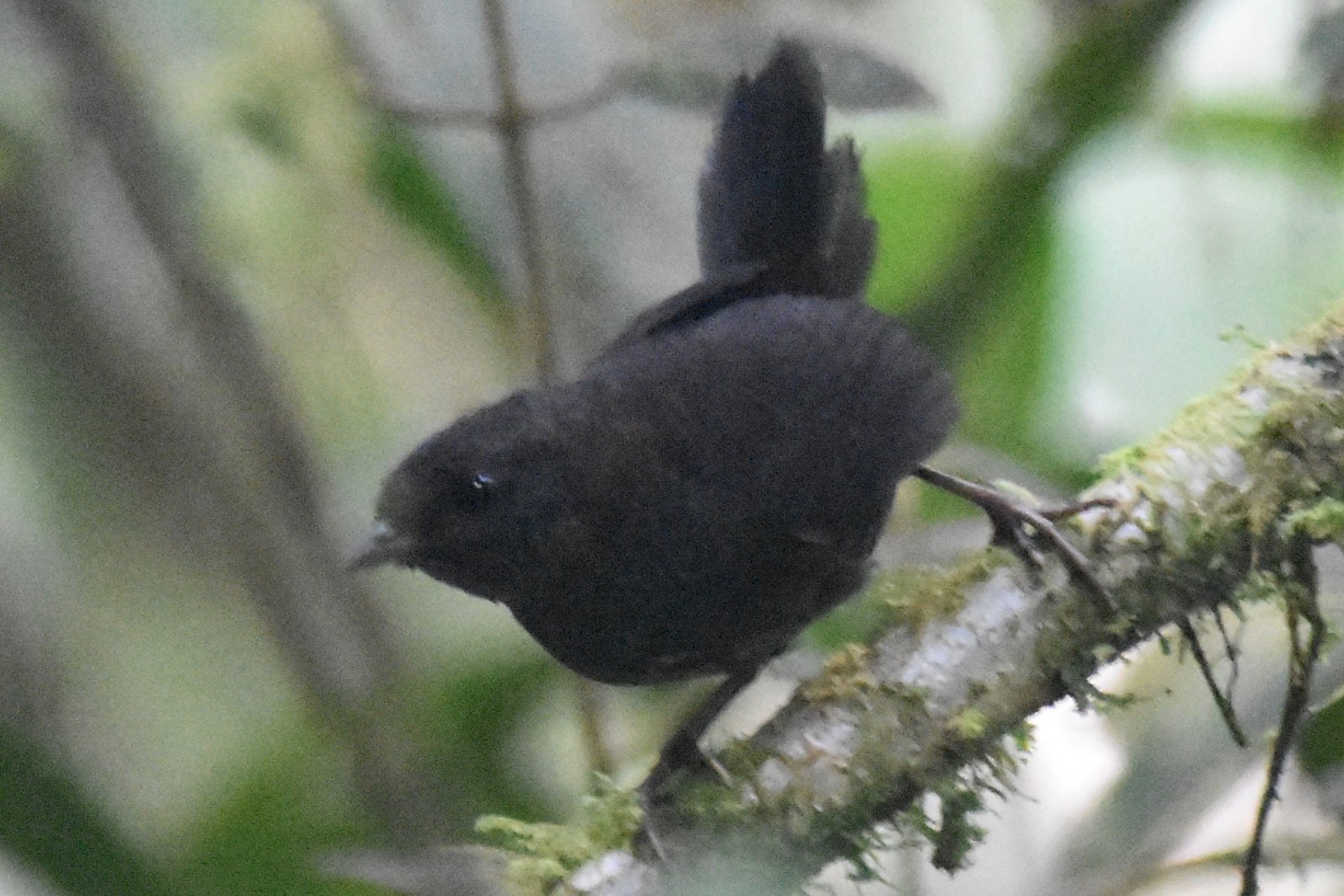
The Narino Tapaculo is a dark grey tapaculo of the understory of humid montane forest on the western slope of the Andes in south-western Colombia and north-western Ecuador. It lives in an elevational zone between the lower-living Choco Tapaculo and the higher-living Spillmann's Tapaculo. As in all tapaculos, the song is the main identification feature.
Voice
The song is a long series of rapidly repeated, identical notes from dense undergrowth, at a different pace from the related species on the same slope. Also short calls.
Recording: Daan van der Hoeven — CC BY-NC-SA 4.0 · xeno-canto
Identification
11.5 cm, round, with a short, often cocked tail, short wings and fairly long legs. The male is uniformly dark grey, with a brown rump and brown rear flanks barred dark. The female is browner above and has more brown on the flanks. Juveniles are brown with dark bars.
Confusion species
Choco Tapaculo Scytalopus chocoensis lives lower, in foothill forest, and has a different song. Spillmann's Tapaculo Scytalopus spillmanni lives higher, in cloud forest, and has a different song. Blackish Tapaculo Scytalopus latrans is blackish, without brown, barred flanks. Tatama Tapaculo Scytalopus alvarezlopezi in the Western Andes of Colombia is more blackish and sings differently.
Habitat
Understory of humid montane and cloud forest, especially in dense vegetation in ravines and along streams, also at forest edges and in old secondary forest, roughly between 1200 and 2000 m. It forages on or just above the ground for small arthropods. Little is known about its breeding.
Where the bird is most at home, classified by the vegetation units of the Andes and the west coast.


Range and movements
In Colombia on the western slope of the Western Andes, from the centre of the country south to Nariño. In Ecuador on the western slope in the north-west, roughly to Pichincha. Absent from Peru, Bolivia and the Galápagos. Does not occur outside the guide area.
- Resident
- dark = core range, pale = thinly spread
How and when to look
At middle elevations on the western slope of north-western Ecuador, for example around Mindo, and in Nariño, listen for the long series of notes from the undergrowth. Wait quietly near a gap in the vegetation.
Conservation status
Least Concern. Habitat on the western slope is cleared locally, but much forest remains and the species also lives in old secondary forest.
Scientific name
Scytalopus vicinior | Zimmer, 1939
Zimmer described the species in 1939 and placed it straight away in the genus where it still stands. The genus Scytalopus was introduced in 1837 by Gould. The genus name combines Greek skutalē or skutalon, 'stick', with pous, 'foot'. The species name comes from Latin vicinior, 'nearer', comparative of vicinus, 'neighbouring', as the form seemed closely related to another tapaculo. The specimen the first description was based on came from Ricaurte, Nariño, Colombia.