All species › Passerines › Tapaculos › Blackish Tapaculo
Blackish Tapaculo | Scytalopus latrans
Zwarte tapaculo | Churrín negruzco | Macuquinho-enegrecido
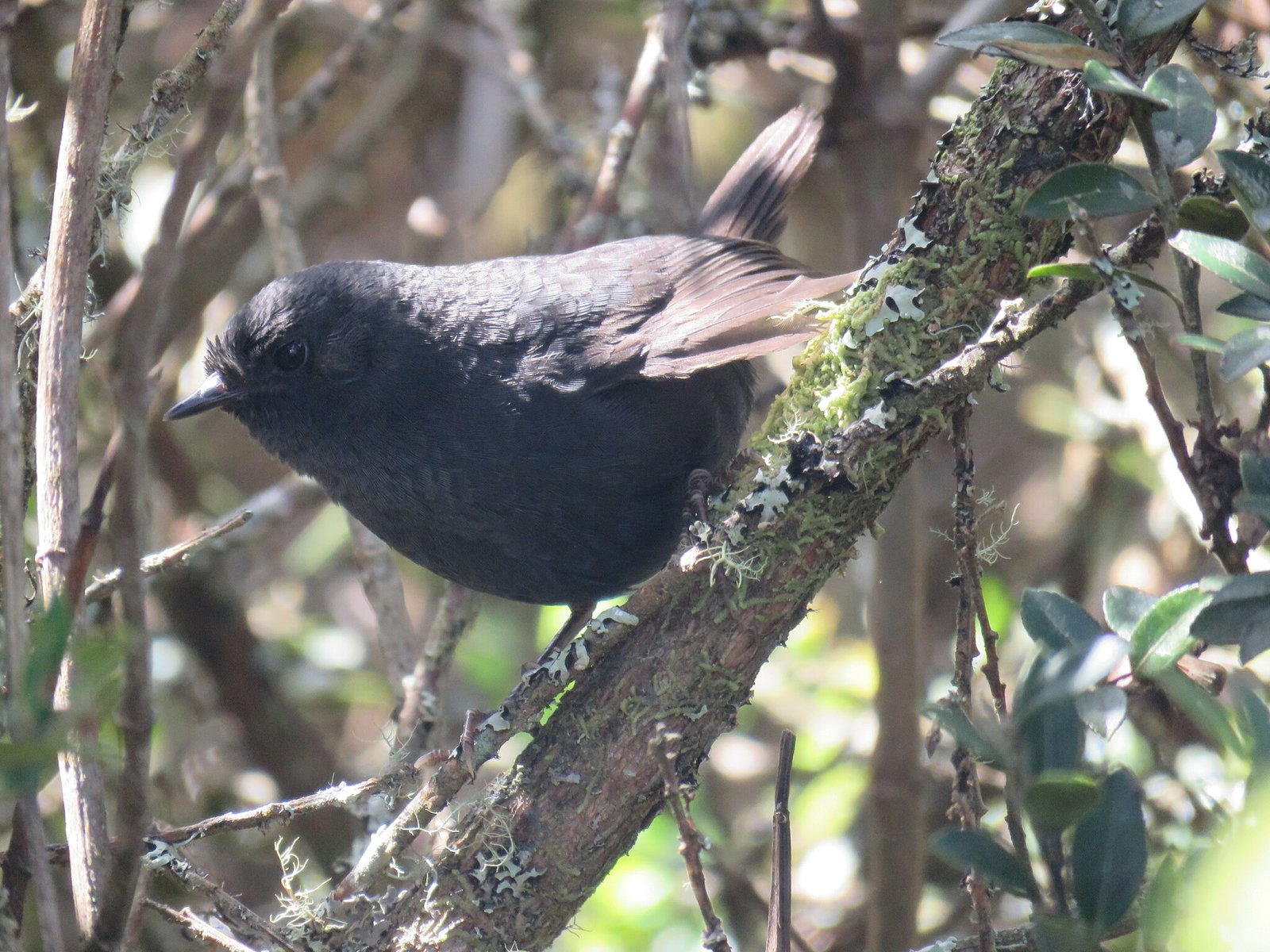
The Blackish Tapaculo is a small, almost entirely black tapaculo of the understory of humid montane forest in the northern Andes. It is one of the most widespread tapaculos of Colombia and Ecuador and also lives in forest edges, scrub and bamboo. It is heard far more often than seen.
Voice
The song is a long series of identical, low notes at an even pace, often kept up for a long time from dense vegetation. The song varies between regions. Also short, sharp calls.
Recording: Juan Freile — CC BY-NC-SA 4.0 · xeno-canto
Identification
12 cm, round, with a short, often cocked tail, short wings, a thin bill and fairly long legs. The male is almost uniformly blackish, without barred flanks. The female is dark grey with a browner tinge, especially on the rear flanks. Juveniles are brown with dark bars.
Confusion species
White-crowned Tapaculo Scytalopus atratus has a white crown spot and rufous, barred flanks. Spillmann's Tapaculo Scytalopus spillmanni is greyer, with brown, barred rear flanks. Narino Tapaculo Scytalopus vicinior and Tatama Tapaculo Scytalopus alvarezlopezi live on the western slope of the Western Andes and have a different song. In tapaculos the song is the main identification feature.
Habitat
Understory and edges of humid montane and cloud forest, old secondary forest, dense scrub, Chusquea bamboo and overgrown clearings, roughly between 1000 and 3500 m. It forages on or just above the ground for insects and other small arthropods. As in related species, the nest is placed in a cavity in an earth bank or among roots.
Where the bird is most at home, classified by the vegetation units of the Andes and the west coast.


Range and movements
In Colombia in all three Andean ranges. In Ecuador on both slopes of the Andes. In Peru only in the north, on the western slope and in northern Amazonas. Absent from Bolivia and the Galápagos. Outside the guide area in western Venezuela.
- Resident
- dark = core range, pale = thinly spread
How and when to look
Listen at forest edges and in scrub along mountain roads in Colombia and Ecuador for the long series of low notes. Wait quietly near a gap in the vegetation; the bird sometimes crosses briefly or appears on a fallen log.
Conservation status
Not Evaluated in its current taxonomic treatment. The species is widespread, also occurs in secondary growth and does not appear to be threatened.
Scientific name
Scytalopus latrans | Hellmayr, 1924
Hellmayr described the species in 1924 and placed it straight away in the genus where it still stands. The genus Scytalopus was introduced in 1837 by Gould. The genus name combines Greek skutalē or skutalon, 'stick', with pous, 'foot'. The species name comes from Latin latrans, 'barking' (latrare, 'to bark'), after its call. The specimen the first description was based on came from Cerro Munchique, Cauca, Colombia.