All species › Passerines › Tapaculos › Tschudi's Tapaculo
Tschudi's Tapaculo | Scytalopus acutirostris
Tschudi's tapaculo | Churrín de Tschudi | Tapaculo-de-tschudi
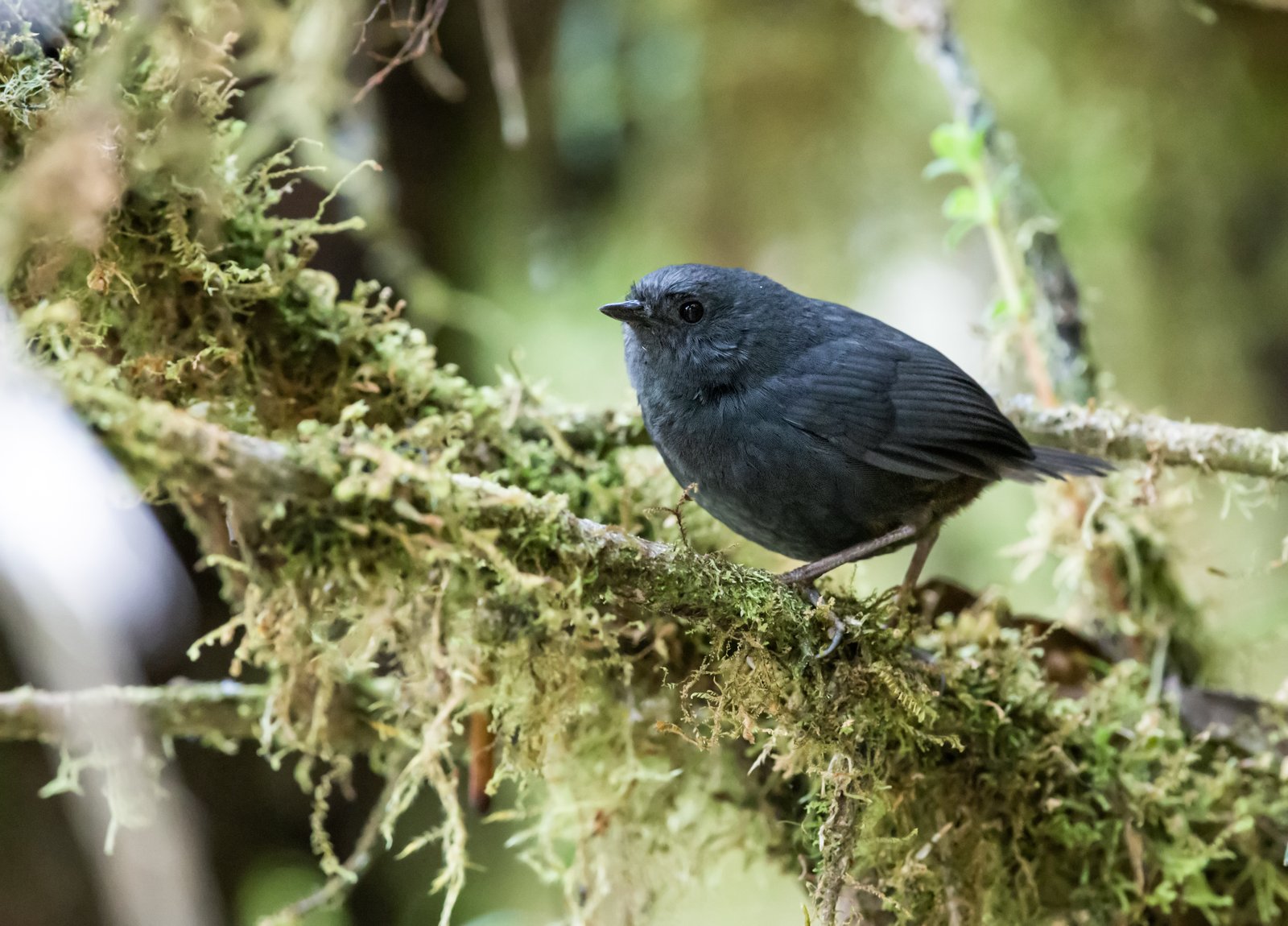
Tschudi's Tapaculo is a small, dark grey tapaculo of high-elevation cloud forest in the Peruvian Andes, with a thin, pointed bill. The species was described by Johann Jakob von Tschudi in 1844 and was later treated as a subspecies of Magellanic Tapaculo, but is again recognised as a separate species on the basis of its song.
Voice
The song is variable: short single notes or a series of notes. The call is a repeated single note.
Recording: Gunnar Engblom — CC BY-NC-SA 4.0 · xeno-canto
Identification
10.5 cm, small, with a thin, pointed bill. The male is dark grey on the upperparts and paler grey on the underparts, with a light brown wash on the flanks. The female is paler, with a brownish rump and tawny, black-barred flanks and undertail coverts. Juveniles are barred and spotted.
Confusion species
Utcubamba Tapaculo Scytalopus intermedius occurs alongside it locally, is slightly larger and has a heavier bill and a different song. Large-footed Tapaculo Scytalopus macropus is much larger and lives along streams. Rufous-vented Tapaculo Scytalopus femoralis is larger and lives lower. Jalca Tapaculo Scytalopus frankeae and Neblina Tapaculo Scytalopus altirostris live locally at similar elevations and are best separated by song.
Habitat
Undergrowth of humid cloud forest and elfin forest up to the treeline, between about 2650 and 3500 m. Unlike several other tapaculos, it is rarely found in bamboo. It searches on and just above the ground for small insects and other invertebrates. Little is known about its breeding.
Where the bird is most at home, classified by the vegetation units of the Andes and the west coast.


Range and movements
Only in Peru, on the eastern slope of the Andes, from southern Amazonas south to Junín. Absent from Colombia, Ecuador, Bolivia and the Galápagos. Does not occur outside the guide area.
- Resident
- dark = core range, pale = thinly spread
How and when to look
Listen in cloud forest just below the treeline on the eastern slope between Amazonas and Junín. The bird moves low among moss and shrubs; when in doubt, focus on the song and the pointed bill.
Conservation status
Least Concern. The range is small, but the population is believed to be large enough not to qualify as threatened.
Scientific name
Scytalopus acutirostris | (Tschudi, 1844)
Tschudi described the species in 1844 as Pteroptochus acutirostris; because it was later moved to another genus, the author and year stand in brackets. The genus Scytalopus was introduced in 1837 by Gould. The genus name combines Greek skutalē or skutalon, 'stick', with pous, 'foot'. The species name comes from Latin acutirostris, from acutus, 'sharp', and rostrum, 'bill': sharp-billed. The specimen the first description was based on came from Maraynioc, Junín, Peru.