All species › Owls › Owls › Pacific Pygmy Owl
Pacific Pygmy Owl | Glaucidium peruanum
Peruaanse dwerguil | Mochuelo del Pacífico | Caburé-do-pacífico
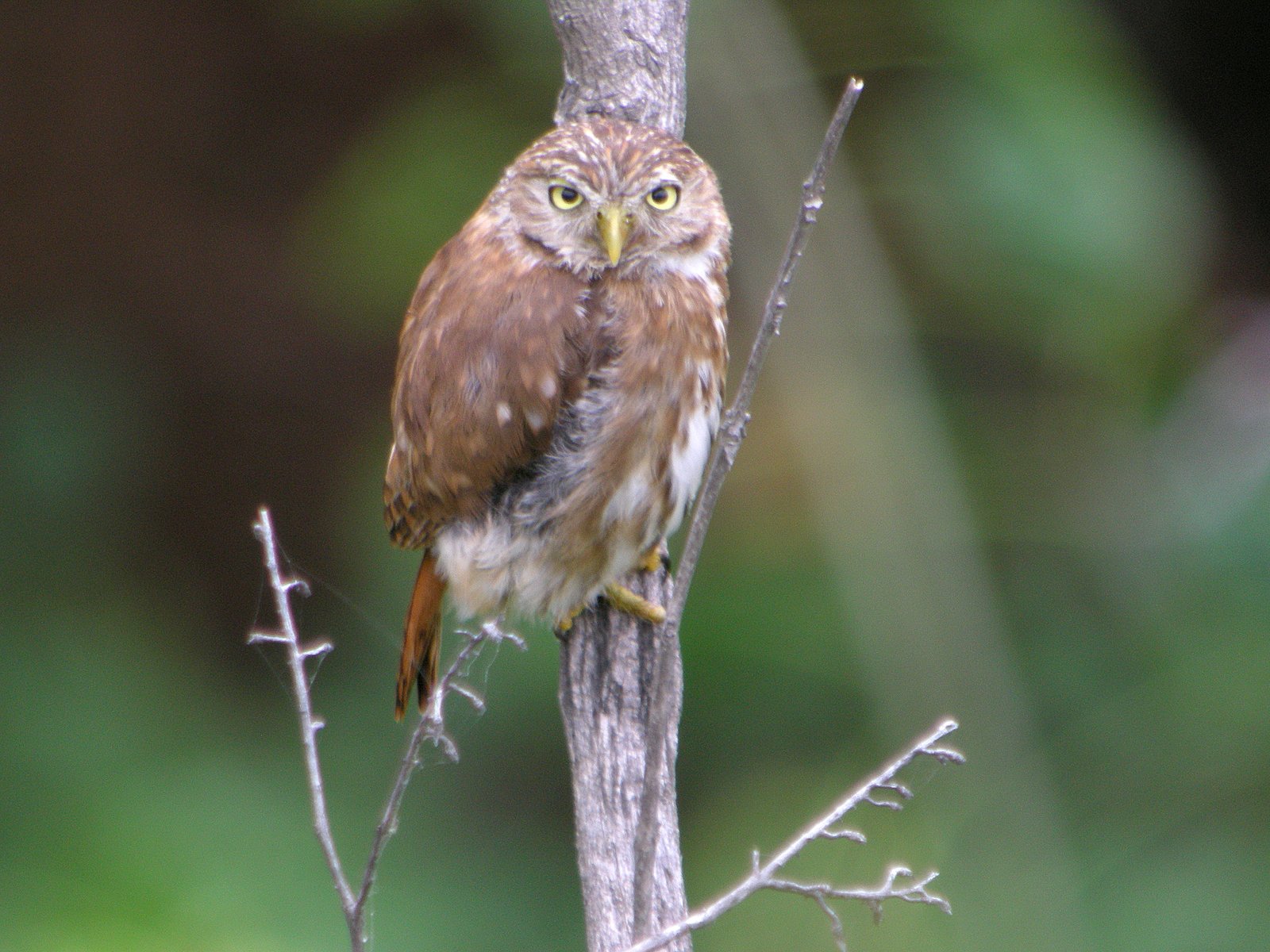
The Pacific Pygmy Owl is the pygmy owl of the dry forests and coastal valleys west of the Andes, from Ecuador to the far north of Chile. It was long included in Ferruginous Pygmy Owl, but differs in voice and plumage. It is largely diurnal and also occurs in villages, orchards and gardens.
Voice
A rapid series of short, high notes, pu-pu-pu-pu, faster than that of Ferruginous Pygmy Owl, and a twittering call.
Recording: Peter de Rouw — CC BY-NC-SA 4.0 · xeno-canto
Identification
15–17 cm, with a round head without ear tufts, yellow eyes and white eyebrows. There is a greyish-brown and a rufous morph. The crown is covered with small white dots, the nape has 'false eyes'. The back is brown, with pale spots on the scapulars. The tail is fairly long and dark, with narrow white or pale bars. The underparts are white, with brown or rufous streaks. The sexes are alike.
Confusion species
Ferruginous Pygmy Owl Glaucidium brasilianum lives east of the Andes, has a finely streaked crown and sings a slower series. Andean Pygmy Owl Glaucidium jardinii lives higher in humid montane forest. Central American Pygmy Owl Glaucidium griseiceps has a grey head and a shorter tail and lives in humid forest in north-western Ecuador. Burrowing Owl Athene cunicularia is larger and long-legged and lives on the ground.
Habitat
Dry forest, thorn scrub, riparian woodland, orchards, gardens and parks, from sea level to about 2500 m in the dry inter-Andean valleys, locally higher. It hunts by day and at dusk, taking insects, lizards, small birds and rodents. It nests in tree cavities.
Where the bird is most at home, classified by the vegetation units of the Andes and the west coast.


Range and movements
Absent from Colombia. In Ecuador in the western lowlands and dry valleys, mainly in the south-west. In Peru along the coast and the western slope and in the dry valleys of the Marañón and other inter-Andean valleys. Absent from Bolivia and the Galápagos. Outside the guide area in the far north of Chile.
- Resident
- dark = core range, pale = thinly spread
How and when to look
Listen in dry forest and shrubby gardens in western Ecuador and Peru for the rapid series of notes, also by day. Alarmed hummingbirds and flycatchers often show where it is.
Conservation status
Least Concern. The species tolerates farmland well and is common in large parts of its range.
Scientific name
Glaucidium peruanum | König, 1991
König described the species in 1991 and placed it straight away in the genus where it still stands. The genus Glaucidium was introduced in 1826 by Boie. The genus name comes from Greek glaukidion, 'owlet', a diminutive of glaux, 'owl'; Friedrich Boie introduced it in 1826. The species name refers to Peru. The specimen the first description was based on came from Peru.