All species › Owls › Owls › Short-eared Owl
Short-eared Owl | Asio flammeus
Velduil | Búho campestre | Mocho-dos-banhados
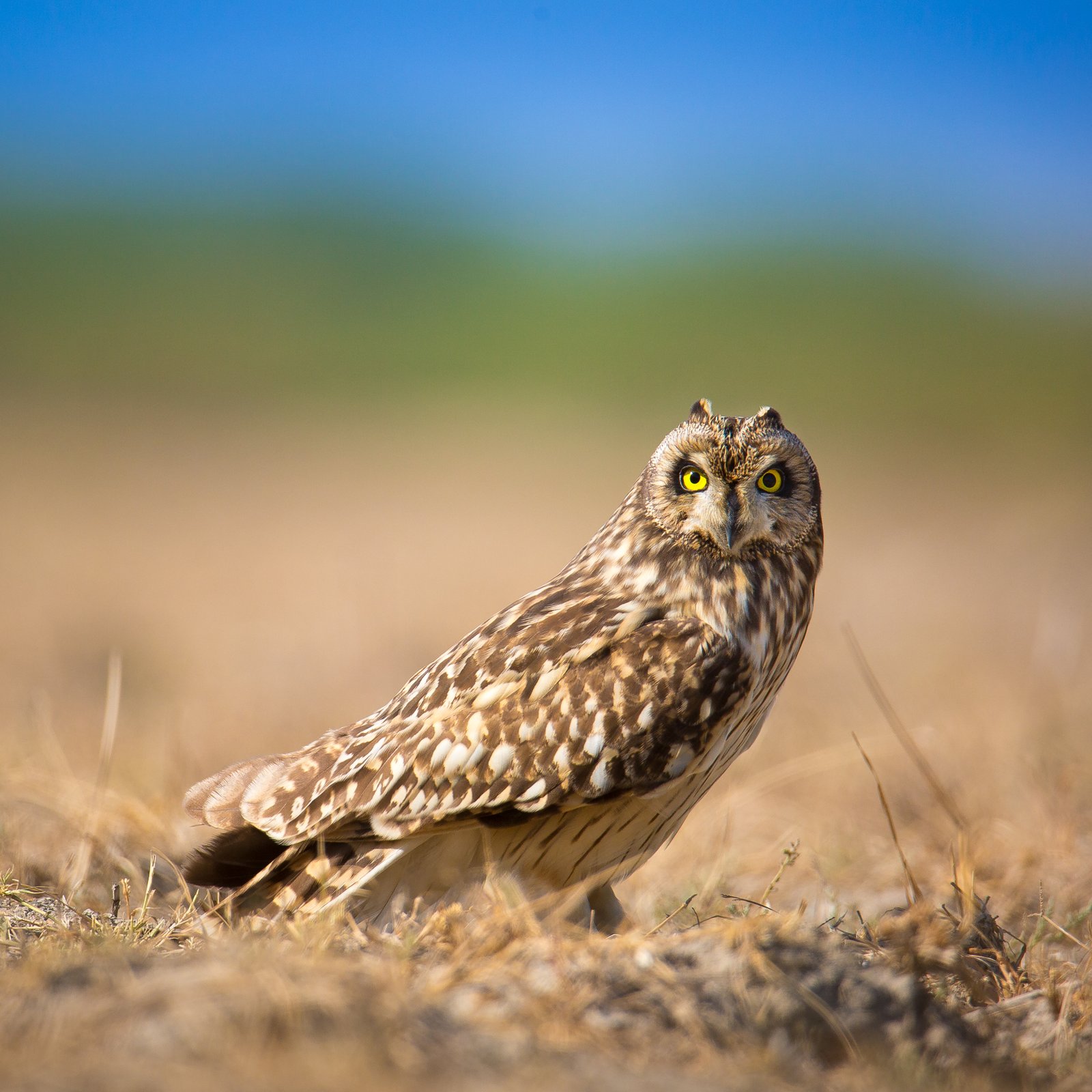
The Short-eared Owl is a medium-sized owl of open country that often hunts low over grassland by day and at dusk. In the guide area it lives in the páramo and puna, in lowland savannas and on the Galápagos, where an endemic subspecies is largely active by day. Worldwide it is one of the most widespread owls.
Voice
Usually silent. In the breeding season a series of low, hollow notes, boo-boo-boo, often during a display flight with wing-claps. When disturbed a hoarse, barking cry.
Recording: Kevin Guille — CC0 1.0 · xeno-canto
Identification
34–42 cm, with a round head with very short, rarely visible ear tufts, yellow eyes set in dark patches and a pale facial disc. The plumage is buff with dark streaks; the breast is heavily streaked, the belly paler and more finely streaked. In flight long, narrow wings with a dark carpal patch, a buff patch at the base of the primaries and dark wingtips. Birds of the Andes and the Galápagos are darker than northern birds. Females are usually larger and darker than males.
Confusion species
Striped Owl Asio clamator has long ear tufts, brown eyes and a white facial disc with a black rim, and lives more at forest edges. Stygian Owl Asio stygius is much darker, with long ear tufts, and lives in forest. American Barn Owl Tyto furcata is paler, with a heart-shaped white facial disc and dark eyes.
Habitat
Páramo, humid puna, bogs, grassland, wet meadows and savannas, fields and pasture, in the Andes to over 4000 m; on the Galápagos in almost all zones, from the lava fields to the pampa. It hunts in low flight for rodents, birds and large insects; on the Galápagos mainly small birds and storm petrels. The nest is a scrape on the ground, hidden in tall grass.
Where the bird is most at home, classified by the vegetation units of the Andes and the west coast.


Range and movements
In Colombia in the páramo and highlands of the Eastern and Central Andes, rarely in the lowlands. In Ecuador in the páramo of the Andes. In Peru locally in the puna and along the coast. In Bolivia in the puna and in the lowland savannas. On the Galápagos on many of the islands. Outside the guide area in large parts of North and South America, Europe and Asia and on Hawaii.
- Resident
- dark = core range, pale = thinly spread
How and when to look
At dusk, scan over páramo and puna grassland for a low-hunting owl with long wings. On Genovesa (Galápagos) it hunts by day among the storm petrel colonies.
Conservation status
Least Concern. In the guide area the species is affected locally by the burning and ploughing of grassland and by intensive grazing; the population in the Andes is poorly known.
Scientific name
Asio flammeus | (Pontoppidan, 1763)
Pontoppidan described the species in 1763 as Strix Flammea; because it was later moved to another genus, the author and year stand in brackets. The genus Asio was introduced in 1760 by Brisson. The genus name is Latin asio, the name Pliny used for a horned owl. The species name is Latin flammeus, 'flame-coloured', for the buff plumage. The specimen the first description was based on came from Sweden.