All species › Owls › Owls › Stygian Owl
Stygian Owl | Asio stygius
Grote ransuil | Búho cara oscura | Mocho-diabo
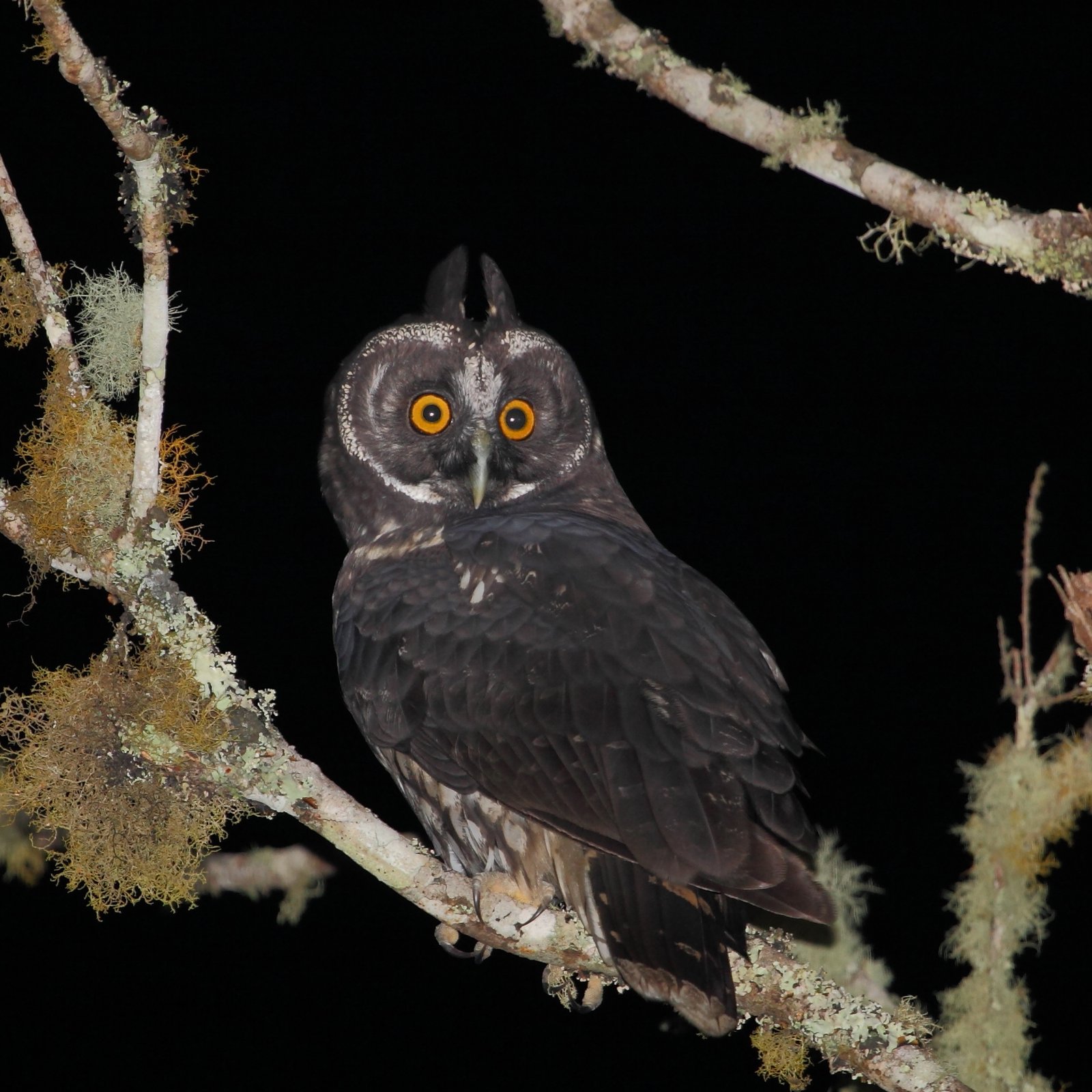
The Stygian Owl is a large, very dark owl with long ear tufts set close together. In the guide area it lives mainly in montane forest in the Andes and very locally in the lowlands. It is strictly nocturnal and is usually detected by its deep, single call.
Voice
The male gives a deep, emphatic hoo or wuh, repeated at intervals of several seconds. The female answers with a higher, cat-like nyek.
Recording: Iván Lau — CC BY-NC-SA 4.0 · xeno-canto
Identification
38–46 cm; females are larger than males. Long ear tufts set close together on the head. The facial disc is blackish, with a narrow white border above the eyes and on the forehead; the eyes are yellow to orange-yellow. The upperparts are dark sooty brown with small pale spots. The underparts are brown to dingy buff with broad dark streaks and cross-bars, forming a herringbone pattern. The legs are feathered to the toes. The sexes are otherwise alike.
Confusion species
Striped Owl Asio clamator is smaller and much paler buff, with a white, black-rimmed facial disc and dark brown eyes, and lives in open lowland country. Great Horned Owl Bubo virginianus is larger and heavier, with ear tufts set further apart, a white throat and barred underparts. Short-eared Owl Asio flammeus has very short ear tufts and lives in open country. Mottled Owl Strix virgata lacks ear tufts and has dark eyes.
Habitat
Humid and dry montane forest, cloud forest and their edges, also semi-open country with groves, in the Andes roughly between 1500 and 3500 m; locally also in forest and savanna with groves in the lowlands. It hunts from a perch and in flight, mainly birds and bats, also rodents. It nests in old stick nests of other birds or on the ground.
Where the bird is most at home, classified by the vegetation units of the Andes and the west coast.


Range and movements
In Colombia very local in the Andes and in the Sierra Nevada de Santa Marta. In Ecuador scattered and scarce in the Andes, on both slopes. In Peru local on the eastern slope of the Andes and in the north also on the western slope. In Bolivia in the Yungas and locally in the eastern lowlands. Absent from the Galápagos. Outside the guide area from Mexico through Central America and some Caribbean islands to Venezuela, Brazil, Paraguay and northern Argentina.
- Resident
- dark = core range, pale = thinly spread
How and when to look
In the first hours after sunset, listen for the deep single call along forest edges and clearings in montane forest. Birds then sometimes perch on a bare branch or a post at the forest edge.
Conservation status
Least Concern, but scarce and very local in the guide area. Loss of montane forest is the main threat; locally owls are killed out of superstition.
Scientific name
Asio stygius | (Wagler, 1832)
Wagler described the species in 1832 as Nyctalops stygius; because it was later moved to another genus, the author and year stand in brackets. The genus Asio was introduced in 1760 by Brisson. The genus name is Latin asio, the name Pliny used for a horned owl. The species name is Latin stygius, 'of the Styx', the river of the underworld, hence 'dark', for the very dark plumage. The specimen the first description was based on came from Minas Gerais, Brazil.