All species › Owls › Owls › Striped Owl
Striped Owl | Asio clamator
Gestreepte ransuil | Búho listado | Coruja-orelhuda
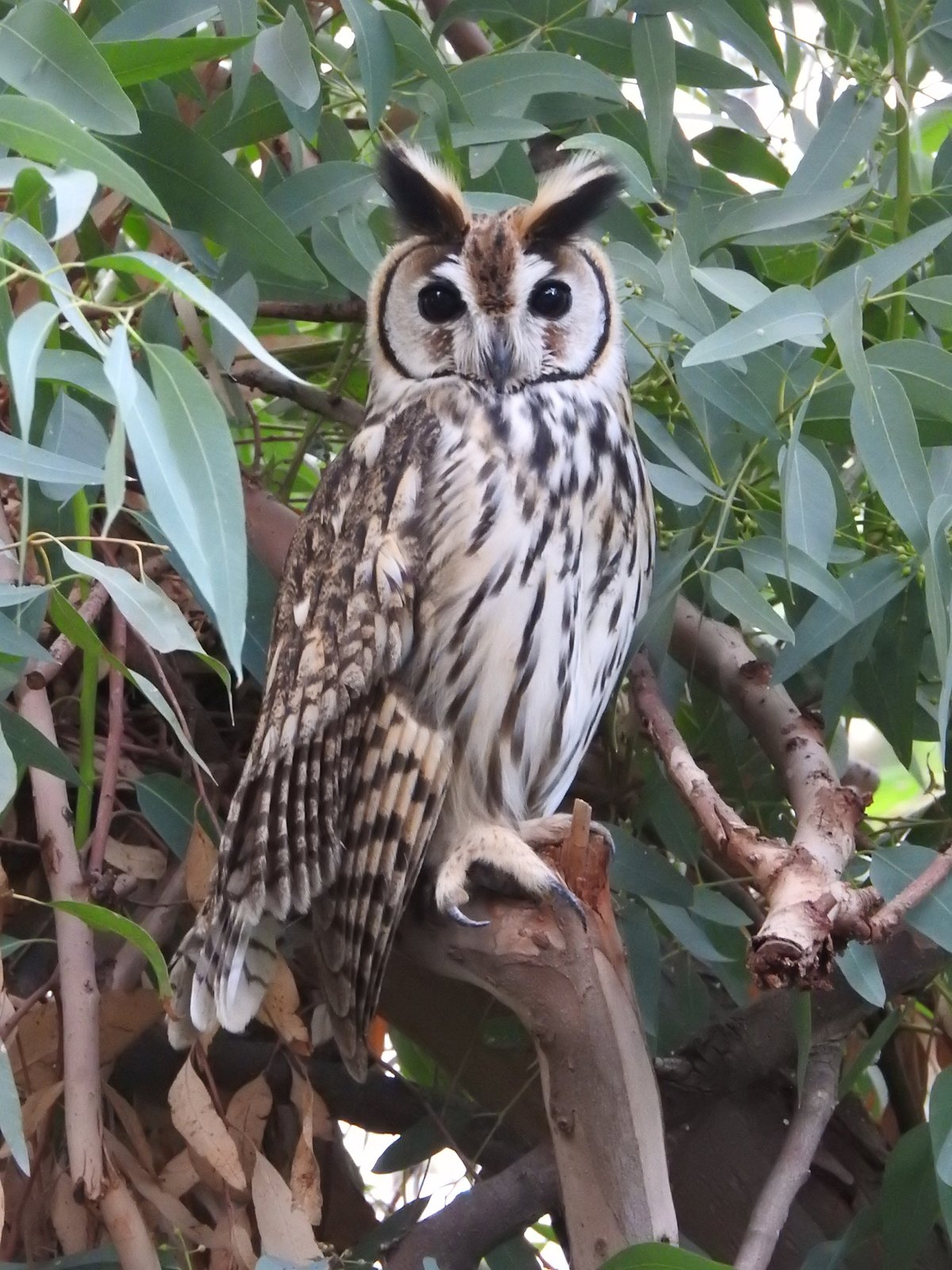
The Striped Owl is a medium-sized, pale owl with long ear tufts and a white facial disc with a black rim. It lives in open and semi-open lowland country, from savannas and marsh edges to pasture with groves. It hunts at night, low over open ground, often from a post or a low tree.
Voice
The male gives series of deep, barking hoo-hoo-hoo notes. The female gives a high, drawn-out, whistled scream, wheeyoo, recalling a bird of prey.
Recording: Jacob Wijpkema — CC BY-NC-SA 4.0 · xeno-canto
Identification
30–38 cm; females are larger than males. Long, dark ear tufts. The facial disc is whitish to pale brown with a narrow black rim; the eyes are dark brown. The upperparts are warm buff with black streaks and spots. The underparts are pale cream to buff with sharp black streaks, without cross-barring. The legs are feathered. The sexes are otherwise alike. Juveniles are downier and have a darker face.
Confusion species
Stygian Owl Asio stygius is larger and much darker, with a blackish facial disc and yellow eyes, and lives mainly in montane forest. Short-eared Owl Asio flammeus has very short ear tufts and yellow eyes set in dark patches, and flies more often by day. Great Horned Owl Bubo virginianus is much larger, with yellow eyes and barred underparts. Screech owls such as Tropical Screech Owl Megascops choliba are much smaller, with short ear tufts and yellow eyes.
Habitat
Open and semi-open country in the lowlands and lower slopes: savanna with scattered trees, wet grassland and marsh edges, pasture, fields, rice paddies and forest edges, mostly below 1500 m, locally higher in Andean valleys. It feeds mainly on rodents, also birds and large insects. It nests on the ground in tall grass or dense vegetation, sometimes in a tree.
Where the bird is most at home, classified by the vegetation units of the Andes and the west coast.


Range and movements
In Colombia in the Caribbean lowlands, the Magdalena and Cauca valleys and the llanos. In Ecuador mainly in the western lowlands, locally also in the east. In Peru local, including open country in the north-east and valleys at the foot of the Andes. In Bolivia in the savannas and open country of the eastern lowlands. Absent from the Galápagos and the high Andes. Outside the guide area from southern Mexico to Venezuela, the Guianas, Brazil, Paraguay, Uruguay and northern Argentina.
- Resident
- dark = core range, pale = thinly spread
How and when to look
At dusk, check posts and wires along roads through savanna and pasture for a perched owl, noting the long ear tufts and pale face. Birds often hunt over the same fields and use the same posts repeatedly.
Conservation status
Least Concern. The species benefits locally from deforestation and the spread of pasture, but suffers from traffic and pesticides.
Scientific name
Asio clamator | (Vieillot, 1808) (GBIF: Pseudoscops clamator)
Vieillot described the species in 1808 as Bubo Clamator; because it was later moved to another genus, the author and year stand in brackets. The genus Asio was introduced in 1760 by Brisson. The genus name is Latin asio, the name Pliny used for a horned owl. The species name is Latin clamator, 'shouter', for the call. The specimen the first description was based on came from Cayenne, French Guiana.