All species › Owls › Owls › Lesser Horned Owl
Lesser Horned Owl | Bubo magellanicus
Magelhaenoehoe | Tucúquere | Jacurutu-de-magalhães
The Lesser Horned Owl is the large horned owl of the central and southern Andes and southern South America. It was long treated as a subspecies of Great Horned Owl, but is smaller, more finely marked and has a different call. In the guide area it lives mainly in open, rocky country in the high Andes. The Spanish name tucúquere renders the call.
Voice
A series of deep, hollow notes, with a short emphasis at the start, roughly hoo, hoo-hoo-oo; the sexes often call in duet, the female higher. Also short barking and chattering sounds.
Recording: Cristian Pinto — CC BY-NC-SA 4.0 · xeno-canto
Identification
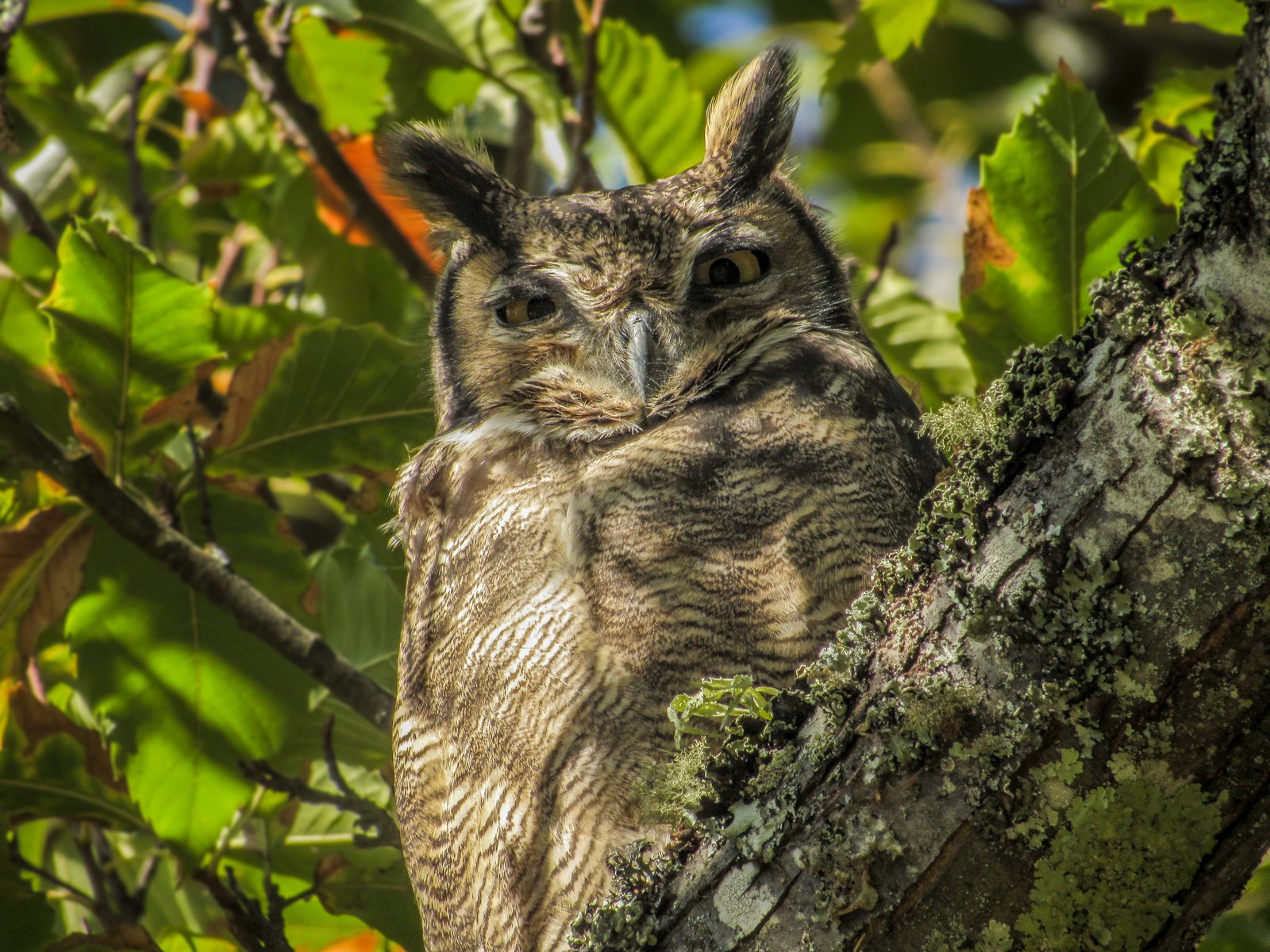
43–50 cm; females are larger than males. Large head with obvious ear tufts and yellow eyes; the facial disc is greyish brown with a dark rim, and the throat is white. The upperparts are greyish brown, finely spotted and mottled with black and pale brown. The underparts are pale, with dense, narrow, dark bars and some dark spots on the breast. The bill and talons are relatively small for a horned owl. The legs are densely feathered. The sexes are otherwise alike.
Confusion species
Great Horned Owl Bubo virginianus is larger and heavier, with coarser and broader bars on the underparts and a larger bill and talons; in the Andes of Ecuador and northern Peru the birds are also much darker. Stygian Owl Asio stygius is slimmer, with ear tufts set close together, a blackish face and streaked underparts. Short-eared Owl Asio flammeus has very short ear tufts and a streaked breast.
Habitat
Open and semi-open country in the high Andes: dry and humid puna, rocky slopes, ravines and cliffs, Polylepis woodland, scrub and farmland with scattered trees, also dry inter-Andean valleys, roughly between 2500 and 4500 m. It feeds mainly on rodents and other small mammals, also birds and large insects. It nests on ledges and in recesses of rock faces, sometimes on the ground or in an old nest of another bird.
Where the bird is most at home, classified by the vegetation units of the Andes and the west coast.


Range and movements
In Peru in the Andes of the centre and south; the boundary with Great Horned Owl in the north is not precisely known. In Bolivia in the Andes and on the altiplano. Absent from Colombia, the Galápagos and probably Ecuador. Outside the guide area in Chile and Argentina, south to Tierra del Fuego, where it also occurs in the lowlands.
- Resident
- dark = core range, pale = thinly spread
How and when to look
At dusk, search along rock faces, ravines and Polylepis groves on the puna. Birds sometimes perch on a boulder or ledge just after sunset and give themselves away by their duets.
Conservation status
Least Concern. The species is persecuted locally out of superstition or because it is thought to take poultry, and suffers from rodent poisoning.
Scientific name
Bubo magellanicus | (Lesson, 1828)
Lesson described the species in 1828 as [Strix] magellanicus; because it was later moved to another genus, the author and year stand in brackets. The genus Bubo was introduced in 1805 by Duméril. The genus name is Latin bubo, 'eagle-owl'. The species name refers to the Strait of Magellan, named after Ferdinand Magellan (c. 1480–1521). The specimen the first description was based on came from Strait of Magellan.