All species › Owls › Owls › Great Horned Owl
Great Horned Owl | Bubo virginianus
Amerikaanse oehoe | Búho cornudo | Jacurutu
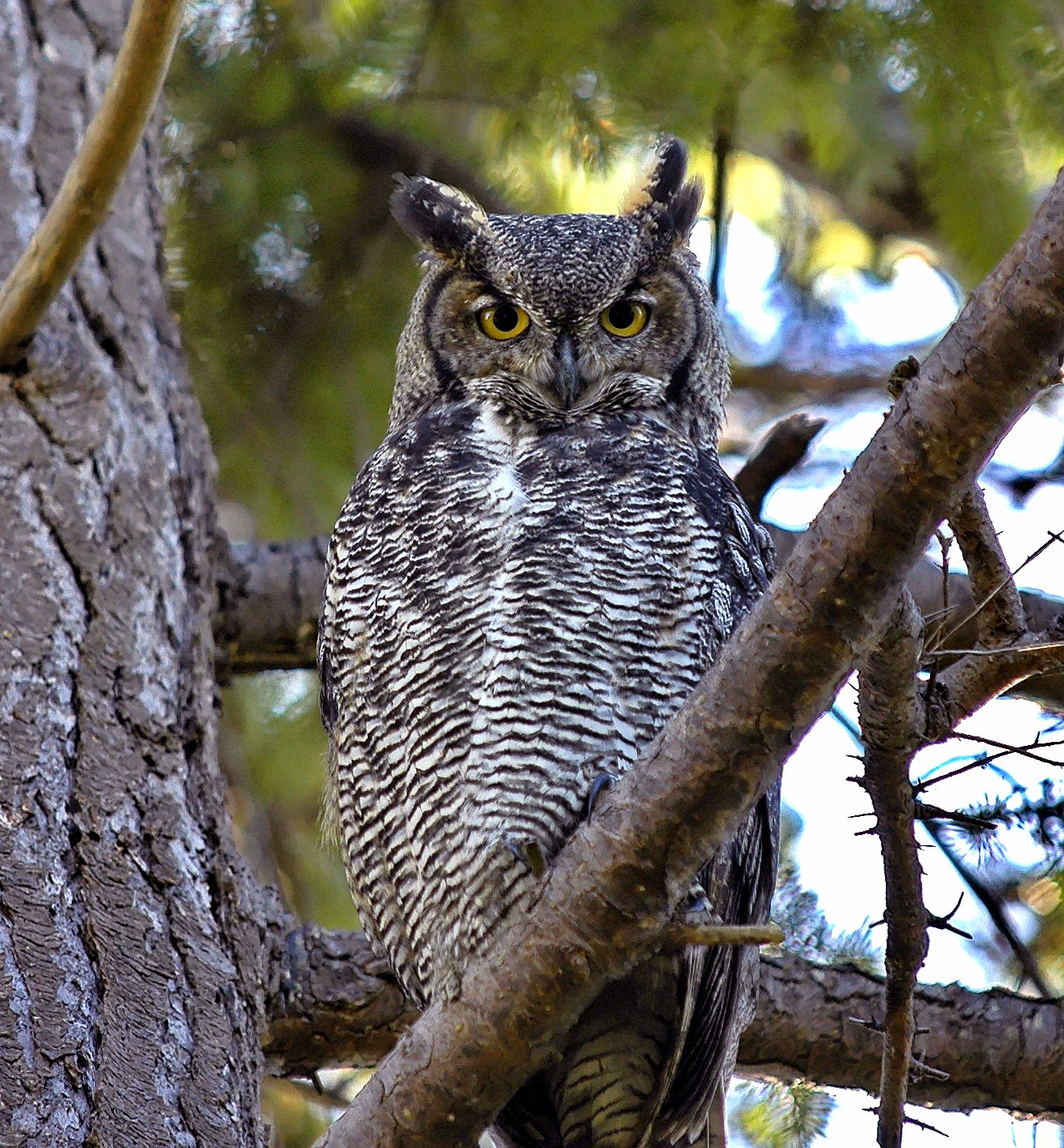
The Great Horned Owl is the largest owl in the guide area, with widely spaced ear tufts and a white throat. It occurs here in two very different forms: a very dark subspecies in the high northern Andes and a paler one in lowland savannas. It is active mainly at night and at dusk.
Voice
A series of four to six deep, soft notes in a fixed rhythm, roughly hoo hoo-hoo hoo hoo; the female calls higher and the sexes often alternate. Young beg with a hoarse, hissing scream.
Recording: Richard E. Webster — CC BY-NC-SA 4.0 · xeno-canto
Identification
46–55 cm; females are clearly larger than males. Large, broad head with long, widely spaced ear tufts, yellow eyes and a white throat band. The underparts are densely barred with dark bars. The Andean form (nigrescens) is very dark sooty brown, with little white and a dark facial disc. The lowland form (nacurutu) is paler greyish brown, with more white on the underparts and a paler, brownish facial disc with a black rim. The legs are densely feathered. The sexes are otherwise alike.
Confusion species
Lesser Horned Owl Bubo magellanicus of the central and southern Andes is smaller, greyer and more finely barred, with a smaller bill and talons, and has a different call. Stygian Owl Asio stygius is slimmer, with ear tufts set close together and streaked underparts. Spectacled Owl Pulsatrix perspicillata lacks ear tufts and has a dark head with white 'spectacles' and a plain yellowish belly.
Habitat
In the northern Andes in páramo, scrub and elfin forest at the treeline, Polylepis woodland, rocky ravines and open country with groves, roughly between 2500 and 4000 m, locally lower in dry valleys. In the lowlands in savanna with scattered trees, gallery forest and dry forest. It hunts from a perch for mammals up to the size of a rabbit, and for birds, reptiles and large insects. It nests in old nests of other birds, in rock recesses or on the ground.
Where the bird is most at home, classified by the vegetation units of the Andes and the west coast.


Range and movements
In Colombia in the high Andes and locally in the llanos. In Ecuador in the Andes, mainly in páramo and dry valleys. In Peru in the Andes of the north; the boundary with Lesser Horned Owl is not precisely known. In Bolivia in the savannas and dry forests of the eastern lowlands. Absent from the Galápagos and from closed rainforest in the Amazon basin. Outside the guide area from Alaska and Canada through the United States and Mexico to Central America, and in South America in Venezuela, the Guianas, Brazil, Paraguay, Uruguay and Argentina.
- Resident
- dark = core range, pale = thinly spread
How and when to look
At dusk, listen in the páramo and along ravines at the treeline for the deep, rhythmic call. Birds then sometimes perch on a rock, a post or a lone tree against the sky.
Conservation status
Least Concern. In the Andes the species suffers locally from persecution, páramo fires and the loss of forest at the treeline.
Scientific name
Bubo virginianus | (Gmelin, 1788)
Gmelin described the species in 1788 as Strix virginiana; because it was later moved to another genus, the author and year stand in brackets. The genus Bubo was introduced in 1805 by Duméril. The genus name is Latin bubo, 'eagle-owl'. The species name is New Latin virginianus, 'of Virginia', the British colony in North America. The specimen the first description was based on came from Virginia, United States.