All species › Owls › Owls › White-throated Screech Owl
White-throated Screech Owl | Megascops albogularis
Witkeelschreeuwuil | Autillo gorgiblanco | Corujinha-de-garganta-branca
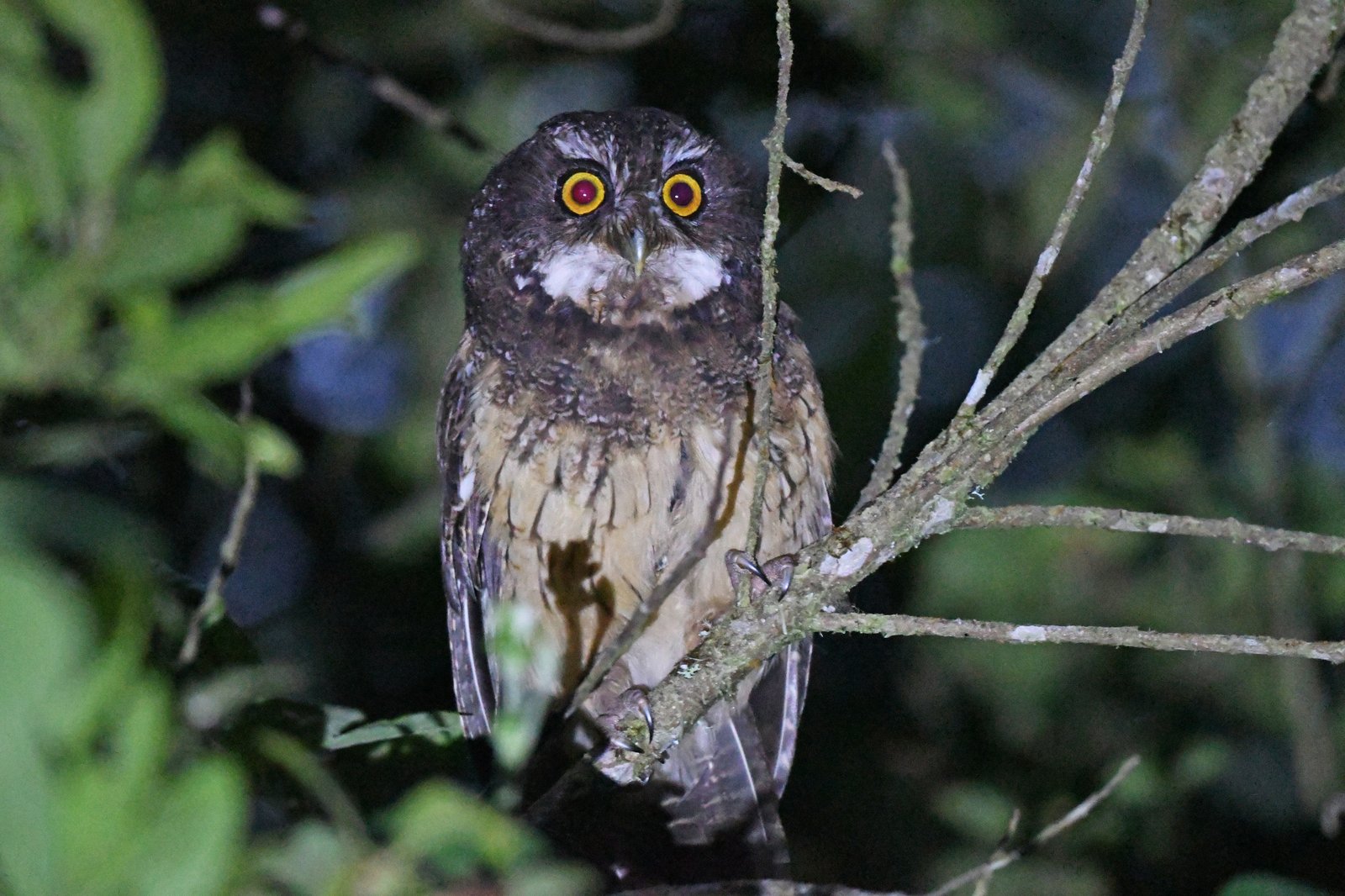
The White-throated Screech Owl is a dark screech owl of high montane forest in the Andes, up to the treeline. It stands out by its white throat, which contrasts sharply with the dark breast, and by its almost absent ear tufts. Pairs often call in duet, with long, rapid series.
Voice
A long, rapid series of short, hollow notes that first rises in pitch and then falls again, often sung by both partners alternately or together, with irregular accelerations. Also short, husky calls.
Recording: Juan Freile — CC BY-NC-SA 4.0 · xeno-canto
Identification
24–27 cm, with a round head lacking or with very short ear tufts and yellow to orange-yellow eyes. The upperparts and breast are dark brown, finely spotted with buff. The throat is white and contrasts strongly with the dark breast. The belly is paler buff with dark streaks and fine cross-bars. The legs are feathered. The sexes are alike.
Confusion species
Rufescent Screech Owl Megascops ingens lives lower, is warmer rufous-brown, lacks the white throat and has dark eyes. Cinnamon Screech Owl Megascops petersoni and Cloud-forest Screech Owl Megascops marshalli are smaller and more rufous, with a distinct facial disc and no white throat. In Bolivia, Yungas Screech Owl Megascops hoyi is more like Tropical Screech Owl and lacks the white throat.
Habitat
High montane forest, cloud forest, elfin forest at the treeline and their edges, locally also Polylepis woodland and groves in open country, roughly between 2000 and 3500 m. It hunts in the middle and upper strata of the forest for large insects and other invertebrates, also small vertebrates. It nests in tree cavities.
Where the bird is most at home, classified by the vegetation units of the Andes and the west coast.


Range and movements
In Colombia in all three cordilleras and the Serranía de Perijá. In Ecuador on both slopes of the Andes. In Peru on the eastern slope along the entire length of the country, in the north also on the western slope. In Bolivia in the Yungas of La Paz and Cochabamba. Absent from the Galápagos. Outside the guide area in the Andes of western Venezuela.
- Resident
- dark = core range, pale = thinly spread
How and when to look
After dark, listen for the long duets along roads through high montane forest and at the treeline. Birds sometimes come close to the forest edge and then perch fairly high in a tree.
Conservation status
Least Concern. The species is locally sensitive to the loss of high montane forest through clearance and fires.
Scientific name
Megascops albogularis | (Cassin, 1849)
Cassin described the species in 1849 as Syrnium albo-gularis; because it was later moved to another genus, the author and year stand in brackets. The genus Megascops was introduced in 1848 by Kaup. The genus name comes from Greek megas, 'great', and skōps, a small owl (scops owl). The species name comes from Latin albus, 'white', and gularis, 'of the throat': 'white-throated'. The specimen the first description was based on came from Choachí, Cundinamarca, Colombia.