All species › Owls › Owls › Tropical Screech Owl
Tropical Screech Owl | Megascops choliba
Cholibaschreeuwuil | Autillo tropical | Corujinha-do-mato
The Tropical Screech Owl is the most widespread screech owl in South America and an owl of semi-open country, forest edges and gardens. It is well adapted to human-modified landscapes and often occurs in villages and plantations. Its purring trill ending in one or two final notes is one of the commonest night sounds in the lowlands east of the Andes.
Voice
A short, purring trill ending in one or two emphatic notes, roughly gurrrrr-kook-kook; pairs often call alternately. Also short, hoarse calls.
Recording: Juan Freile — CC BY-NC-SA 4.0 · xeno-canto
Identification
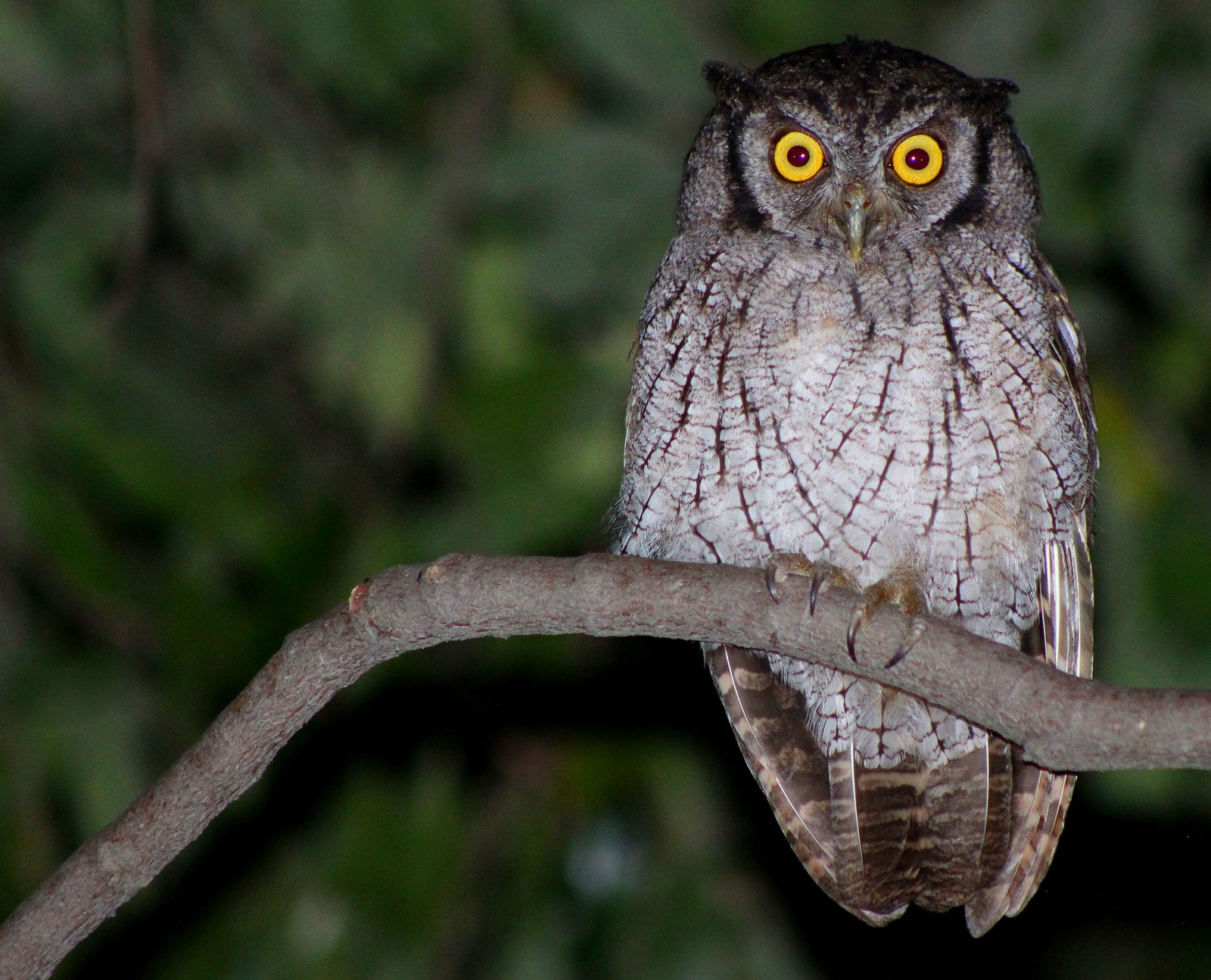
20–24 cm, with short ear tufts and yellow eyes. The facial disc is pale grey to pale brown with a distinct black rim. The upperparts are greyish brown, finely spotted and streaked with black, with a row of white spots on the scapulars. The underparts are pale greyish white with dark streaks and fine cross-bars, together forming a herringbone pattern. A rarer rufous morph also occurs. The sexes are alike.
Confusion species
Tawny-bellied Screech Owl Megascops watsonii is darker, with a tawny belly, a less distinct rim to the facial disc and often dark eyes, and lives inside rainforest. Foothill Screech Owl Megascops roraimae lives in foothill forest at the base of the Andes and has a faster, even trill. West Peruvian Screech Owl Megascops roboratus replaces it in the dry forests of the west and in the Marañón valley. Yungas Screech Owl Megascops hoyi in the Bolivian Yungas lives higher, in montane forest.
Habitat
Forest edges, secondary forest, open woodland, gallery forest, savanna with trees, plantations, parks and gardens, also the edges of villages and towns, mostly below 1500 m, locally higher in valleys. It avoids the interior of closed rainforest. It feeds mainly on large insects and spiders, also small rodents, birds and lizards. It nests in tree cavities, also old woodpecker holes and nest boxes.
Where the bird is most at home, classified by the vegetation units of the Andes and the west coast.


Range and movements
In Colombia widespread in the lowlands east of the Andes, in the Caribbean lowlands and in the Magdalena and Cauca valleys; absent from the Chocó. In Ecuador in the eastern lowlands and at the foot of the Andes. In Peru in the Amazonian lowlands and in valleys at the foot of the eastern slope. In Bolivia widespread in the lowlands, the Chaco and the lower Yungas. Absent from the Galápagos and from the dry west of Ecuador and Peru. Outside the guide area from Costa Rica to Venezuela, the Guianas, Brazil, Paraguay, Uruguay and northern Argentina.
- Resident
- dark = core range, pale = thinly spread
How and when to look
After dark, listen for the purring trill in villages, along forest edges and in plantations in the lowlands. Birds often perch low at the edge of a clearing or in a garden.
Conservation status
Least Concern. The species is common in large parts of the guide area and benefits from semi-open, human-made landscapes.
Scientific name
Megascops choliba | (Vieillot, 1817)
Vieillot described the species in 1817 as Strix choliba; because it was later moved to another genus, the author and year stand in brackets. The genus Megascops was introduced in 1848 by Kaup. The genus name comes from Greek megas, 'great', and skōps, a small owl (scops owl). The species name comes from Chóliba, an Aragonese folk name for the Eurasian Scops Owl. Félix de Azara gave this name to the owl in Paraguay, because that was what people called the Scops Owl in his home region when he was a boy. The specimen the first description was based on came from Paraguay.