All species › Owls › Owls › Koepcke's Screech Owl
Koepcke's Screech Owl | Megascops koepckeae
Koepckes schreeuwuil | Autillo de Koepcke | Corujinha-de-koepcke
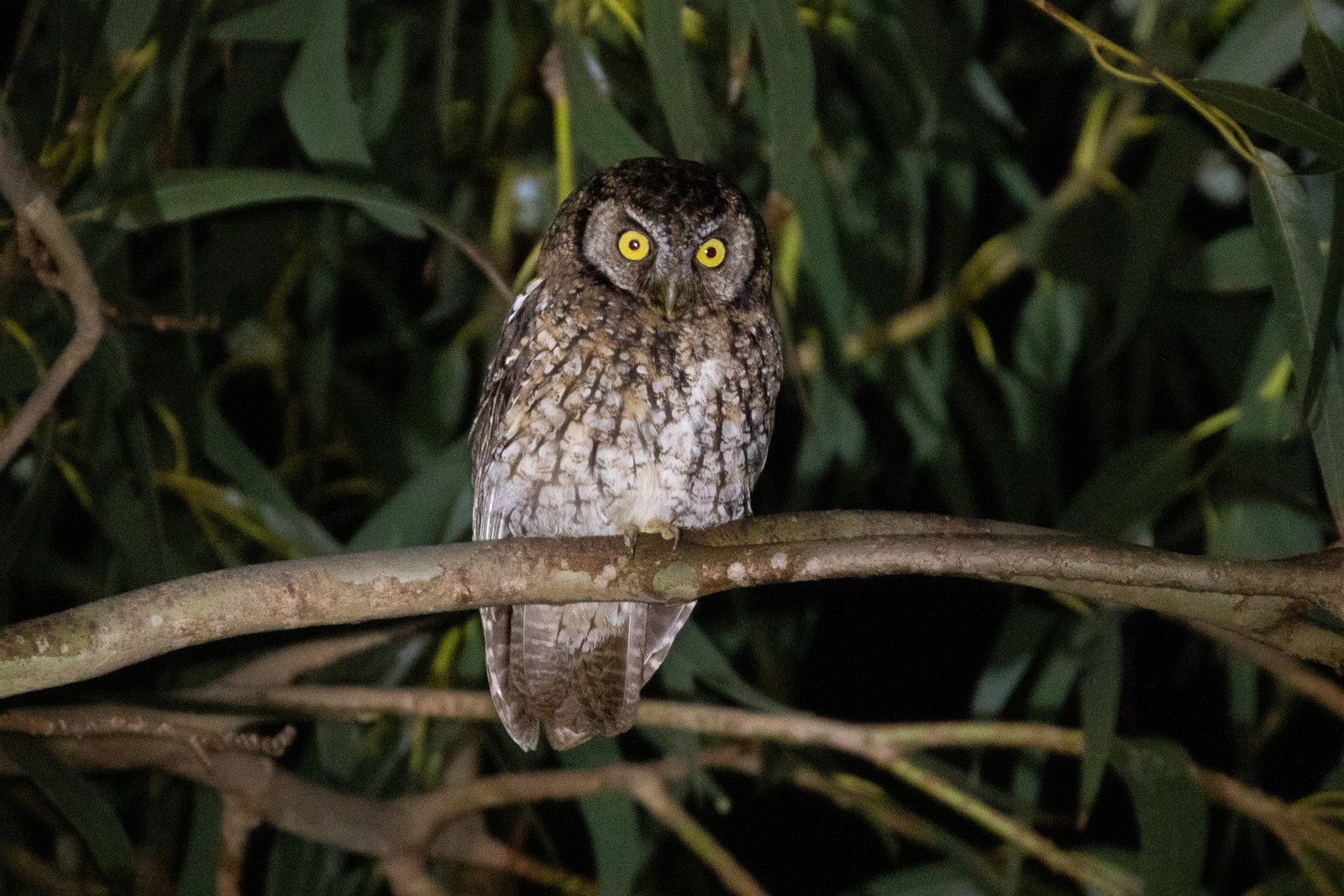
Koepcke's Screech Owl is a medium-sized screech owl found only in Peru, in dry to semi-humid woodland and scrub on the western slope of the Andes and in the inter-Andean valleys. It is named after the ornithologist Maria Koepcke, who worked in Peru for many years. It often lives in Polylepis woodland, which places it among the highest-ranging screech owls in the Andes.
Voice
A series of short, hollow notes that accelerates, mainly at dusk and at night. Pairs sometimes sing in duet. Also short, barking calls.
Recording: Bram Vogels — CC BY-NC-SA 4.0 · xeno-canto
Identification
22–24 cm, with short ear tufts, yellow eyes and a greyish-brown facial disc with a narrow dark rim. The upperparts are greyish brown with dark streaks and a row of whitish spots on the scapulars. The underparts are pale grey to whitish, with distinct black streaks and fine cross-barring. The tail is fairly long and barred. The sexes are alike.
Confusion species
West Peruvian Screech Owl Megascops roboratus lives lower, in dry forest of the Marañón and the Tumbes region, and has a broad black rim to the facial disc and a shorter tail. Tropical Screech Owl Megascops choliba usually lives lower and in more humid country, is smaller, also has a black rim to the facial disc, and sings a short trill with one or two separate final notes.
Habitat
Dry to semi-humid montane woodland, Polylepis woodland, scrub with scattered trees and wooded ravines, also around villages with trees, roughly between 1500 and 4000 m. It hunts at night, mainly for large insects and other invertebrates, and sometimes small vertebrates. It nests in tree cavities.
Where the bird is most at home, classified by the vegetation units of the Andes and the west coast.


Range and movements
Endemic to Peru: along the western slope of the Andes and in the dry inter-Andean valleys, from Cajamarca and La Libertad through Áncash south to Apurímac. Absent from Colombia, Ecuador, Bolivia and the Galápagos.
- Resident
- dark = core range, pale = thinly spread
How and when to look
In Polylepis woodland and wooded ravines in the Cordillera Blanca (Áncash), in the evening shortly after sunset, when the birds sing. By day they roost hidden in a dense tree crown or against a trunk.
Conservation status
Least Concern. The species has a limited range; clearing of Polylepis and other montane woodland may affect the population locally.
Scientific name
Megascops koepckeae | (Hekstra, 1982)
Hekstra described the species in 1982 as Otus choliba koepckei; because it was later moved to another genus, the author and year stand in brackets. The genus Megascops was introduced in 1848 by Kaup. The genus name comes from Greek megas, 'great', and skōps, a small owl (scops owl). The species name honours Maria Koepcke (1924–1971), German ornithologist in Peru, who collected the type. The original form koepckei was later corrected to koepckeae. The specimen the first description was based on came from Quebrada Llanganuco, Áncash, Peru.