All species › Owls › Owls › Rufescent Screech Owl
Rufescent Screech Owl | Megascops ingens
Andesschreeuwuil | Autillo rojizo | Corujinha-ruiva
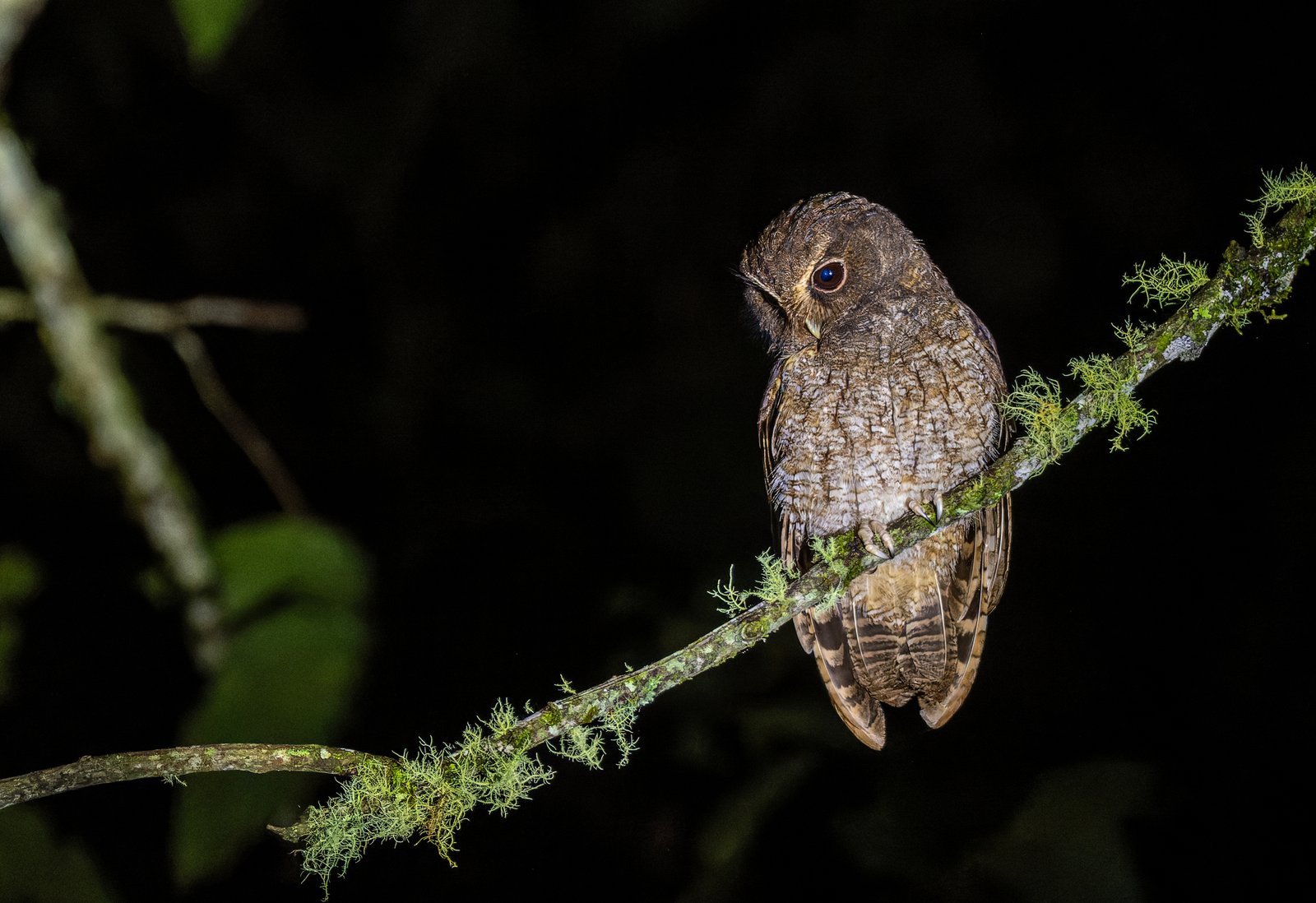
The Rufescent Screech Owl is the largest screech owl of the montane forests on the slopes of the Andes. It has brown rather than yellow eyes and a warm rufous-brown, finely patterned plumage. Birds from the Western Andes of Colombia and north-western Ecuador (colombianus) are sometimes treated as a separate species.
Voice
A long series of rapid, evenly spaced hollow notes, too-too-too-too-too, lasting several seconds and accelerating slightly. It sings mainly at dusk and at night.
Recording: José María Loaiza B. — CC BY-NC-SA 4.0 · xeno-canto
Identification
25–28 cm, with short ear tufts, brown eyes and a buffy brown facial disc without a distinct dark rim. The upperparts are warm rufous-brown to greyish brown, with fine dark vermiculation and a row of pale spots on the scapulars. The underparts are paler buffy brown, with fine dark shaft streaks and fine cross-barring. The sexes are alike; there are darker and paler, greyer birds.
Confusion species
Cinnamon Screech Owl Megascops petersoni is smaller and more uniformly cinnamon-brown, with pale eyebrows, and usually lives higher. Cloud-forest Screech Owl Megascops marshalli is smaller, with a broad black rim to the facial disc and dark-edged white spots on the underparts. White-throated Screech Owl Megascops albogularis has a white throat and a dark breast and lives higher. Tropical Screech Owl Megascops choliba and Foothill Screech Owl Megascops roraimae are smaller, with yellow eyes, and live lower.
Habitat
Humid montane forest and cloud forest on the slopes of the Andes, also forest edges, roughly between 1200 and 2500 m, locally higher. It hunts at night from a perch in the middle layers of the forest, mainly for large insects and other invertebrates. It nests in tree cavities.
Where the bird is most at home, classified by the vegetation units of the Andes and the west coast.


Range and movements
In Colombia in all three Andean ranges. In Ecuador on the eastern slope and, in the north, also on the western slope. In Peru along the eastern slope of the Andes over almost the entire length of the country. In Bolivia on the eastern slope in the north and centre of the country. Absent from the Galápagos. Outside the guide area in western Venezuela.
- Resident
- dark = core range, pale = thinly spread
How and when to look
After sunset, listen along forest edges and roads through montane forest on the eastern slope, for example along the Manu road in Peru, for the long series of hollow notes. By day it roosts hidden in dense foliage or among epiphytes.
Conservation status
Least Concern. The species is fairly common in undisturbed montane forest, but deforestation on the Andean slopes is reducing its habitat.
Scientific name
Megascops ingens | (Salvin, 1897)
Salvin described the species in 1897 as Scops ingens; because it was later moved to another genus, the author and year stand in brackets. The genus Megascops was introduced in 1848 by Kaup. The genus name comes from Greek megas, 'great', and skōps, a small owl (scops owl). The species name comes from Latin ingens, 'huge, enormous'. The specimen the first description was based on came from Jima, Azuay, Ecuador.