All species › Passerines › New World sparrows › Pale-naped Brushfinch
Pale-naped Brushfinch | Atlapetes pallidinucha
Bleeknekstruikgors | Atlapetes nuquipálido | Tico-tico-de-nuca-pálida
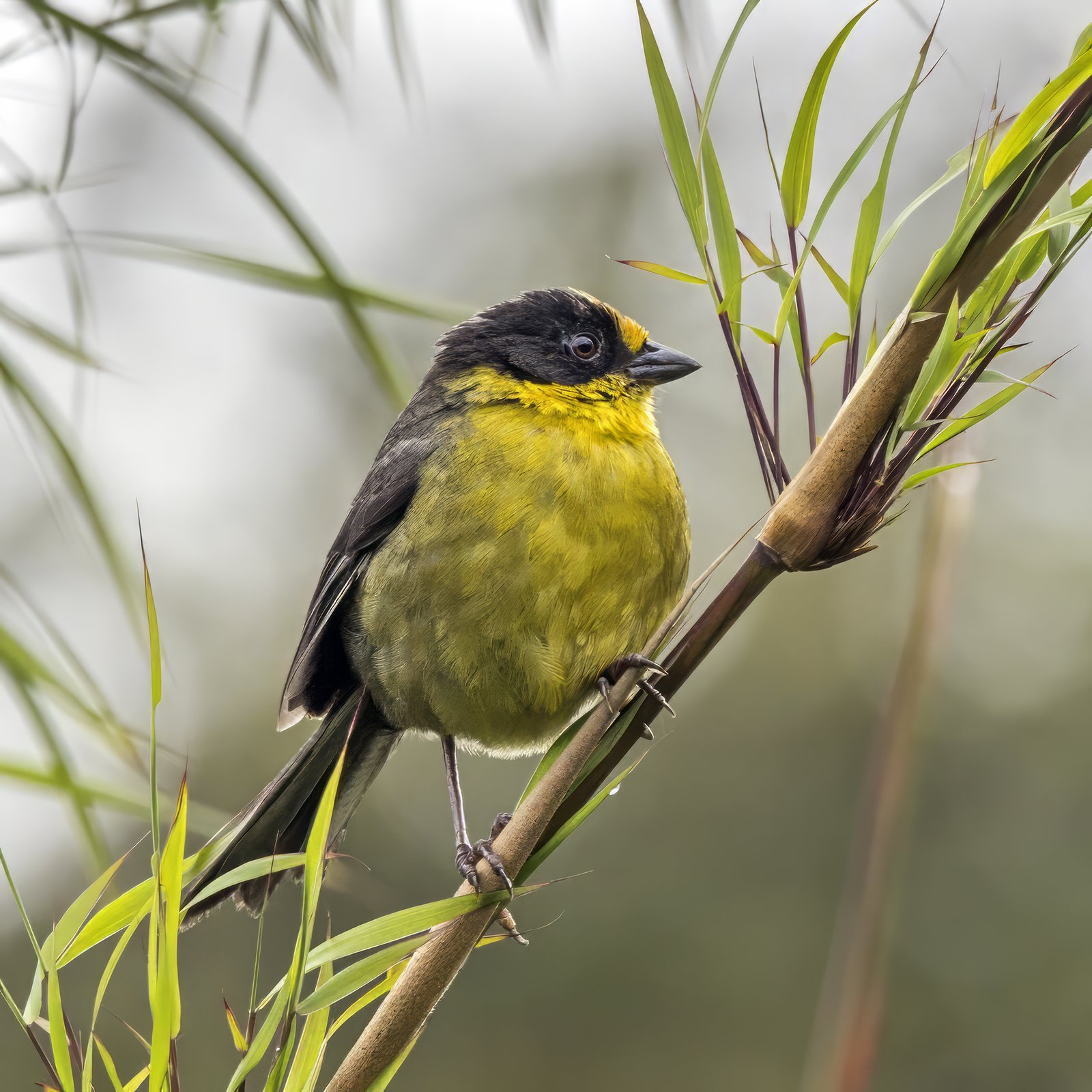
The Pale-naped Brushfinch is a brushfinch of the highest forests of the northern Andes, where forest gives way to páramo. It stands out by a cinnamon to yellowish forecrown that fades to a whitish nape, above a black face and yellow underparts. It lives in pairs or family groups close to the ground.
Voice
The dawn song is usually a duet of thin, high notes, the last note rising sharply. The territorial song is a short, whistled series of wheet-tew notes. Calls are a high, soft tip and a repeated, nasal pffe.
Recording: Mauricio Cuellar Ramirez (@Birding.travel) — CC BY-NC-SA 4.0 · xeno-canto
Identification
18 cm, with a sturdy black bill. A pale cinnamon or yellowish stripe runs from the forehead to the middle of the crown; the hindcrown and nape are whitish. The face is black, the upperparts dark slate grey, the wings and tail blackish. The throat, breast and belly are bright yellow; the sides and flanks are washed olive to grey. In birds of Ecuador and Peru the forecrown is paler and the underparts, except the throat, are more strongly washed olive-grey. The sexes are alike.
Confusion species
Yellow-breasted Brushfinch Atlapetes latinuchus has an entirely rufous crown and nape without a whitish nape, and usually lives lower. Slaty Brushfinch Atlapetes schistaceus has a rusty crown and grey, not yellow, underparts. Moustached Brushfinch Atlapetes albofrenatus of the Eastern Andes has a white moustachial stripe and an olive back.
Habitat
Undergrowth and edges of humid forest near the treeline, also secondary and elfin forest; inside forest mainly in bamboo, roughly between 2500 and 3700 m. It searches on the ground and low in the vegetation for insects, other invertebrates, seeds and berries. The nest is a cup in dense undergrowth.
Where the bird is most at home, classified by the vegetation units of the Andes and the west coast.


Range and movements
In Colombia in the Eastern Andes south to Cundinamarca and in the Central Andes. In Ecuador along the eastern slope of the Andes over the full length of the country. In Peru only in the far north, to the Marañón on the border of Piura and Cajamarca. Absent from Bolivia and the Galápagos. Outside the guide area in far southern Táchira in Venezuela.
- Resident
- dark = core range, pale = thinly spread
How and when to look
Search the edges of forest at the treeline, for example at the Papallacta pass in Ecuador or at Chingaza in Colombia. Pairs sing in duet at dawn; during the day they move low along the forest edge and the edge of the páramo.
Conservation status
Least Concern. Its treeline habitat is locally damaged by fires, grazing and deforestation.
Scientific name
Atlapetes pallidinucha | (Boissonneau, 1840)
Boissonneau described the species in 1840 as Tanagra (Arremon) pallidinucha; because it was later moved to another genus, the author and year stand in brackets. The genus Atlapetes was introduced in 1831 by Wagler. The genus name comes from Greek: the mythical titan Atlas and petēs, 'flyer'. The species name comes from Latin pallidus, 'pale', and Medieval Latin nucha, 'nape', for the pale nape stripe. The specimen the first description was based on came from Bogotá, Colombia.