All species › Passerines › New World sparrows › Antioquia Brushfinch
Antioquia Brushfinch | Atlapetes blancae
Antioquiastruikgors | Atlapetes antioqueño | Tico-tico-de-antioquia
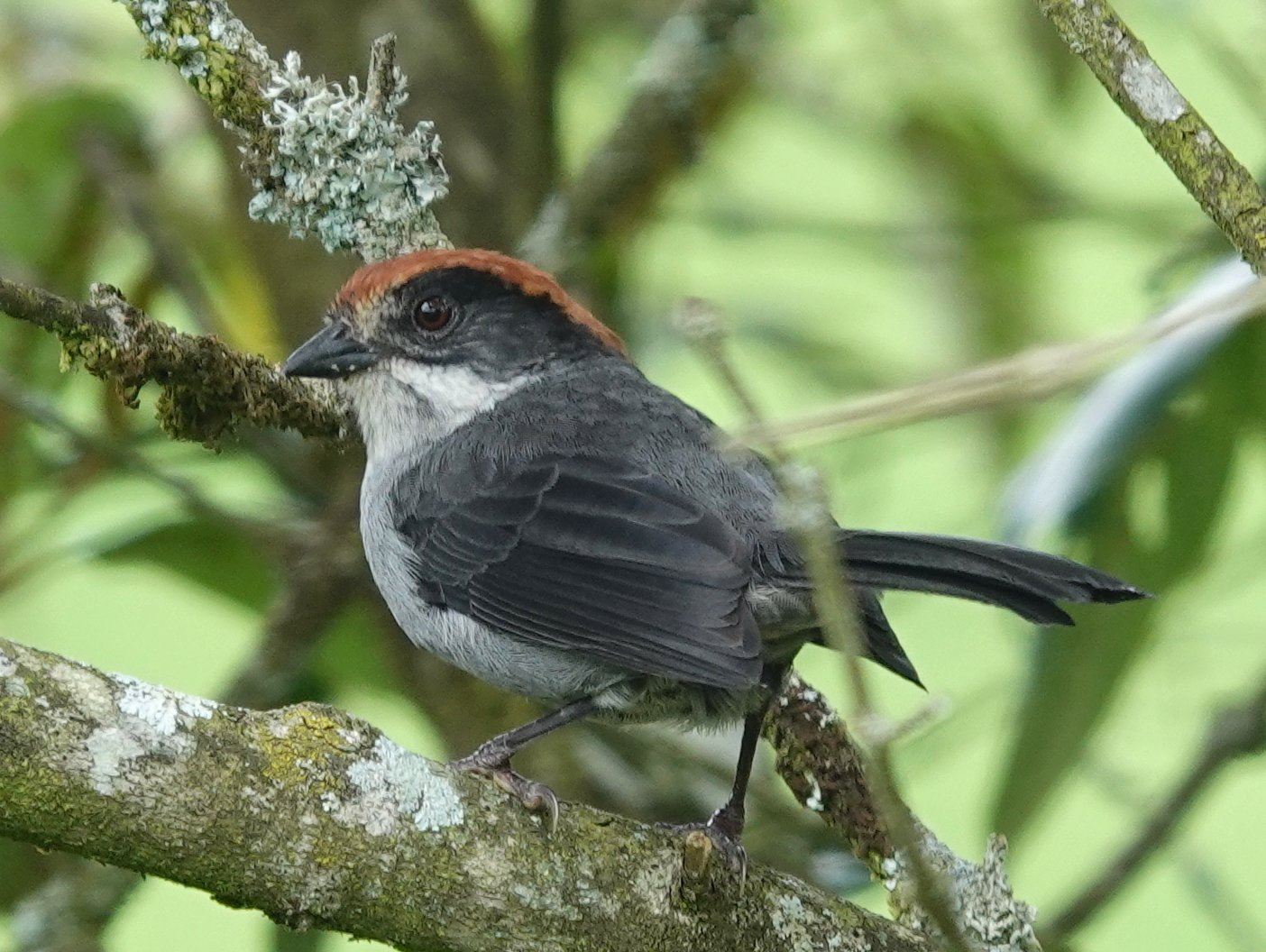
The Antioquia Brushfinch is a grey brushfinch with a rufous crown found only on a high plateau in Antioquia in Colombia. The species was described in 2007 from three old museum specimens labelled as Slaty Brushfinch, and was found alive only in 2018, at San Pedro de los Milagros, not far from Medellín. It lives in scrub in a landscape strongly altered by farming and cattle ranching.
Voice
The song consists of short series of high, whistled notes; pairs also duet. The calls are high, thin notes, as in other brushfinches. The repertoire has been described only briefly.
Recording: Diego Calderon-F. — CC BY-NC-SA 4.0 · xeno-canto
Identification
17 cm, with a sturdy black bill and a fairly long tail. The crown is rufous, and the face has a black mask with a narrow pale line along the side. The back and tail are dark grey; the throat, breast and belly are whitish grey. Some birds show a small white spot on the wing. Males have a whiter throat and breast and a redder crown than females and are slightly larger. Juveniles are browner, with a yellowish lower mandible and a greyer mask.
Confusion species
Slaty Brushfinch Atlapetes schistaceus lives in more humid forest in the area and is darker grey, with a distinct white moustachial stripe, a thin black stripe below and a grey breast. Yellow-breasted Brushfinch Atlapetes latinuchus has a rufous crown, but yellow underparts. Rufous-collared Sparrow Zonotrichia capensis is smaller, with a streaked back, a rufous collar and grey head stripes.
Habitat
Disturbed and regenerating vegetation with low trees, native shrubs, weedy herbs and overgrown pasture, often on acidic, rocky soil and near small wetlands, roughly between 2400 and 2900 m. It searches low in shrubs and on the ground for insects, seeds and berries. Little has been published on the nest; Shiny Cowbird Molothrus bonariensis parasitizes brushfinches.
Where the bird is most at home, classified by the vegetation units of the Andes and the west coast.


Range and movements
Only in Colombia, on the Santa Rosa de Osos plateau in the north of the Central Andes in Antioquia, in two separate areas: a northern one around Angostura, Santa Rosa de Osos, Belmira and Yarumal and a smaller southern one around San Pedro de los Milagros. Absent from Ecuador, Peru, Bolivia and the Galápagos. Does not occur outside the guide area.
- Resident
- dark = core range, pale = thinly spread
How and when to look
Search scrub, rough pasture and copses on the plateau around San Pedro de los Milagros and Santa Rosa de Osos, preferably with local guides who know the territories. Birds sing mainly in the early morning from a shrub.
Conservation status
Critically Endangered. The population is very small and is estimated at about 400 birds in a highly fragmented habitat. The main threat is the loss of scrub to the expansion of farming and pasture; brood parasitism by Shiny Cowbird and the isolation of the two areas are also a risk. Protected areas barely overlap with its habitat.
Scientific name
Atlapetes blancae | Donegan, 2007
Donegan described the species in 2007 and placed it straight away in the genus where it still stands. The genus Atlapetes was introduced in 1831 by Wagler. The genus name comes from Greek: the mythical titan Atlas and petēs, 'flyer'. The species name honours the Colombian lepidopterist Blanca Huertas, wife of the describer Thomas M. Donegan; Spanish blanca, 'white', also refers to the whitish underparts. The specimen the first description was based on came from Antioquia, Colombia.