All species › Passerines › New World sparrows › Yellow-breasted Brushfinch
Yellow-breasted Brushfinch | Atlapetes latinuchus
Geelborststruikgors | Atlapetes pechiamarillo | Tico-tico-de-peito-amarelo
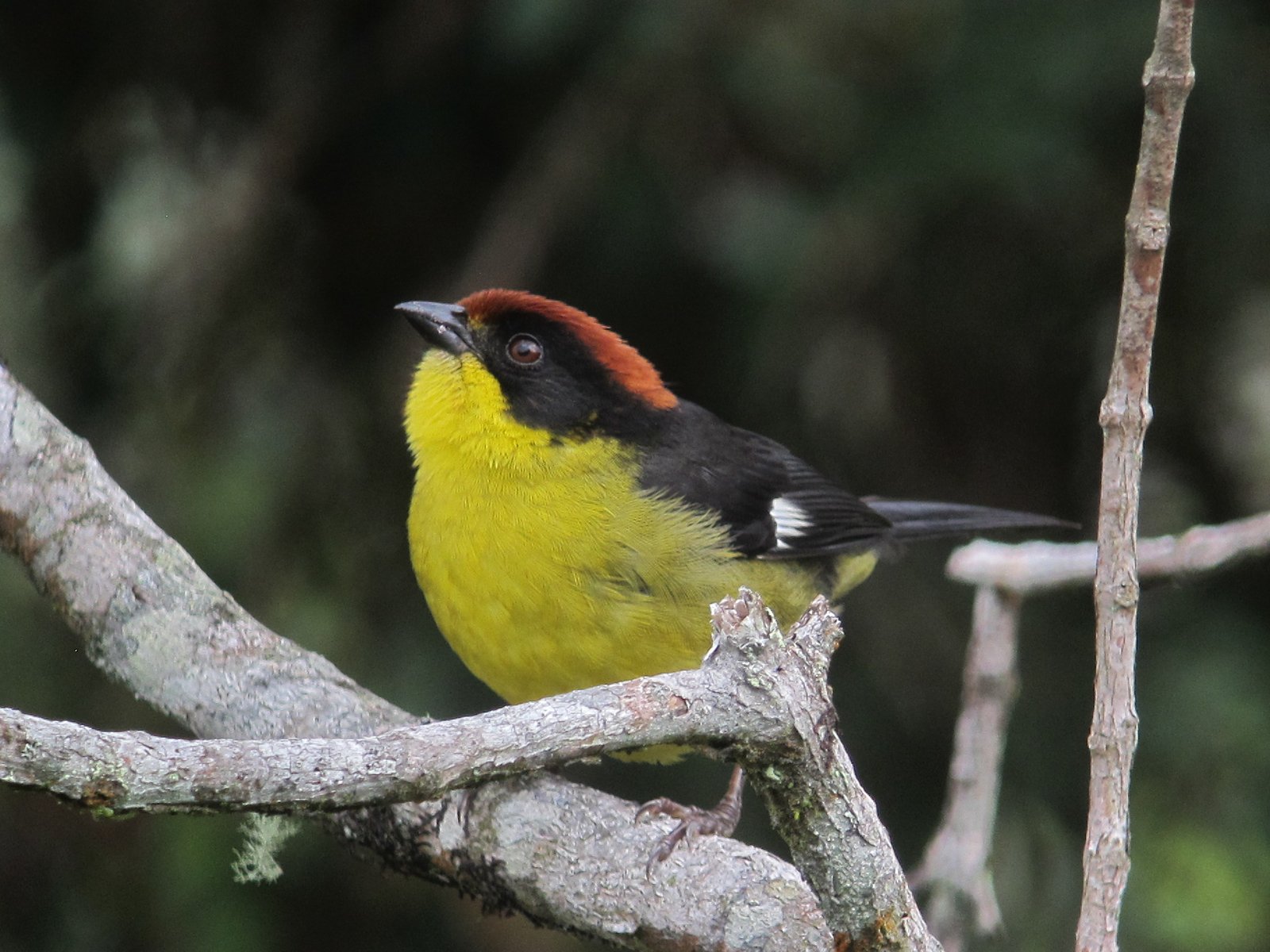
The Yellow-breasted Brushfinch is one of the most widespread brushfinches of the northern Andes, with a rufous crown, a black face, slate-grey upperparts and yellow underparts. It was formerly treated as one species together with the Bolivian Brushfinch. It lives in pairs in thickets at forest edges and tolerates disturbed ground better than most of its relatives.
Voice
The dawn song is a short, simple whistled phrase, repeated with variations every few seconds. Calls are a very high, short tink or tsik and a buzzy tsweet.
Recording: José María Loaiza B. — CC BY-NC-SA 4.0 · xeno-canto
Identification
17 cm, with a sturdy black bill. A rufous to orange-rufous stripe runs from the forehead to the nape. The face is black, with a broad yellow patch on the lower cheek in many birds. The upperparts are dark slate grey; the throat, breast and belly are bright yellow. Some subspecies show a small white wing patch; crown colour, cheek stripe and the tone of the upperparts vary between subspecies. The sexes are alike. Juveniles are duller and browner.
Confusion species
Pale-naped Brushfinch Atlapetes pallidinucha has a cinnamon forecrown and a whitish nape and lives higher, at the treeline. Choco Brushfinch Atlapetes crassus has a golden-tawny crown and olive upperparts and lives lower on the Pacific slope. Slaty Brushfinch Atlapetes schistaceus also has a rusty crown, but grey underparts and a white moustachial stripe.
Habitat
Semi-open, shrubby terrain: forest edges, secondary forest, roadside thickets and overgrown pastures, roughly between 1500 and 3600 m. It searches low in the vegetation and on the ground for insects, other invertebrates, seeds and small fruits. The nest is a cup in a shrub or in dense undergrowth.
Where the bird is most at home, classified by the vegetation units of the Andes and the west coast.


Range and movements
In Colombia in the Western and Central Andes, in the Serranía de los Yariguíes in Santander and in Nariño. In Ecuador on both slopes of the Andes, on the eastern slope to Chimborazo and in Azuay and Loja, on the western slope from Cañar south. In Peru in the north, in Piura, Cajamarca, Amazonas and La Libertad. Absent from Bolivia, where the related Bolivian Brushfinch Atlapetes rufinucha lives, and from the Galápagos. Does not occur outside the guide area.
- Resident
- dark = core range, pale = thinly spread
How and when to look
Search forest edges and shrubby verges of mountain roads; the species also occurs in gardens and rough pasture near forest. Pairs sing at dawn from an open perch and are then often found in mixed flocks at the forest edge.
Conservation status
Least Concern. The species is widespread and tolerates disturbed and secondary habitats.
Scientific name
Atlapetes latinuchus | (Du Bus de Gisignies, B-AL, 1855)
Du Bus de Gisignies, B-AL described the species in 1855 as Buarremon latinuchus; because it was later moved to another genus, the author and year stand in brackets. The genus Atlapetes was introduced in 1831 by Wagler. The genus name comes from Greek: the mythical titan Atlas and petēs, 'flyer'. The species name comes from Latin latus, 'broad', and Medieval Latin nucha, 'nape', for the broad rufous crown and nape. The specimen the first description was based on came from Colombia and Peru (per the description).